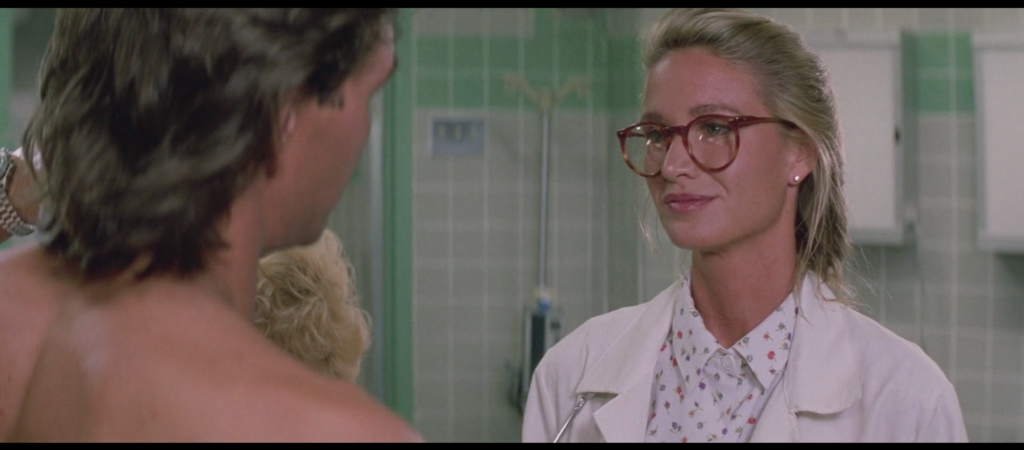
[inaudible] again please. We know of a little town called Jasper, in Missouri, where Emmett lives. Emmett who. Who is— […] What is the first name of this man Emmett. […] “Emmett” is his first name? What is his surname? […] Surname. Last name. Honestly, this is exhausting, my having to explain this to you. […] He has no last name. It’s just “Emmett,” is it? […] Well then how do you know which name it is? […] Yes it is. Yes it is important. How am I to describe the film amid such uncertainty? […] Then whose job is it, if not mine? I know my job, sir. I know precisely what my job is and isn’t, more than I can say for you. And your friend. […] If you want me to say “Emmett” I will say “Emmett,” I simply wish to be on record as stating it makes no sense. I’ve no wish to be held responsible you see. […] Fine. Fine. Are we ready? […] Exhausting. […] We know of a little town called Jasper, in Missouri—now you’ve done it again. You’ve added an “in” where no “in” need be. […] Jasper, Missouri. That’s— […] That’s—it’s more pleasing to the human ear to say Jasper, Missouri than it is to say Jasper, in Missouri. […] The English language. Do you say New York, in New York? […] We know of a little town called Jasper, Missouri, where Emmett lives. Emmett raises horses…raises horses. No, […] No, something does not— […] The sound of it. Raises horses. Too sibilant. The phrase sounds like the buzzing of bees. […] Well if you won’t change it then at least tell me you hear it. Indulge me if you would, please. […] Thank you. How very kind. […] Emmett raises horses on his little ranch, just across the water from—you know you will confuse people. […] The water, as if you expect them to know which or what water. Emmett raises horses—and I’m only proceeding under duress you understand. Miserable. […] Emmett raises horses on his little ranch, just across the water from this man. His name: Brad my God. […] You want me to launch right into his name right after saying the words His name. But you see if you massage it a bit— […] If you add a goddamned verb and massage it a bit it sounds much cleaner. His name is Brad Wesley. […] But I’m looking at the copy and […] Put down that ridiculous mug and pay attention! You want the emphasis to be on the sentence that follows: He is the most dangerous man in town. But you cannot emphasize that sentence as it’s written right now because you’re emphasizing his name. […] It’s before we are told what distinguishes him that’s the problem. […] Why are we leaping ahead all of a sudden? […] Well that is bullshit, I’m sorry, because I said it in passing. If you want me to read it and do what you’re paying me for then do me the kindness of allowing me to do a read of it. […] His name is Brad Wesley. He is the most dangerous man in town. Are you sure? […] Because […] No no, because it doesn’t match up with the footage at all. He is the most dangerous man in town and you have him eating breakfast. The least dangerous man in town no doubt eats breakfast as well. One should hope. […] So you see it does not distinguish him. […] Yes, I’ll wait. This day is beyond salvage whatever the case. […] [unintelligible] bit prosaic to show him with a gun when you’re saying he’s the most dangerous man in town. Prosaic and redundant. […] The picture and the words together tell the story and you have them speaking in unison as it were. From which school were you matriculated? […] Where did you go to school, to university. […] [prolonged exhalation] […] See, that’s it! Now you’re using your head, for arguably the first time today if you’ll pardon my saying so. If you show him in the car— […] What was that? Who was that, rather. […] My God how many people do you have back there? Must I answer to this new fellow as well? […] Don’t you see, New Fellow, don’t you see how much nicer it is to say he’s dangerous when he’s swanning about in his car than when he’s brandishing the pistol. The most dangerous man in town and he’s singing, what was it again? […] Yes, “Sh-boom.” […] Because everybody eats breakfast, that’s the issue. Not that breakfast isn’t dangerous. Everybody eats breakfast but here he’s weaving to and fro and singing and you’re saying he’s the most dangerous, it’s intriguing. […] No I’m sorry to interrupt but who is this? Who is— […] No, the dancer. The fellow with no shirt. […] Oh horseshit. […] No, I do beg your pardon but it’s preposterous, what you’re saying. The man is a dancer! […] His physique. […] One expects the bruiséd ear and uncertain gait of a prizefighter and this fellow moves like Nureyev. […] Sets him apart from what. From— […] … […] I’m listening. […] Yes, always. […] Well it’s absurd don’t you see. Don’t you see that the very idea of it would get you laughed out of Bellevue! […] Explain to me how one becomes a famous bouncer and I’ll whack the both of you off simultaneously. […] Another famous bouncer! Too much bouncing around here. You’re saying this famous bouncer has an— […] A mentor. How delightful for him that must be. […] If either of you gentlemen had had a mentor we might not be so utterly outmatched by this. Road House: A Roddy Herrington Film. […] What? […] His name is never Rowdy. […] His name is Rowdy? Rowdy Harrington, Herrington excuse me. […] Road House: A Rowdy Herrington Film. No, this isn’t worth it. […] You go again and I won’t be here because no money is worth it and [unintelligble]
269. In Search of the Lost Goon
Some men have a face that says “I can and will kick your ass, and I will be weird doing it.” In the ’80s and ’90s these men often found work as memorable goons in Hollywood action films, playing the heavy’s henchman, a mutant in leather bondage gear, someone who gets dispatched with a one-liner, you know the deal. In the case of Road House, one wore a sporty blue t-shirt and didn’t do much of anything.
The man you’re looking at here is Benny Urquidez, martial artist, stuntman, and fight trainer. He worked closely with Patrick Swayze and Marshall Teague to help choreograph the legitimately phenomenal fight scene between Dalton and Jimmy that will take place later in the film. Even though he’s just kind of in the background here, milling around with all the other goons as Brad Wesley prepares to order the destruction of a Ford dealership, he stands out. You know how I’ve gone on about how to be a good goon, you need to get introduced with a memorable shot or while performing a memorable action? Benny’s nameless goon whips off his sunglasses like a @dril character, revealing a distinctive beady-eyed visage beneath. He’s hard to miss, so hard in fact that the first few times I saw the movie my mind just filled in the blanks and conjured him into fight scenes in which he was not present at all.
Because that’s the thing: He’s not present in any fight scenes. He’s not present in any scenes period, except for this one. In a way he’s the heir to Karpis: He makes an impression and then <poof> he’s gone. Only unlike that dashingly handsome mystery man and possible Cousin in Memphis, his legacy lives on in the titanic struggle between an itinerant bouncer-philosopher and the chief enforcer of a guy who has his own reserved parking space at the mall. It is through Dalton and Jimmy that the Lost Goon may be observed, ripping throats from another plane.
268. Happiness Is a Squashed Ford
Gary grins from ear to ear. Jimmy does a double fist-pump. O’Connor raises an arm aloft in triumph. Tinker yee-haws his hat off his head. Pat McGurn and Morgan? They literally embrace. (Jimmy and Tinker merely clasp hands.) The Goon in Blue (about whom more later) is just happy to be there. And Brad Wesley acts like a game show host. Truly, the destruction of Strodenmire Ford by the coward Gary Ketcham is the high-water mark of villainous delight for the Brad Wesley organization. For once in their miserable lives they managed to get one over on their enemies in a way that did not require any of them to get their asses kicked. They didn’t even need to throw a punch, much less take one. They just had to get behind the wheel of a monster truck—one of them did, anyway—and drive on through to the other side. The rest take a joy in this of the sort you see in bars when the home team wins the Super Bowl. They are thrilled, inordinately thrilled, “the director overdid it” thrilled, to have watched a monster truck run over a car dealership. Did I point out that Morgan and Pat, the two orneriest cusses in the whole gang, hug each other, like one just announced his wife is expecting? This is the rough beast they gave birth to instead, haulin’ ass towards Bethlehem to put a little something down on a new car.
“The Terror: Infamy” thoughts, Season Two, Episode Seven: “My Perfect World”
“Your people made this mess. Now you gotta live with it.” Admit it: When you first sat down to watch The Terror: Infamy, billed as a historical horror story set in World War II–era internment camps for Japanese Americans, you didn’t expect the show’s thesis statement to come from the narcissistic bigot who serves as camp commandant. But there’s really no way around it. Major Bowen’s assessment of the evil presence stalking the camp is entirely accurate. Yuko the yurei is not the product of American jingoism, springing instead from the superstitions and beliefs of the Japanese community she menaces. I don’t think the makers of this show set out to imply that these poor people brought it on themselves, but how can the work they’ve produced be read any other way?
I reviewed the latest misfiring episode of The Terror: Infamy for the A.V. Club.
267. Gary
You’ve heard me complain about Ketcham, Brad Wesley’s most anonymous goon. How he’s handsome in a generic, Ken-doll way. How he’s a shirt-tucked-into-jeans kind of guy. How he doesn’t get a memorable introduction, just kind of sidling along in the background during the Bleeder scene. How no one ever bothers saying his credited name “Ketcham” out loud. How he pales in comparsion to Morgan, O’Connor, Jimmy, Pat McGurn, even Tinker, but how he’s the final guardian of Brad Wesley and the killer of Wade Garrett. How despite wielding the boot-knife and driving the monster truck you could walk right past him without even realizing who he was. How he’s aggressively, almost confrontationally non-descript.
Imagine how I feel now that I realize his name is “Gary.”
“Well, what are you waitin’ for, Gary? Drive through there!” That’s what Brad Wesley yells just before this tool in his giant red baseball cap runs over Strodenmire Ford with his monster truck. He says it with his back turned and with no eyeline-match cut, which is why I’ve watched this movie several dozen times and never noticed it before, but yeah, that’s Ketcham’s first name, Gary. Gary Ketcham. Gary, that most vanilla of names. If beige were a name rather than a color, it would be Gary. Gary is the “pic of myself wearing Oakleys in the driver’s seat of my car as a twitter avatar” of names. Gary. Wade Garrett gets killed by a guy named Gary. You remember Gary, don’t you? Wait, who are we talking about again?
266. Head On Down to Wagon Days
“Dalton, you gotta check this out,” Jack says. “Looks like Wesley wants to put a little something down on a new car.” This is his tipoff to his boss that Brad Wesley plans to take a monster truck and destroy a car dealership with it. Why he chose to deliver this information in a wisecrack is the viewer’s to decide. Spider-Man, I’m thinking—Jack reads Spider-Man comics, hence the resort to jokes during tense moments. Do I get a No-Prize?
But Jack and his banter and his weirdly small boots with his stonewashed denim tucked into them is beside the point. Mostly I want to call attention to the assemblage of humanity present for the impromptu monster truck rally. Jack is there, and so are his Double Deuce coworkers Carrie Ann and Frank Tilghman. Red Webster is there too—guess he didn’t skip town after all—along with Emmett, who has finally taken his place in the Council of Elders I suppose. Brad Wesley has brought along virtually his entire goon crew, though that’s to be expected when you’re planning to destroy a place of business in broad daylight.
And here in their car are Dr. Elizabeth Clay, Dalton, and Cody from the Jeff Healey Band. What was their plan for the afternoon? What did that conversation sound like? “Hey Cody, it’s Dalton. Look, me and the Doc were gonna swing by Wagon Days at Strodenmire Ford after lunch sometime. Wanna come with?” “Sure thing, man, just gotta drain the main vein first.” “Okay, well, as I said we won’t be heading over till like one or two, so you should have plenty of—hello? Hello?”
How ‘Last Blood’ Destroys Rambo’s American Myth
“When you’re pushed,” John Rambo once said, “killing’s as easy as breathing.” In his decades-long career as an action-movie icon, Rambo has been pushed plenty.
In 1982’s First Blood, the traumatized Vietnam vet ran afoul of a small-town sheriff in the Pacific Northwest and proceeded to all but level that town in a quest to simply be left alone. In 1985’s Rambo: First Blood Part II, he was extracted from prison and sent back to Vietnam on a hunt for American POWs, slaughtering Soviet and Vietnamese communists in service of one of the great American right-wing myths. In 1988’s Rambo III he journeyed to Afghanistan to rescue his old mentor from Soviet captivity, and in the process helped the country’s mujahideen fighters make the place Russia’s Vietnam. And in 2008’s inimitable Rambo, he rained death upon a Burmese warlord in order to free missionaries who’d been tending to he needs of the country’s oppressed Karen minority.
And now, in Rambo: Last Blood, he kills some guys who killed his niece.
Directed by Adrian Grünberg from a script he co-wrote with star Sylvester Stallone, Last Blood strips the Rambo franchise of any overt political ideology whatsoever. He’s not on a rescue mission, at least not for long. He’s not fighting for his country, or for some nostalgic, patriotic version thereof. He’s spilling blood because he wants to — because he feels he needs to. It’s all red; no white, no blue.
I wrote about Rambo: Last Blood and how it strips the Rambo myth down to straight-up murder for Thrillist. It’s a sequel of sorts to my piece on the 2008 Rambo film on its tenth anniversary. As a body of work, the Rambo movies—one of two film franchises based on Sylvester Stallone’s idea that watching other men destroy his perfect body is inherently interesting—are so strange and fascinating to me.
“The Affair” thoughts, Season Five, Episode Five
It’s rare for “The Affair” to dump a full-fledged heel like Adeline on its audience, and for good reason. The show’s characters have always thrived on nuance, contrast, even contradiction — characteristics that render clear-cut heroes and villains obsolete. That’s what makes Adeline a misfire, even in the hands of an actor as gifted as Leigh. Debuting as she does in Sierra’s first P.O.V. segment, before we’ve had a chance to see much of the world through her daughter’s eyes, she comes across as a grinning, oblivious monster. She’s a one-note character, and that one note nearly drowns out this entire section of the episode.
“Succession” thoughts, Season Two, Episode Seven: “Return”
Doesn’t this get tiresome for people other than me? Like, don’t you want a little more variety in your comedy-drama hybrid than fucking dick jokes an average of once every ten minutes like clockwork? Is that really and truly the only way the venality and machismo of the ultra-rich can be conveyed via humor? Dick dick dick dick dick dick dick dick dick? (“How many dicks is that?” “A lot.”)
I reviewed episode seven of Succession Season 2 for Decider.
Music Time: The Juan MacLean – The Brighter the Light
Variety is the spice of the Juan MacLean. Like label co-founder James Murphy, this core DFA act—comprising frontwoman and LCD Soundsystem alum Nancy Whang and Six Finger Satellite guitarist turned synth wizard John MacLean—has historically taken a magpie approach to dance and electronic sounds. That’s how a Heaven 17 pastiche like The Future Will Come’s 2009 title track can accompany a piano-house banger like “Happy Home,” or how the New Order-esque “Love Stops Here” can share real estate on 2014’s In a Dream with “Charlotte,” a song that sounds more like Beaucoup Fish–era Underworld than anything Underworld have recorded since. Derivative? Pshaw: Whang and MacLean are so proficient and so soulful in their craft that TJM always feels like its own life-affirming entity.
So what to make of The Brighter the Light, an album assembled with sameness in mind?
I reviewed the Juan MacLean’s new singles compilation The Brighter the Light for Pitchfork. (Don’t miss “Feel Like Movin'”!)
265. Fear itself
Frank Tilghman is having scotch on the rocks at the “village worthies meet at Red Webster’s house as he packs up to move following the destruction of his place of business and the subsequent barfight instigated by the arsonist” function, as a totally normal innocent normal man could be expected to do. But he has more to offer than the jolly sound of ice tinkling in his glass. “You scared him last night,” he says to Dalton regarding Brad Wesley, who we’ve just learned from Red Webster has the police department in his pocket, hence the lack of official inquiries when people are beaten half to death in front of hundreds of other people. “Brad Wesley, he’s not afraid of anything, right?” he asks rhetorically. “Well, last night, that son of a bitch was afraid.”
“No he wasn’t,” Dalton retorts, smiling. Normal conversation with normal reactions all around.
Dalton is right, of course. Brad Wesley oozed confidence out of every pore in the Double Deuce the night before. He had his girlfriend or kept woman or whatever poor Denise is strip to prove his prowess. He then ordered his boy Jimmy to fight the bouncers and Wade Garrett for the same reason. Finally, he fired a gun to call the fight off, showing that the action starts and stops on his say-so. He really could not have been more empowered, and more sure of his empowerment, even before we get to the whole “getting away with arson” thing. Christ (as Wesley would say), he went to the Double Deuce for the express purpose of rubbing his role in the arson in everyone’s face!
So once again we must wonder, what’s Tilghman’s angle here? Why is he having a drink? Why is he smiling? Why is he touting a nonexistent weakness in Brad Wesley’s armor to the man he wants to attack that nonexistent weakness? Why would he instigate further hostilities given the tremendous cost incurred by everyone involved other than himself?
264. The Council of Elders
The destruction of Red Webster’s Auto Parts by the coward Brad Wesley triggers alarm bells for the Jasper Chamber of Commerce, or whoever the assembled worthies in the scene that follows the morning after the bar fight are supposed to be. Red and Tilghman, sure, they’d be there. Dalton, why not, he’s obviously the focal point for Brad Wesley’s anger. Doc is Red’s niece, and as the ostensible purpose of the meeting is to persuade him not to pack up and run away from town it makes sense she’d be there. These other fellows? At this point it’s anybody’s guess. So let me be the first to assure you that you will never see the two gentlemen in the background ever again. Who are they? What do they think? Are they Fotomat and 7-Eleven franchisees who got into bed with Brad Wesley and are now feeling buyer’s remorse? Does maybe one of them own the boat store that forms the third point of the Double Deuce/Red’s Auto triangle? Why isn’t Emmett here? What about Big T of Big T Auto Sales, or the crusty guy who sells Dalton spare tires, or the crusty guy who runs one of the several greasy spoons Dalton visits, or anyone we’ve ever seen before? We will never know. Accept the mystery.
But the mustachioed fellow in the ill-fitting gray suit in the center? Ah, so you’ve met Pete Strodenmire. We are currently one hour and twenty-four minutes into the film, with half an hour to go; what better time to introduce a major new character—as well as the fourth and final Car Salesman of Jasper, Missouri—who will go on to participate in the killing of the film’s antagonist? He does little of equivalent efficacy here. He just asks Red if he has insurance and offers to contact a friend in the FBI in Springfield about the arson in order to work around Wesley’s control of the local constabulary. Red truly does not want to hear about either proposal. So in its way this film is setting up our next encounter with Pete just a few minutes hence, when he proves as unable to stop a monster truck from running over his car dealership as he is to talk Red off the ledge here.
One final note here: Can you guess which august personage here assembled wants to continue the fight?
Now why on earth would that be? We wonders, precious, we wonders.
263. “Same town, new story, huh, pal?”
Wade Garrett may have taken a few too many shots to the head at this point, because I swear the thing he says to Dalton as Brad Wesley, Jimmy, and the rest of the gang saunter away makes no sense. “Same town, new story, huh, pal?” he asks, which…I’m sorry, what? Surely he means “New town, same story,” insofar as Dalton and Wade both talk non-stop about how they’ve seen it all before during their lives on the road. Unless he means that their fun time gallivanting with the Doc was one story and now this whole explosion/striptease/barfight scene is a different story entirely. And the beers Wade proposes at the end of this scene—are they a third story? Or would they be a continuation of the first story, the gallivanting-with-Doc story, given how integral beers were to that story? Or is it a continuation of the second story, the explosion/striptease/barfight story, since it takes place in the same location? Or did Sam Elliott flub this line and director Rowdy Herrington liked the sound of it so he kept it intact, like how in “Pass the Mic” Mike D rhymed “commercial” with “commercial” instead of “rehearsal” but it actually made the point he was making (“Everybody rapping like it’s a commercial / acting like life is a big commercial”) better if he delivered it incorrectly?
What a Time to Watch Wrestling
I’ve got my media-consumption hands full. I’m a full-time freelance critic who spends pretty much every free moment watching some show or movie or listening to some album or reading some comic I’m getting paid to write about. I’m a parent of two kids who have their own faves, for which I come along for the ride. My partner, the smartest person I’ve ever met, is a cartoonist and aesthete, adding another set of artistic reference points for me to follow. I don’t watch “real” sports, admittedly, but I play the occasional video game while high, and I think that counts.
Which is why I can tell you without fear of contradiction that wrestling — freaking professional wrestling — is as exciting and engrossing and life-affirming and generally excellent as all of the above. I enjoy it with a purity I didn’t think possible. I think you might, too. Because here’s the thing about being a wrestling fan today: 20 years’ worth of advances in technology, representation, and pure athleticism have made the sport smarter, better, and more fun than ever before.
I wrote about why this is such a great time to get into wrestling for Vulture. This piece was months in the making and means the world to me. I hope you like it, and if you like it I hope you share it!
Music Time: Type O Negative – None More Negative
Type O Negative sounded how clove cigarettes smell, how crushed red velvet feels, how black hair dye looks when it stains your bathroom sink. Led by singer and bassist Peter Steele—a towering figure with bone structure to die for, best described as either Evil Thor or Dracula with a gym membership—these Brooklyn-based purveyors of goth metal spent their career exploring the genre’s inherent tension between seriousness and schtick. Originally released on Record Store Day in a limited run and now reissued (on gorgeous green vinyl), None More Negative packages nearly that entire career, featuring all six albums from their years on Roadrunner Records. (Their final effort, Dead Again, was released on another label and isn’t included here.) It’s a suitably massive set for a band best known for its eerie epics.
The best-known of these kick off 1993’s Bloody Kisses: “Christian Woman” explores its subject’s sublimation of sexuality into the crucified body of Christ with all the subtlety of “Ken Russell’s The Devils: The Musical.” It continues with “Black No. 1,” an affectionate send-up of a goth girl’s beauty regimen that launched the band into the public consciousness, via a striking black-and-white video that received heavy Beavis and Butthead rotation. Both songs showcase Steele’s distinctive, vampiric baritone, complete with theatrically rolled R’s and overemphasized consonants (“on her milk-white neck-kkh, the devil’s mark-k”). The man eroticized diction.
I reviewed Type O Negative’s box set None More Negative for Pitchfork. I should note that for me, any number grade above like 6.2 means “you should give this a listen, it’s worth spending some time with.” To the extent that the numbers are under my control (I never have the final say) I grade with that in mind, something that gets lost when people react to the numbers alone but which I believe is borne out in the text of the reviews. Which I hope people read!
262. Parallels
It’s not often that you encounter two shots of two diametrically opposed characters doing basically the same thing but in such different ways that you can understand everything there is to know about them both at a glance. It’s not often that you encounter a movie like Road House either, though. And here we have two future combatants in a life or death struggle, one arm pulled back, the other extended. The first is poised but serene, making a fist but with no intention to use it, shirtless, glistening, one with nature, wet with nature. The second is enraged, pointing at an enemy, singling him out, hungry for a kill, blocking out the blue light of the happy societal microcosm in which he is an interloper. Dalton and Jimmy, two sides of the same coin, the Batman and Joker of the JC Penney.
261. “Your ass is mine, boy”
There’s a thin line between threat and come-on, and Road House spends its final reels dancing all over it. When Dalton steps in to stop Jimmy’s trouncing of Wade Garrett (and we love Wade, we love Wade Garrett, but this is a piss poor showing on the sensei’s part), he naturally makes a mortal enemy of his opposite number. Jimmy’s relationship with Dalton heretofore has been one of long, meaningful stares, without so much as a word exchanged. But the relationship has escalated, and a statement is called for. It’s almost an overture for the opera to follow, featuring all the major melodies: smug superiority, possessiveness, infantilization, a reference to Dalton’s ass. Jimmy and his biological father Brad Wesley (that’s my statement, no further questions) will return to these refrains over and over as the duel for Jasper heads toward its bloody conclusion. After much toil and tribulation, we will finally learn whose ass is whose.
“The Terror: Infamy” thoughts, Season Two, Episode Six: “Taizo”
Perhaps by now you’ve seen the problem with all this: The allegory at work here is an absolute muddle. The prisoners in this internment camp are being stalked not by some punishing avatar of the crimes of American empire or even those Imperial Japan, but by…a spiritual representation of their own community’s small-mindedness and provincialism, derived from their own mythology and belief system. Horror logic does not have a strict one-to-one relationship with reality—and you shouldn’t trust any polemical horror story that does—but essentially, they brought this particular horror on themselves. Why set the story in an internment camp when you run the risk, unintentional but still very much a factor, of implying that internment is punishment for some original sin?
Indeed, by divorcing the central supernatural premise so totally from the show’s sociopolitical framework, The Terror: Infamy effectively argues itself right out of its historical context. After all, had Japanese Americans never been rounded up and held in concentration camps, wouldn’t Yuko still have risen from the grave to seek Chester and extract revenge against those who wronged her? She’d be just as much the ghost of his suicidal mother if the war never broke out and they were all back home on Terminal Island happily fishing, or even if they’d been permitted to get on board with the war effort like every other American subculture instead of being treated like the enemy within. Why bother with the internment camp setting at all?
I reviewed this week’s episode of The Terror: Infamy for the A.V. Club. Despite showing some life in the supernatural department, it’s a mess.
260. “This isn’t working out, Dalton”
Brad Wesley has had enough, though it’s unclear of what. Denise’s dance? He ordered it. The barfight? He started it. Jimmy’s faceoff with an outmatched Wade Garrett and an untested Dalton? He instigated it. Everything happening in the Double Deuce right now—even the bit where the whole place ran out to watch Red Webster’s store explode—is Brad Wesley’s design. So why fire a gun in the air and call everything off?
When all you have is a hammer, every problem looks like a nail. Brad Wesley has two things: a colossal ego, and a gun. Not even he can shoot a man or two men to death in front of a bar full of witnesses, but still, the possession of the gun necessitates its use. That’s when the colossal ego comes in. Brad Wesley made the nights events happen, and he must show that he can unmake them as well.
What’s more, he must exert ownership over all of the involved parties. Think of how he told Denise to dance: “Of course you can dance, honey,” as if she’d asked his permission. It was noblesse oblige even to phrase it that way—he was commanding her, not responding to an audible request after all—but it still put him in the driver’s seat. So too did rolling with Dalton’s pet metaphor and summoning forth Jimmy, his top dog.
And so does his statement, after firing the gun to stop everyone in their tracks and saying “that’s enough”: “This isn’t working out, Dalton.” As if Dalton had asked. As if he and Dalton had entered into some agreement his end of which Dalton was no longer holding up. As if all events in Jasper, in every home and every place of business, must be run past Brad Wesley.
In that sense, this really isn’t working out, as Brad Wesley will learn to his sorrow, but not before sorrow is meted out in kind.
The Boiled Leather Audio Hour #93: A Song of Ice, Fire, and Water
I’m back on BLAH this week with a look at the role and symbolism of water in A Song of Ice and Fire—including water-based magic, houses that derive their strength and identity from water, the use of bodies of water by characters in the story, and more!