I’m so Lost

By participating in and perpetuating the theory-school of Lost fandom, the show’s creators no doubt think they’re fanning the flames of the Lost phenomenon. But this afternoon I got thinking that maybe they’re actually doing the show a disservice. Not because I don’t personally go in for theories, mind you–I mean that they might think they’re building buzz, and therefore ratings, for the show when in fact they might be driving potential and actual audience members away.

Here’s the thing: How many times have you heard people say they can’t follow the show, that they have no idea what’s going on, that it’s over their head? But I don’t think Lost is over anyone’s head. Strip away the intriguing sci-fi elements and occasionally baroque flashback/flashforward structure and it’s an action-adventure show about sweaty sexy people shooting things and Frenching each other on a tropical island–a very very compelling and well-made one, of course. I think the greatest trick the show ever pulled was convincing people it was over their heads by making people think that instead of simply watching and enjoying it, you need to “figure it out.” As I’ve said, you can never figure the show out based on what you’ve seen because there are still two and a half unseen seasons chock full of information that will change the big picture. So if that’s the level at which you’re engaging the show, you will always feel outsmarted by it, and for many viewers that’s going to drive them away from watching it at all.

Carnival of souls

* I’ve seen the news that after a gangbusters test screening Lionsgate is preserving The Midnight Meat Train‘s full meaty title and giving it an August 1st Stateside theatrical release everywhere today, but I’m sourcing it with Jason Adams just because the title of his post is easily the greatest thing I read all day.

* Here’s news about North American screenings of two highly touted French horror movies, Inside and Frontier(s); the latter, at least, will be coming to NYC.

* Entertainment Weekly goes yard on the Edward Norton vs. Marvel Studios Incredible Hulk spat. The fact that Norton and director Louis Leterrier appear to be on the same page would seem to refute the “Norton’s a prima donna who should shut up and just read his lines” school of analysis. (Via J.K. Parkin.)

* CRwM at And Now the Screaming Starts reviews the cheeseball killer-crocodile movie Primeval. Normally I wouldn’t care, but he kicks it off by recounting the incredible, true story upon which the film is based: a gigantic crocodile from Burundi, twice the size of normal adult males and with a suspected body count of three-hundred human victims, meaning it was killing them for sport rather than sustenance.

* If all the Watchmen does is give us Rorschach action figures to buy, it will already have achieved something. (Via Kevin Melrose.)

* Finally, good news, horror fans! The Supreme Court says we can start executing people again!

Comics Time: Tales of Woodsman Pete

Photobucket

Tales of Woodsman Pete

Lilli Carré, writer/artist

Top Shelf, May 2006

80 pages

$7

Buy it from Top Shelf

Buy it from Amazon.com

Was this a webcomic first? A series of microminis? I ask because the skill Lilli Carré shows in this anthology is so considerable in terms of its ability to build to a punchline that also doubles as an indictment of the specific brand of thoughtless waste she’s gunning for that it feels like you’re reading a best-of collection rather than a debut.

Tales consists of strips of varying length chronicling the comical misadventures of both the titular woodsman and the legendary tall-tale hero Paul Bunyan and his blue ox Babe. I’m not saying it’s a masterpiece–Carré occasionally gives into the temptation of a too easy joke, as in the first strip, where Woodsman Pete remarks upon the beauty of a pair of birds’ song and then kills them anyway; meanwhile many of her strips on Pete dealing with aging strike me as being a young person’s view of what old age is like; a lengthy section involving a future globally-warmed world where dried-up oceans leave great salt deposits behind never clicks as well as its length demands.

What I am saying is that it’s a remarkably assured book, one where even its weak spots (which strike me as less important the more I think about the collection) feel like deliberate choices rather than missteps. Carré’s thin, clear line, attractively presented in blue throughout, enables her to simultaneously cram many panels onto the book’s small pages–resulting in a bit-by-bit inch-by-inch dialogue pace that perfectly fits the stories’ shaggy-dog-tale rambliness–and give her characters an expressiveness that belies their knowingly crude design. I could sit and stare at Paul Bunyan’s hair and beard for minutes, while at certain points the shading on Pete’s hat and beard is almost tactile. The comparative realism of the animal heads mounted on Pete’s wall lends weight to what struck this particular vegetarian as a message of conservation buried beneath the black humor.

Meanwhile, the gags frequently arrive from unexpected directions. Along with his wall-mounted hunting trophies, Pete keeps row upon row of beard trimmings to mark the decades. A stuffed deer head presented as a flourish on the top of one strip is revealed to have a stuffed butt attached to it when we turn the page. When Pete calls one of his trophies his favorite, another one silently cries. In a strip called “Saturday Night,” Pete strips butt naked, dances around, then stops and falls asleep, and that’s the whole strip. It’s bracingly dry and cleverly delivered stuff.

The most impressive aspect of the collection is the unforeseen interlocking of the Pete and Paul Bunyan material. The giant lumberjack and his bovine friend don’t show up until about a third of the way through the book; when we realize what’s going on and that the images that kick off his arrival seem tied directly to the events of the preceding Pete strip, it’s a rewarding little epiphany. However, Carré fudges the details of the strips so that it’s never quite clear whether or not Pete and Paul are actually anywhere near each other temporally or spatially, which besides being a fairly complex narrative conceit for a gag-strip collection speaks directly to the larger point she’s making about the unreliable nature of memory and storytelling and the dubious prospect that these mental phenomena can actually enable true and lasting connections between different people. All this for seven bucks? Sold.

Carnival of souls

* It’s official: The Lost season finale has been expanded to two hours.

* Meanwhile, it should be noted that as much as I dislike the “theory” school of Lost fandom, it’s one that is actively headmastered by the show’s creators.

* Now this is what I’m talkin’ ’bout: The tandem comicsbloggers at Thought Balloonists tackle Junji Ito’s horror masterpiece Uzumaki.

First up is Craig Fischer, who to my surprise looks at the series through the lens of three texts that were key to my senior essay on horror from college: Linda Williams’s “Film Bodies: Gender, Genre and Excess,” H.P. Lovecraft’s Supernatural Horror in Literature, and Noel Carroll’s The Philosophy of Horror. (Fischer misses the way Williams fudges her character/viewer physical-response chart for horror, but he’s forgiven.) His review is laden with deliciously debatable quotes about horror:

I think Uzumaki is effective at unsettling readers like me because of its fidelity to the general traits of the horror genre. On the most elemental level, the purpose of horror is to impart fear and nausea, and Uzumaki has that effect on me. Horror is the genre that raises goosebumps, that makes the hair on the back of your neck stand up.[…] For me, Uzumaki works as horror because its hybrid monsters and piles of spiral flesh violate enough natural, cognitive categories to make me sick.

Charles Hatfield’s follow-up focuses on the series’ self-reflexive theme of obsession and repetition. He also takes issue with two aspects of the story I consider features, not bugs: The characters’ comparatively blasé reaction to the horrific goings-on (I take it as a sort of “horror realist” approach) and the failure of the early chapters to cohere into a narrative (as Curt Purcell and I agree, side-stepping Noel Carroll’s “complex discovery plot” is no vice). Regardless, both Hatfield and Fischer’s posts are must-reads for fans of the comic and the genre.

* CRwM of And Now the Screaming Starts gives the film version of The Ruins a rave review, which is interesting because he argues that the “distillation” of the novel that so bothered me is in fact the key to making a successful film of the story. I might agree that it’s the key to making a film of the story, period; successful? Not so much.

* From the sublime to the ridiculous: This Guardian thinkpiece by John Patterson about how American horror filmmakers really ought to be concentrating more on how awful America is has got to be the nadir of the inescapable “I enjoy horror movies to the extent that they are allegories about political issues I don’t care for” meme among mainstream critics. Look, you don’t even have to disagree with the political premise of such critics (and while Patterson gets a little ridiculous and sloppy with his points of comparison, and also so grossly misreads Hostel that he pretty much invalidates himself as a critic, I’m guessing I do indeed agree with him on the underlying issues). It’s simply a question of whether or not sociopolitical allegory is either a necessary or sufficient component of good horror. If neither, then this unrelenting focus on it would seem to me to be a colossal misallocation of critical resources, akin to every single critic focusing on whether the monster’s teeth or killer’s chainsaw should have been more obviously penis-like. (Via Jason Adams.)

* My buddy Patrick Carone interviewed Gillian Anderson for Maxim, resulting in vague statements about the second X-Files movie and hotsy-totsy pictures that will likely remind you of small hours spent alone with the Internet ten years ago. You will then feel old and sad. (Also via Jason Adams, who will need to substitute Duchovny into this equation to reach this conclusion.)

* Battlestar Galactica mastermind Ron Moore will be helming a new sci-fi show called Virtuality, based on an idea by ABC’s axed early Lost proponent and “previously on Lost” voice Lloyd Braun. The description sounds intriguing. (Via my pal Sophie.)

* I’ve gotta file this one away for now, but the great Jon Hastings reviews M. Night Shyamalan’s much-maligned The Lady in the Water. I know it’s inexcusable that I haven’t seen it given that my affinity for Shyamalan’s films is inversely proportionate to that of the public at large (my ranking would go The Village, Unbreakable, Signs, The Sixth Sense).

Carnival of souls

* The big news today, for me, is that Midnight Meat Train may yet get a theatrical release in the U.S. If it’s one of these “coming soon to a theater near you, provided you are near Tampa, Florida” deals, I’m breaking out the meat tenderizer.

* The other big news today is that Phoebe Gloeckner, one of the four or five best living cartoonists, has been awarded a Guggenheim Fellowship to complete work on her years-in-the-making graphic novel about the mass murder of women in Juarez, Mexico. It does indeed sound like she’ll be using the digital technique I noticed a while back.

* My long-distance love affair with gaming continues: Joystick Divison’s Gary Hodges presents the Top 5 Most Unforgivable Video Game Enemies–not bosses, mind you, but the little pissants who made a level or game impossible to beat. Fucking Bald Bull, man.

* This Ernest Hemingway quote reminds me a bit of Bruce Baugh’s contention that mainstream critics have it backwards when addressing monsters in horror movies:

“No good book has ever been written that has in it symbols arrived at beforehand and stuck in,” says Hemingway. “That kind of symbol sticks out like raisins in raisin bread. Raisin bread is all right, but plain bread is better.” He opens two bottles of beer and continues: “I tried to make a real old man, a real boy, a real sea and a real fish and real sharks. But if I made them good and true enough they would mean many things. The hardest thing is to make something really true and sometimes truer than true.”

Comics Time: Mattie & Dodi

Photobucket

Mattie & Dodi

Eleanor Davis, writer/artist

self-published, 2006

40 pages

$5

Buy it from Little House when its shop re-opens in June

This one didn’t quite do it for me. Partially I think it’s because Davis’s relatively realist story this time around, about a working-class woman who’s forced to take care of her elderly, bed-ridden grandfather and her very young and withdrawn little sister, lacks a certain level of mystery compared to the fables and fantasies I’m more familiar with from her. The problem is that Davis tries to apply some of the same storytelling techniques here that she uses in her fantasy stories–mysteriously silent characters, long wordless stretches, a touch of the monstrous (in the form of the moaning grandfather), matter-of-fact nudity–and they end up overwhelming any sense that this is real life carefully observed. (She isn’t helped by the hard-to-swallow obliviousness with which she imbues her main character.) Her cartooning is as strong as ever, with dynamic figures and an at times stunning selection of body language for her characters, but an overuse of zip-a-tone, strangely inorganic lettering and slightly over-animated facial expressions push it just a bit into slickness. It’s funny, I remember reading in Gary Groth’s interview with Davis in Mome that this was the comic that really made him sit up and take notice, but for me it feels like a detour from the more fruitful avenues of expression she’s pursued before and since.

Surf Nazis Must Die: The Musical!

Isn’t that something you could totally see happening on Broadway today?

Extraordinarily brief carnival of souls

* More hotness from Becky Cloonan:

* Quote of the day:

…I do worry that the series will feel such a need to send all of its plot threads rushing to their conclusions that it will abandon some of the more lyrical and human moments that gave the series such power in its first three seasons.

Todd VanDerWerff on Battlestar Galactica

* Speaking of BSG, Jim Hanley HENLEY WITH TWO E’S and his commenters have a worthwhile discussion of the most recent episode going on too.

And what rough blogosphere, its hour come round at last, slouches toward Bethlehem to be born?

I don’t know how I missed this–sometimes I think my RSS reader gets a little lazy now and then, or is maybe just in the vanguard of the machines’ war on humanity and this is its first tentative steps toward full-scale slaughter–but Curt Purcell added another post to the ongoing discussion about whether a more cohesive horror blogosphere would be a good thing, and whether the kind of big-deal linkblog that might help create such a blogosphere could also keep it on its best behavior. My instinct was that no, it couldn’t, not really: at best it could lead by example (which is no small feat, to be sure), and at worst it would simply be one less jerkwad blog.

Curt points out something that hadn’t even occurred to me: Given such a linkblog’s ability to generate traffic for the sites it links to and attention for the ideas on those sites, by choosing to focus on better-behaved (or just qualitatively better) blogs it could indeed help shape the discourse. That’s an excellent point, and I’m sure it would work in that way.

But then again (and uh-oh, here comes the Eeyore in me again), it would only work on blogs that were in it for the traffic and attention, which (while I can’t read anyone’s minds) I would imagine would be the blogs most deeply prone to cattiness, dogmatism, and other negative traits that don’t begin with domestic animals. That kind of thing would be tough to shake.

My guess is that real quality blogging comes from a “blog gratia blogis” mentality. I know Curt frequently says he wants to reach as wide an audience as possible, But I can’t help but feel that even if his audience consisted solely of googlebots and people who screwed up an “austin powers groovy baby” search, he’d still be rolling merrily along, blogging about Nazisploitation and whatnot. That’s what makes his blog great, and the kinds of folks who tailor their blogging to make themselves more acceptable to linkfarms are probably not so hot to begin with.

All that being said, I really have no idea why I’m being such a gloomy gus about all this when I would be genuinely happy to see a horror blogosphere develop, where more voices interacted and more people were around to hear those voices. (Though I must say I’m pleased with the sites I regularly visit right now.) I hope I’m totally wrong about all of this stuff!

Well, now I’m curious as to what Curt thinks about my other, less personality-driven quibble: the inherent difficulty in creating a cohesive blogosphere around a genre rather than a medium. I hope he posts on it…

Carnival of souls: special theoretical edition

* This EW set-visit article on Lost by their irritating, fanboy-CW-reinforcing Island correspondent Jeff Jensen is packed with mild spoilers of the who-gets-a-flashback variety, but it’s also got some interesting bits regarding how the cast and crew’s perception of the show has changed since it cemented its 48-episode endgame. You pays your money and you takes your choice. (Via Jim Treacher.)

* Speaking of Lost, for whatever reason, it’s only been this season that I’ve reached critical mass with obsessive theory-spouting Lost fandom, and here’s why: It’s a total waste of time. Trying to predict what the show is “about” based on the information we have now presupposes that nothing that happens in the remaining two and a half seasons will alter or add to that information. Given the history of the show, and how many layers it adds to its mythos season after season after season, that’s a patently ridiculous notion. Trying to “explain” what’s going on now is like finding a bunch of pieces of a DIY Ikea furniture item and putting together a nice sturdy table, but then turning around and discovering like 60 more pieces and realizing it was supposed to be a sectional sofa. And that’s not even getting into the fact that these cockamamie theories almost always a) assert as fact suppositions with no roots anywhere but the theorizer’s mind (“given that the Island is stuck in 1996…”); b) completely lack any kind of character-based/emotional component, which is the whole point of the show, not whether the Monster is made of nanotechnology.

* Bruce Baugh hated, hated, hated the ending of Frank Darabont’s The Mist. In a separate post he uses the film’s Mrs. Carmody as a springboard for a call for more Scripturally accurate fanatics. For real, they could have done something rooted in the millennialist brand of evangelical Protestantism that’s made the Left Behind series a hit, and instead they coughed up a muddled cliché.

* This in-depth LA Times article on the long strange trip of the giant-shark movie Meg says there’s still some hope it’ll get made. (Via Bloody Disgusting.) I’m almost positive the eventual film will be very, very bad, but the water monster lover in me would be remiss not to show the totally bitchin’ promo image:

Photobucket

* I love how Paul Pope’s art looks more and more like elaborate cursive handwriting.

Photobucket

* Hey, Renee French has a blog! (Via Brian Heater.)

Photobucket

* Hotness from Becky Cloonan:

* Custom-made steampunk Star Wars action figures. Wowsers. (Via Topless Robot.)

Photobucket

* This week’s Horror Roundtable is about our favorite horror quote. With sexy results!

* Finally, “Hey Trash, what did Old Lady Clinton say when you torched her campaign headquarters?”

Comics Time: Wet Moon Book 1: Feeble Wanderings

Photobucket

Wet Moon Book 1: Feeble Wanderings

Ross Campbell, writer/artist

Oni Press, December 2004

172 pages

$14.95

Buy it from Oni

Buy it from Amazon.com

I’d imagine your tolerance for this book will vary proportionately to your tolerance for goth culture, because it’s definitely about goths. There are a lot of piercings and unusual hairstyles and ripped stockings and purses with little batwings sewn on them. But this strange, slow story about a group of kids at either the Savannah College of Art and Design or a fictional facsimile thereof isn’t your usual po-faced every-day-is-Halloween goth artifact. There’s a sadness and a weakness and a feebleness to everyone’s presentation of themselves as Goths, a recognition that this identity is the result of chipping away at certain surface characteristics until the desired result is achieved but that there can still be any number of chinks in the armor. Cleo and her friends/enemies more or less live in squalor, with pizza boxes and bags of chips and cockroaches strewn hither and yon. They make much of their bodily functions. They always look kind of tired and sickly. None of this is in the glamorous way that goths are supposed to work, either. Indeed the only character who truly appears to have perfected a seamless goth look and lifestyle is treated almost like an alien. And humor deflates the pretension on several occasions (what’s up, punch to the boobs?).

What is glamorous about the book is its recreation of that sense of languid, sexy ennui-bordering-on-mania that afflicts certain types of people in college. Laziness so profound it becomes almost sensual, a constant unspoken sizing-up of your fellow young people as sexual objects, a feeling that, despite being surrounded by like-minded individuals in a setting expressly designed to stimulate the exchange of ideas, you’re alone with your thoughts. This is essentially the storyline, but it’s best expressed through Campbell’s art itself. His women are extremely sexy in the way his lush line sort of idealizes their imperfections, and his dudes ain’t so shabby either, but they all have this slightly slackjawed, tired-eyed look of being dazed. Campbell frequently frames them awkwardly within their panels, using the surrounding space to suggest that they’re always a little lost, which is sort of the point.

Carnival of souls

* Goddammit: Greg “Wolf Creek” McLean’s killer-crocodile movie Rogue‘s release by the Weinsteins is so limited…

How limited is it?

…it’s so limited, it’s not even being screened in New York Fuckin’ City! (Via the suitably outraged Jason Adams.) Truly it seems like there’s a neverending litany of bad news for horror projects dear to the hearts of us in the horror blogosphere, from Rogue to Cowboys for Christ to All the Boys Love Mandy Lane to The Midnight Meat Train to the Hellraiser remake. And it’s not exactly like Doomsday or The Ruins set the box office on fire, either.

* Here’s your unintentionally all-too-accurate quote of the day–Brad Meltzer on Justice League of America #150:

I was eight years old and it had Superman, Batman, Wonder Woman, and the rest all trapped in this intricate (remember, I was eight) villain deathtrap. Seeing all those superheroes together in one place set my eyes on fire. My addiction was born right there. To this very day, I treasure the idea that you can have a group of friends who will always be there to catch you. Why else would I spend the next 30 years fighting to get right back to that exact same space?

Emphasis mine, although Meltzer’s career to date is probably emphasis enough. (Via Tom Spurgeon.)

* And while I’m feeling uncharacteristically grumpy: Though I am indeed kind of hostile to the Meltzerian “gussying up your childhood favorites with Seriousness so you can keep loving them without being embarrassed” school of superherodom, at this point I’m starting to prefer it to creators of children’s entertainment product browbeating people about their weekly half-hour licensing showcase.

* I’m being slightly facetious by saying that a proper 50 Greatest Comedy Sketches of All Time list should contain 50 Monty Python sketches, but only slightly. Actually, I do love The State quite passionately and have always been amazed at how well their stuff holds up given how much of it parodied ’90s alternative youth culture in some way. And the SNL sketches they selected were pretty awesome, particularly Bass-O-Matic and the Chase/Pryor thing. But no Upper-Class Twit of the Year? Nigel, please. (Via Andrew Sullivan.)

* You know what’s funny? A few months ago I realized that while I may like individual albums by, say, Soundgarden or Alice in Chains better than any one album by Stone Temple Pilots, I like more Stone Temple Pilots records than Soundgarden or Alice in Chains or Pearl Jam records, and they’re only slightly outpaced by Nirvana (depending on how you count live albums and odds’n’sodds collections) and Smashing Pumpkins. They were actually pretty terrific and unpredictable songwriters, their first three albums are all solid listens from beginning to end and full of weirdness, they had Jawbox open for them when I saw them at Jones Beach way back when. In other words I like them more than many of the much “cooler,” more credible grunge bands–to my credit this was one time when I never pretended otherwise; I always liked them and was pretty unabashed about it–so it’s nice to see a full-scale, early-Weezer-esque reevaluation of the band going on. (Via Matthew Perpetua.)

* Here’s a pleasant little story about a woman who found a skeleton in her late mother’s closet–literally. Well, more of a decomposing corpse of the mother’s missing housemate, wrapped in plastic, but that doesn’t have that same ring to it.

* The indispensable Aeron at Monster Brains reports that there are Mat Brinkman prints for sale at PictureBox Inc.’s website (which is down at the moment, but maybe you can get there).

Photobucket

* Finally, via my pal David “The Face of Evil” Paggi: Can you beat this gallery of posters for ’60s and ’70s porno flicks? I submit to you that the answer is no, you cannot.

Photobucket

Photobucket

Photobucket

Carnival of souls

* Another episode of Lost this season! I’m not even gonna pretend this doesn’t excite me greatly. (Via The Tail Section.)

* Bruce Baugh takes on Cloverfield in a pair of excellent posts. First, he focuses on how the good stuff was quite good but the bad stuff was not just bad but avoidable, which is dead on; he also has some insightful things to say about why 9/11-esque imagery is going to be showing up in disaster movies simply by default, and about a missed opportunity for the otherwise great creature design. (Meanwhile, check the very active comment thread for a Blair Witch bash-fest, and then click here to find out why they’re all wrong.) Second, he focuses on mainstream critics of monster movies and their “allegory or bust” approach to analyzing the films; Bruce wonders why the monsters aren’t first and foremost considered for what they are and what they do within the world of the film, and then considered for whether what they are and what they do is reminiscent of something going on in our world. (There’s a useful comment thread on this one too.)

* In a thoughtful review, Jason Adams echoes my take on The Ruins: Strong performances and memorable horror imagery undercut by rushed pacing and a loss of tension. He also points out something I forgot, which is that the time frame for the events of the story is shortened considerably not just before we get to the ruins, but after. He’s reserving final judgment until he gets a second viewing free from annoying audience members, though.

* Jason also runs down five of his favorite things from the season premiere of Battlestar Galactica. I’ve gotten the impression that people are classifying it as “good but not great,” and I would actually lean toward great. Granted, I was a little taken aback by the way (as Jim Henley astutely noted) the sci-fi/mythos aspects were foregrounded as opposed to the whole “human drama in a sci-fi setting”–I mean, they changed the intro from describing the basic premise to a more or less context-free description of a particular dangling plot thread, even. But from the cinematography and the performances on down–is there a better ongoing performance on television than James Callis’s?–I was constantly reminded what a great show this is by this episode. I mean, at varying times three or four of the main characters looked/look like they could be in the process of getting killed, and I believed in it every single time. That to me is a signal of great television.

* Art show, part one: Daybreak cartoonist Brian Ralph is cleaning out his morgue and putting some killer pulp covers on display. This, uh, unique water monster struck a chord with me, as you might have guessed:

Photobucket

Giant hippos!

* Art show, part two: The Blot cartoonist Tom Neely has another weekly comic strip up and it begins like this:

Photobucket

* Art show, part three: Aeron at Monster Brains digs up another awe-inspiring Hieronymus Bosch knockoff, Herri met de Bles’ “The Inferno”–here’s a glimpse:

Photobucket

Comics Time: Jessica Farm Vol. 1

Photobucket

Jessica Farm Vol. 1

Josh Simmons, writer/artist

Fantagraphics, April 2008

100 pages

$14.95

Buy it from Fantagraphics

Buy it from Amazon.com

It’s a truism to say that comics have an unlimited special effects budget, thus casting their unfettered nature with regards to other narrative arts like film and television as primarily rooted in spectacle. But that sky’s-the-limit difference can be a formal one as well. With few if any physical or logistical constraints on an ongoing creator-owned comic’s length–particularly during this Internet Age–the ways in which stories are told may be similarly stretched. Any artist with a preexisting propensity for rambling, discursive narratives will find this limitlessness to be right in their wheelhouse.

No one seems to be stepping up to this plate with more determination than Josh Simmons, the underground-informed cartoonist behind many gleefully vulgar minis and anthology contributions who really exploded into comics-cognoscenti consciousness with his relentlessly bleak, wordless survival-horror graphic novel House last year. Jessica Farm Vol. 1 is the initial fruition of a project he’s apparently had simmering for eight years, a projected 600-page graphic novel drawn one page per month and released in 96-page installments every eight years until its completion in the year 2050. With Jessica Farm, Simmons has created a comics-reading experience where getting there isn’t half the fun–it is, by definition and at least for the next half-century or so, all the fun.

Is it fun? The answer is a qualified yes. For starters, Simmons tackles the erotic far more directly than any other cartoonists of his generation that I can think of, excepting Hans Rickheit I suppose–certainly more directly than anyone else with his Fantagraphics-granted level of exposure. The parts of this volume I’ll remember most vividly involve the titular teen (?) grabbing other male characters by the cock on more than one occasion, an earthy and erotically matter-of-fact gesture. While character design does not strike me as Simmons’s strong suit, he does give Jessica a winsome jolie-laide beauty, with wide eyes and sensually ropy tresses. And he really tapdances along the line that separates sexy from smutty from potty-humor in his depiction of his characters’ bodies. When we catch a glimpse of Jessica’s pudenda sticking out slightly from between her legs as we see her shower from behind, or when the mute, naked Mr. Sugarcock seasons her soup by dipping his balls in it Louie-from-The-State-style, or when Sugarcock’s full-tilt sprinting is indicated by his namesake member flopping like a windsock in the opposite direction, the sight is intimate, titillating and discomfiting all at once.

Indeed Simmons excels as an artist of human physicality. Fans of his memorably gruesome Batman pastiche will no doubt be delighted to find that comic’s thoughtful illustration of the body at work echoed throughout Jessica Farm, from watching tiny little people clamber up stairs that are each twice their height to the many shots of Jessica diving or pole-sliding through the many floors of her seemingly enchanted home. Depicting the cavernous and claustrophic contours of that home and other environments by moving his characters through them is another great strength of Simmons’s cartooning, and the scenes in which Jessica and her alternately adorable and threatening companions wend their way through the house’s darkened corridors no doubt contain within them the seeds of House, the artist’s full-length exploration of exploring.

The problem with this experiment, I suppose, is one of its methodology. The attention-getting publishing schedule is no doubt what made you aware of the book in the first place, and in terms of sounding completely awesome, hey, mission accomplished. But once you hit page 96 and realize that it’ll be another eight years before a subsequent volume provides you with a continuation–and more importantly, a context for–what you’ve just read, the bloom fades off that rose in a hurry. As I was getting at before, the format lends itself perfectly to a peripatetic story in which Jessica, Alice- (or Odysseus)-like, has a variety of surreal encounters. But as Alan Moore once astutely pointed out, myths need a Ragnarok, and without the hard defining line of an ending (at least until the grandchildren of the Bushes and Clintons are running for office), there’s no real way to judge whether Jessica’s rambling, discursive adventures are more or less than the sum of their dream-logic parts. So for every powerful image, like the Paperhouse-esque silhouette/villain/father or the little French band that plays in Jessica’s shower, there’s something that seems a bit on the nose without further explanation or exploration, like the cute li’l monkey getting stabbed to death or a room full of giant fetus-babies with their eyes gouged out and tongues pulled out. Without the constant an ending would provide, the equation is unsolvable. Of course, we wouldn’t even be discussing these challenging topics if the comic were not an experiment to begin with.

Carnival of souls: special derailment edition

* First we learned that Lionsgate was pushing back the release of the upcoming Clive Barker adaptation The Midnight Meat Train. Then (i.e. this morning) we find out that they may have once again shortened the title to the Pips-esque Midnight Train (prompting hyuk-hyuk approval from the same doof who was baffled by what The Ruins was about.) And now we discover that, meaty or meatless, it’s going straight to DVD. For crying out loud.

* Here’s another bummer: Ed Brubaker, Matt Fraction, and David Aja, the founding creative team of The Immortal Iron Fist—the best superhero comic of 2007—are leaving the book.

* B-Sol at the Vault of Horror serves up another of his sharp overviews of horror-movie history. This time he’s kicking off a series of posts on the modern zombie movie with a look at the early years of the genre, starting with its foundational text, George A. Romero’s Night of the Living Dead, and the “rules” for zombie behavior it established.

* And here’s the first of a weekly series of interviews with Battlestar Galactica writer/producer Mark Verheiden over at ComicMix. Okay, I feel a little better about life now.

Carnival of souls

* Let’s get started with some Clive Barker beefcake, shall we?

Photobucket

(Via Dread Central.)

* And let’s follow it up with some Frank Quitely Batman and Robin, why don’t we?

Photobucket

(Via Newsarama.)

* Back to Barker for a second, you kind of had to see this coming when their screenplay got shelved in favor of one from the people who write the Saw sequels, but French director duo Alexandre Bustillo and Julien Maury are now officially no longer directing the Hellraiser remake. The Weinsteins’ horror-movie reign of terror continues. (It’s a good thing Jason Adams was taking the day off.)

* I have good news and bad news about the new, decade-in-the-making Portishead album. The bad news is that there are no beats, and that’s a huge letdown. But the good news is that band members Adrian Utley and Geoff Barrow are talking about director John Carpenter’s work as a film score composer.

* In recent months I’ve talked a bit about how the video game tropes we take for granted are actually incredibly bizarre and merit examination and exploration, perhaps even within the framework of narrative fiction a la Bryan Lee O’Malley’s Scott Pilgrim books. Because I don’t actually play video games and therefore don’t know what the hell I’m talking about, it never even occurred to me to think about this in terms of not just weird story/worldbuilding elements (a star makes you invincible, you fight turtles and mushrooms, etc.) but also in terms of the mechanics of gameplay itself. Why should you be able to climb walls and ceilings as easily as walking? Why, when you have a rocket launcher, can you not open certain doors without a particular key? Why does just touching certain objects instantly kill you? God bless the Internet, and reader kiss the next few hours goodbye, because the TV Tropes wiki has an absurdly comprehensive and well-written list of every video game trope you can think of. Besides being both funny and nostalgic, it’s actually quite eye-opening if you haven’t thought about this stuff in this way before. (I found this via Nate Patrin at Joystick Division, who lists some of his favorites.)

* Finally, I only have one word to say about this unique Lost recap (via Jim Treacher)…what?

Comics Time: Tekkon Kinkreet: Black and White

Photobucket

Tekkon Kinkreet: Black and White

Taiyo Matsumoto, writer/artist

Lillian Olsen, translator

Viz, September 2007

624 pages

$29.95

Buy it from Amazon.com

Perhaps the most fascinating thing about Taiyo Matsumoto’s Tekkon Kinkreet is how its art constantly draws attention to its nature as art yet never compromises the totality of the story’s vision. Like a Gahan Wilson cartoon or Klaus Voorman’s cover for the Beatles’ Revolver, Matsumoto’s shaky—I almost wanna say gawky—line reveals itself as the product of a hand committing ink to paper on every page. Its largely uniform weight draws the eye to every detail at once, momentarily disabling the part of our brain that tricks us into seeing comics pages as three-dimensional environments rather than an assemblage of flat shapes, at least until Matusmoto’s skillful spotting of blacks (holy moses, check out page 538!) once again guides us back into the illusion.

Step back for a wider view and the gangly linework fits neatly with the spindly, frequently scarred characters, and the messy city they inhabit, most often viewed from the ground up like a lost child would see it. There’s a weakness to the art that is again reinforced by the story: On a certain level it’s a futuristic, dystopian crime-action thriller about rival factions (cops, street gangs, yakuza, a sinister religious/entertainment corporation, and two feral kids named Black and White) battling for control of a sprawling city called Treasure Town. But while the action is thrilling–and, refreshingly enough for a translated manga with a potentially byzantine plot, easy to follow–where the book really hits home is on an emotional level. Its elegiac feel is perhaps meant to recall real-world analogues like the Disneyfication of New York City, but for me it functions as a message about caring for people and things who are past caring for themselves. It’s defined by relationships between people who end up making themselves emotionally vulnerable and yoked to a belief in something better at great risk to themselves–streetwise Black’s love for his idiot-savant brother White, White’s love for his increasingly brutal brother Black, crimelord the Rat’s desire to preserve the city he’s mostly just stolen from, the cops’ desire to preserve even the criminal underclass against an encroaching and even more vicious modernity. Now, as someone who’s gotten a lot more enjoyment out of Disneyfied Times Square than Taxi Driver Times Square, many of the book’s more didactic moments and gangster poses fall flat with me. But there’s a part of everyone that still pines for wild youth, warts and all.

In the end almost all the characters are forced to choose the things that are most important to them and move on, leaving the rest behind, which is essentially how the process of growing up works. It’s a coming of age tale that actually feels like coming of age does. I’m really impressed by how slowly and naturally these themes unfold, too–Matsumoto has a grasp on pacing that makes this serialized work read just great in a collected edition. It’s all packed into a well-designed, hefty softcover, the kind of book that begs to be given as a gift or passed from reader to reader. Recommended.

The Uplift Mofo Movie Plan

I’m sure it says something about me that with the exception of DoomsdayDoomsday!–I can’t remember the last time I went to a movie that made me feel good. I’m talking about feeling good thanks to what happens in film, of course, not the film’s quality. I’ve certainly seen plenty of good and even great movies in recent months, movies that make me feel good the way all great art does. But the vast majority of films I’ve chosen to see in the theater since 2005–this includes The Ruins, Rambo, Cloverfield, The Mist, I Am Legend, No Country for Old Men, There Will Be Blood, Eastern Promises, Hostel Part II, 28 Weeks Later, Children of Men, Pan’s Labyrinth, The Host, King Kong, A History of Violence, War of the Worlds, and Land of the Dead–are about making the audience feel the emotional effects of cruelty, brutality, violence, and despair in some combination or other. Checking my review-link sidebar over on the lefthand side of the page I see that I also saw some movies that are slightly less interested in making one feel awful, like Dragon Wars and Grindhouse and Shoot ‘Em Up, but they were too crappy to make me leave the theater whistling a happy tune, and at any rate I’m stretching it with Grindhouse, while Shoot ‘Em Up is in many ways more bothersome than your average torture-porn flick, and needless to say all three were violent. Hell, even my feel-good flick contained a viral semi-apocalypse and dismemberments galore, while the most recent one before that was 300, which is in the same boat.

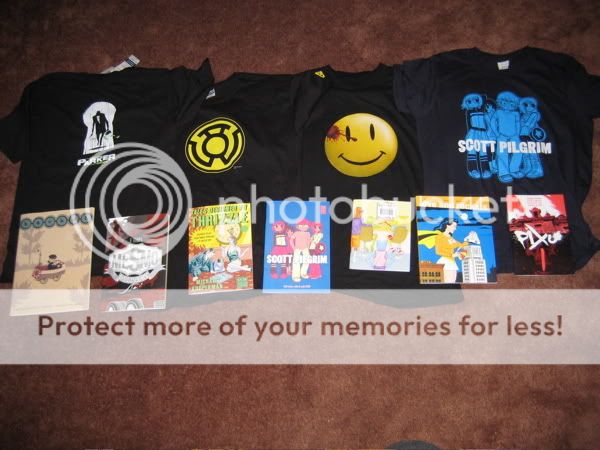
Looking back on all those movies, I would guess that becoming a horror blogger has influenced what I consider to be “must-sees” in the theater. And hey, that’s fine. Back when I did my first horrorblogging marathon while this was still mostly a comics blog, I very consciously was trying to reconnect with the genre that had given me so much enjoyment as I discovered it late in high school and throughout college. Making this a full-time horror blog was done with that in mind as well. I mean, I like being the guy with a Hellraiser T-shirt on at opening night of Cloverfield. I like being the guy my friends and co-workers turn to when they want an “authoritative” opinion about the adaptation of The Mist or I Am Legend. Moreover, I simply enjoy seeing movies in the theater. It’s one of my favorite things to do, and since horrorblogging (for me at least) is largely a subset of filmblogging, I do it a lot now, which is great.

But there have been times recently when the lights go down and the trailers roll and the opening credits finally start and I wonder to myself what it would feel like to have this experience knowing that I’m not going to see people get brutally killed in the next 90 minutes. I’ve actually forgotten!

Carnival of souls

* I saw and reviewed The Ruins today.

* And while we’re on the subject, Bruce Baugh reviews The Ruins author Scott Smith’s first novel, A Simple Plan. I haven’t read the book so I’m skittish about reading the whole review, but I got a lot out of Bruce’s opening paragraphs regarding differing approaches to moral criticism in fiction.

* Here’s a character breakdown for the upcoming Battlestar Galactica prequel Caprica which I will be trying to avoid spoilers on so I’m not reading it but you can if you want and I won’t judge you.

* In one of her all too infrequent geekblogging breakouts, Eve Tushnet tackles a slew of horror films: Audition, May, Session 9, Ringu, and The Ring. Regarding those last two, like most people she prefers the version she saw first, but for a different reason than I’ve ever seen anyone cite before.

* Chris Butcher continues to refer to the Geoff Johns/Grant Morrison/Greg Rucka/Mark Waid/Keith Giffen/cast of thousands weekly series 52 with words like “pablum,” and I continue to be baffled by this given how clearly, even ostentatiously weird, idiosyncratic, and follow-your-bliss its peripatetic plot and themes were. Also, I liked the last issue of World War Hulk.

* This week’s Horror Roundtable is about out favorite writings on horror. Curt at Groovy Age takes issue with my citation of Noel Carroll’s The Philosophy of Horror, pointing out the way Carroll treats horror plotlines like mysteries in which the characters attempt to “solve” the horrific presence. (Kind of like the initial set-up of The Ring, now that I think about it.) The funny thing is I didn’t even REMEMBER the focus on “solving” the horror until Curt brought it up in this post. What resonated for me was Carrol’s emphasis on how horror violates our sense not just of safety (like a lion on the loose or a mugger would) but also our sense of normalcy and even sanity. That seems like such a key distinction between horror proper and other things that are just scary. I read TPoH at a time when I was searching for a theory to explain why images that didn’t present a physical threat to the character who sees them–the girls in The Shining are the best example–were still so scary. This was an issue the prevailing Carol Clover-driven horror-film theories couldn’t account for.

* Finally, this shit is bananas, B-A-N-A-N-A-S: Frank Miller’s The Spirit, ladies and germs. Get ’em while they’re hot. (Shhhhh.)

Photobucket

Photobucket

Photobucket

Hollywood and vines

I probably went into Carter Smith’s film adaptation of Scott Smith’s (no relation) The Ruins expecting too much. I don’t see how I could have avoided that given just how wonderfully written the novel was. Unless they were to get very lyrical with landscapes and objects and sound, a la No Country for Old Men or There Will Be Blood, there was simply no way the filmmakers could translate the book’s ferociously intense interiority to the screen. (Well, now that I think of it, that was a way, and it was a way they didn’t take.) They made a good movie, don’t get me wrong. If you haven’t read the great novel you might think they made a great movie. I’m not sure.

What they did is rely on the ability of their actors to perform pain, and whenever that was going on they succeeded in a big way. As I’ve said before, the casting of this film was a real coup. Each of the main characters is attractive not in a plastic MTV/CW way, but in a your-girlfriend’s-cute-best-friend or your-good-looking-roommate way. You’re instantly attracted to each not in the way you’re attracted to matinee idols or pin-ups, but to good-natured, presentable people in the prime of their lives. Perhaps that’s why the necessarily truncated intro—which collapses our American foursome’s meeting and befriending of German tourist Matthias and a group of party-hardy Greeks and their subsequent decision to set out to an off-the-map Mayan ruin to track down Matthias’s brother and his newfound archaeologist lady friend from days into literally minutes—doesn’t feel nearly as rushed as it probably ought to. If I bumped into any of these people on vacation, I’d probably go offroading with them too. (Certainly I defy you not to come away from this movie with a crush on Jena Malone, if you’re oriented in that direction.)

The cutting and splicing doesn’t start to hurt until they reach the ruins, where a series of decisions made by the Smiths (Scott wrote the screenplay as well as the novel) in the interest of economizing character and conveying the stakes as quickly as possible upset the complex, nuanced interplay that made the novel such a pleasurably unpleasant read. (I’m about to SPOIL THE HELL OUT OF THIS MOVIE, so be warned.) Instead of putting two and two together regarding how much business the Mayan guards mean via the discovery of the body of Matthias’s brother, the movie gets the point across by having the Mayans kill the Greek right away. With him down, it’s left to Matthias to become the outsider figure who breaks his back in an ill-fated descent down the ruins’ shaft. So not only do we lose the pathos of a mortally wounded character whom the language barrier has rendered completely isolated (the Greek), we also strip ersatz group leader Jeff of his other competent counterpoint (Matthias), whose calm and melancholy works in strange harmony with Jeff’s frustration and angry optimism in the novel.

Then, for reasons less immediately apparent, Stacy and Eric swap roles so that it’s she who becomes infested with the killer vine and subsequently falls apart at the seams. This switch has the unfortunate effect of producing a far more stock character—the hysterical female, the Barbara from Night of the Living Dead—than what we had in the book. It also creates less of a contrast between Jeff and Eric, so now instead of a sullen MacGyver and an OCD self-mutilator we’ve got two shades of macho, one simply less take-charge than the other.

But let’s get back to the good—the suffering. It’s palpable and at times hard to watch. Though essentially asked to embody a cliche, Laura Ramsey as Stacy in particular is extraordinary. As with Malone, her body is used astutely by the filmmakers first to entice and then to unnerve with its soft, all-underbelly physicality. Her screams and sobs during the scene in which her friends finally take a knife to her to try to extract the infestation are so gutwrenchingly convincing I literally almost started crying myself out of sheer sympathy. Shortly thereafter she’s asked to carry the biggest gore effect in the film and aces it with understatements and false bravado, which quickly give way to utter (and utterly believable) despair. Malone is mostly her support throughout, but she’s quite good at it, repeatedly drawing on childlike gestures (hand-holding, hugging). And the person-on-person gore is as unflinching as you’ve heard, as raw as David Cronenberg’s recent crime movies.

What about Jeff, though? In the novel his was one of the most unique survival-horror characters I’d ever seen: He got more and more on top of his game as events progressed, as though on fire with the knowledge that his whole life had led him to this moment—yet he became less and less likable as this happened, and he knew it, and he still couldn’t do anything about it. (Along with Will Smith’s competent-to-the-point-of-neurosis Robert Neville in Francis Lawrence’s I Am Legend, Jeff was one of two fascinating riffs on the Survivor Type I came across last year.) Actor Jonathan Tucker has a hangdog handsomeness, a weary beauty, that lights him from within as he plays out Jeff’s ever-increasing level of no-nonsense decision making. The problem is that he’s not playing it out against anything. The aforementioned changes to the characters and their relationships gives him less to work with. Meanwhile the novel’s relentless emphasis on quotidian physical deterioration (as opposed to the menace of the vines or even just the Mayans)—thirst, sunburn, filth, starvation, heat, aches and pains, the need to find and conserve food and water and pain medication—is almost completely eliminated from the film beyond a few token shots of rationed grapes and swigs from a water bottle. What I missed most of all is the characters’ use of booze: The fact that the Greek packed more tequila than water, Eric Stacy and Amy repeatedly getting drunk despite knowing it will help kill them, and most importantly Jeff (and Matthias)’s reaction to their drunken stupidity. With none of those factors there to test him, we don’t really feel Jeff’s pain over knowing he’s got to be good enough to survive on behalf of the whole group.

Which leads us to the end of the film, the most rushed part of the whole movie. It deviates significantly from the novel, which is fine in principle, and could have even worked in practice. But since they couldn’t depict Jeff’s struggles throughout, they condense it into an incongruous “his name was Robert Paulson” speech to the Mayans that feels grafted from a different movie and makes Jeff’s sacrifice feel like it was done out of a kind of shakily established chivalry rather than fatigued rage. The penultimate sequence is straight out of The Texas Chain Saw Massacre or The Descent, a nice bookend to the Shining riff of the opening credits. But given what we know of the vines’ epidemiology, this development has eschatological repercussions that are completely unexplored. Instead we get a coda involving the remaining Greeks that cuts so quickly to the closing credits and their mood-killing Yeah Yeah Yeahs music that it’s almost like the movie had a plane to catch or something. I understand the filmmakers’ need to shorten a marathon to a steeplechase, but not this breakneck sprint to the finish line.

Part of me wishes I’d gone into the movie sight-unseen, like all those Ain’t It Cool reviewers. I probably would have remained mightily impressed by the performances and by Carter Smith’s taut, smart shots. I doubt I’d have felt the cuts and the rush, and I probably would have gone and read the book afterwards anyway. Coulda woulda shoulda.