From Crackle:
(Via Pterodactyls)

Recently I decided to steal an idea from my pal Matthew Perpetua and upload an occasional mix for your listening pleasure. First up is this assortment of some of my favorite Nine Inch Nails songs.
Leaving Hope: A Personal Best of Nine Inch Nails
Pinion / 2 Ghosts I / Wish / 12 Ghosts II / 13 Ghosts II / The Fragile / Just Like You Imagined / The Becoming / Happiness in Slavery / Something I Can Never Have [edited and extended] / 10 Miles High (Version) / Burn / In This Twilight / 36 Ghosts IV / The Fragile [Still] / The Becoming [Still] / Gave Up / In This Twilight (Fennesz Remix) / Leaving Hope
This particular mix leans heavily on textured instrumentals, quiet haunted-house piano, abrasive guitars, and alternately melancholy or nihilistic lyrics–occasionally all at the same time. These happen to be among my favorite NIN songs, so that’s the main reason I selected them, but Trent Reznor is a pretty deeply unfashionable character at this point among smart-music circles, so I wanted to put together a mix that displayed some of his ambition, range, and skill as a composer and arranger. There’s another mix coming that showcases a completely different side of the band, so please stay tuned.
* Not a whole lot to recommend this episode, I don’t think. That’s unfortunate. There aren’t a lot to go!
* Things I liked: Fine little acting moments from actors that the show has pretty much abandoned, Jamie Bamber, Tamoh Penikett, and the still prominent but underused James Callis. Apollo shouting “Gaius Baltar?!?” in disbelief when one of the members of the new quorum asks what everyone’s favorite former scientific genius and collaborationist president turned sex-cult leader and paramilitary commander (?!?) thought of the potential abandonment of the Galactica was a hilarious moment of exasperation, not least because it mirrors my own at the notion that anyone cares what Baltar thinks in the world of the show.
* Penikett played Helo’s begging for permission to search for his daughter with just the right mix of sorrow, desperation, hope, and barely concealed rage at Adama’s obstinacy (and hypocrisy–he’s the admiral of the fleet and he abandoned everyone so he could sit around in a raptor and wait for the President to show up, remember?). And
* Baltar’s brief encounter with Caprica Six was one of the few emotionally true moments that character’s been granted in quite some time, since it sidestepped the season-long guessing game regarding his sincerity about his religious proclamations and dove right into something we know to be legit, his ever-present emotional turmoil regarding what happened between him and Caprica Six before the Cylon attack.
* I did wish that Head Baltar showed up for Six, though–was the implication that he doesn’t do so anymore?
* And since Baltar’s thought process during his cult-leader storyline has been opaque, it was impossible to figure out just why the fuck he outed Starbuck as some kind of revenant in front of the whole frakking fleet. Is it because he really believes what he’s saying about angels and wants to prove it to the world? Is it because he doesn’t really believe what he’s saying about angels and wants to convince himself that he’s not crazy or the victim of a Cylon brain-implant? Is it because he doesn’t really believe what he’s saying, and doesn’t want to convince himself, and simply wants to increase his sway over the hoi polloi for his own selfish reasons? We have very little way of knowing.
* I did like that he didn’t even remember who Starbuck was despite fooling around with her a few years back. That’s the Baltar we know!
* We’ve seen Adama start doing something, then get more and more frantic about it, then totally flip out, then crash and cry, a few too many times for it to retain much power.
* I kind of liked turning Sam into a hybrid. Led to some nice visuals at any rate.
* The thing about the show’s shift of focus from “life during wartime” to “what’s up with the Cylons” is that it went from, well, a show about life during wartime to the kind of “sci-fi musings on the nature of consciousness and life and mortality and what makes us human and so on” that we’ve been seeing for nearly a century now. This morning when I woke up I flipped on the TV and there was an episode of The Twilight Zone on involving Jack Klugman as the captain of a spaceship that lands on some planet and finds the crashed remains of his own spaceship, and he and the crew start wondering whether they’re already dead or what. Sound familiar? Don’t get me wrong, that kind of thing can be very appealing, but it would have been just as easy for Battlestar Galactica never to go down that route, and since its execution of that kind of material has on the whole been less successful than its execution of the war material, there’s a bit of a let-down inherent in having the final episodes focus on that.
* At the Partyka site, Matt Wiegle draws a zombie attack!

And oh yeah, Dustin Harbin is this month’s Partyka guest artist.
* Paul Hornschemeier’s got an odds ‘n’ sods collection called All and Sundry in the pipeline.
* What we talk about when we talk about Dr. Manhattan’s dick.
* Speaking of, dig Rickey Purdin’s Watchmen sketchbook.

The mere act of naming this song “Marriott Cock Squat” alone is a stroke of genius. (Via Topless Robot.)

Ultimate Spider-Man #131
Brian Michael Bendis, writer
Stuart Immonen, artist
Marvel, February 2009
32 pages
$2.99
The problems with Marvel’s Ultimate line were easy to spot from the start. Its appeal stemmed from its freshness: You didn’t need to be conversant with decades of continuity to understand it, you could get a thrill out of seeing familiar characters and concepts appear and behave in entertainingly new ways, and because the series were all brand new the writers could tie them to their cultural and political moment much more tightly than could writers of characters whose first appearances involved atomic testing or the Vietnam War. In all three cases, eventual obsolescence was, if not planned, then at least inherent: After a few years the books would develop convoluted continuity of their own, the novelty of the tweaks would wear off, the writers would run out of A-listers and start introducing lesser characters to dwindling returns, and the cultural and political environment would shift even as the characters would be stuck in corporate-superhero aging limbo. What’s more, and this was harder to anticipate, the mainline Marvel Universe would itself become Ultimatized, as Ultimate writers Brian Michael Bendis and Mark Millar were hired to apply their “realistic,” paramilitary spin on superheroes to the company’s flagship titles.
So it was inevitable that each of the Ultimate books would reach its sell-by date sooner or later. For me, Ultimate X-Men navigated strong runs by Millar, Bendis, and Brian K. Vaughan but was undone by a combination of Robert Kirkman’s “I Love the ’90s” nostalgia and a slow drift from depicting the characters, particularly Wolverine (who now looks exactly the same as his Marvel U. counterpart), as teenagers, which was part of what made it work. Ultimates lost steam in its second volume, which featured the introduction of magical antagonists in a way that didn’t jibe with the basic premise of the book and also suffered from writer Millar’s usual tics (self-impressed dialogue, lack of earned peripeteia). Ultimate Fantastic Four, originally a collaboration between Millar and Bendis, unimaginatively recast the FF as kids to no discernible benefit, then handed the reins to Warren Ellis for dreary and unscary reimaginings of their two best villains, Dr. Doom and (in spin-offs) “Gah Lak Tus.” The less said about miniseries like Ultimate Daredevil & Elektra, Ultimate Vision, and (remember this?) Ultimate Adventures, to say nothing of Loeb’s Ultimates 3, the better.
The one lasting highlight? Ultimate Spider-Man, Brian Bendis’s starmaking series and the line’s heart, if not its flagship (that would be Ultimates). Cooked up by Marvel’s then-President Bill Jemas as a reaction to a mainline Peter Parker who seemed hopelessly old and square (I think Jemas once compared him to late-period Billy Joel), the series stars a teen version of the Wall-Crawler and is the closest thing superhero comics have ever served up (completely unintentionally as best I can tell) to shonen manga. The length of its run (well over 100 issues at this point, a virtually singular accomplishment among non-creator owned superhero comics today), the big-eyed art of longtime penciller Mark Bagley, the age of its protagonists, and Bendis’s never less than deft combination of genuinely kick-ass superhero combat and intrigue with teen romance and angst all evoke Japan’s bread-and-butter boys’ adventure series. A brief slump in the upper-double-digit issues gave way to strong arcs wrapping up long-running storylines, while a recent, seamless transition from Bagley to Stuart Immonen gave the book a more polished look and a more faithful window into teen fashion and physical comportment. Of the four for-the-ages superhero titles that made me a Bendis believer and a regular superhero-comic reader in the early part of this decade–the others were Daredevil, since handed by Bendis and Alex Maleev to the equally capable Ed Brubaker and Michael Lark; Alias, the mature-readers super-private-eye collaboration with Michael Gaydos (starring best-new-female-character-in-years Jessica Jones), preemptively shuttered by Bendis, who subsequently picked up its plot threads in less satisfactory fashion in his mainstream-Marvel titles The Pulse and New Avengers; Powers, Bendis and Michael Avon Oeming’s creator-owned cops-and-capes procedural, hampered by erratic scheduling ever since its move from Image to Marvel’s Icon imprint–Ultimate Spider-Man is the only one still going strong.
So it pains me some to see it gamely playing along with Loeb’s reboot, which doesn’t seem like half the book USM is at its worst–but fortunately, the USM tie-in issues, of which this is one, are FAR from USM at its worst. Indeed, this is exactly how big event crossovers should be done. Bendis takes the simultaneously goofy and gruesome conceit at the heart of Loeb’s series–Magneto steals Thor’s hammer and uses it to drown Manhattan in a tsunami, killing millions–and treats it completely seriously, casting Spider-Man’s heroism against a genuinely traumatic and tragic backdrop. Bendis also takes the opportunity to shake up the supporting cast: Just before the flood hits, Aunt May is arrested under suspicion that she knows Spidey’s identity; during the flood, J. Jonah Jameson spots Spider-Man trying to help people while JJJ himself heads for the hills, and realizing everything he’d said about Spidey was bullshit, completely changes his tune; Spider-Woman, here interpreted as a clone of Peter, returns (presumably to take the reins after the reboot). Bendis makes great use of the definitive event trope–crossover appearances by other characters–by dodging the fight/team-up binary: Daredevil, who in the Ultimate Universe is kind of an asshole to Spider-Man, shows up but only as a dead body, a pretty traumatic thing for Peter to discover; the Hulk shows up too, alternating between his old-school childlike monster persona and the destructive weapon of mass destruction approach, which means you get both the classic Spidey-Hulk vibe you remember from your childhood and the raw terror of Spidey fleeing from his life from the Cloverfield monster in purple pants that the Ultimate Universe version of that relationship could be expected to provide. For his part, Immonen’s figurework is loose yet clearly thought-through–it’s very appealing, particularly his floppy, blocky hairstyles–and he has a knack for whacked-out visuals like J. Jonah Jameson’s picture windows revealing the fact that the Daily Planet building is almost totally underwater.
I have no idea where Ultimatum will leave Ultimate Spider-Man, and no particular desire to find out where it will leave the rest of the Ultimate line. But for now, it’s providing Bendis and Immonen an opportunity to do Spider-Man vs. the Apocalypse, and they’re seizing that opportunity with gusto. Good for them. I hope there are 131 more issues.
* My pal Zach Oat at Television Without Pity is the reason why I was able to see Watchmen the other night in the first place, and many of the points I make in my review were first aired in conversation with him after the screening, so perhaps it’s no surprise that his review of the film is my favorite so far. I thought this was a clever point:
…while many reviewers might disagree with me, the film version of Watchmen is not your standard superhero movie. True, it has guys in costumes fighting street-level thugs — and, later, other costume types — with the same martial-arts moves you’d see in any of the Batman flicks. But the big difference is that this isn’t an origin tale, like Batman Begins or Iron Man or most other superhero films. It’s the opposite of an origin, where the heroes are out of the spotlight on the other side, slowly dying and being forgotten about as they reflect on their lives.
* Meanwhile, Frank Santoro’s read of Watchmen over at Jeet Heer’s blog is so good, and so in sync with what I’ve been trying to get across about the movie and the book and Moore’s superhero/superhero-ish work generally, that I’m going to quote it in its entirety:
Watchmen is a Lutheran reformation text knocking on the door of the Catholic establishment by a devout believer. Or something like that. And why I think scholars of comics don’t really enjoy it because they aren’t superhero fans. The text is an indictment of the form, the laws, by a believer in the form. I don’t know if anyone who wasn’t a “true believer” to start with really “gets” the full impact of the text. It’s like a Muslim saying he doesn’t enjoy the New Testament.
That’s exactly right, and exactly what I’ve been saying: No matter what Moore himself says today, Watchmen is not Eightball #23.
* When my former boss Gareb Shamus wasn’t busy firing everyone who works for him who isn’t his brother Stephen, he apparently collected all 12 original Watchmen covers. I had no idea! That’s a pretty terrific collection.
* Closed Caption Comics member Ryan Cecil sings the praises of the Wachowski Brothers’ stunning Speed Racer. Man, is that movie ever a grower. Actually, thinking about my experience watching Watchmen, Speed Racer is the film I think it’s the closest to. Some kind of cross between Speed Racer and Rambo, which is a pretty heady brew.

* Another altcomic bites the dust: Tom Spurgeon reports that Ted May is canceling the completed Injury #3 until further notice. That’s a travesty, because look at the goddamn cover. That’s the best thing I’ve ever seen him draw. Damn.

* Speaking of May, sorta, USS Catastrophe has reopened and is selling Rumbling a new Kevin Huizenga mini containing the continuation of a story from the now-defunct Or Else. (Via Tom Spurgeon.)
* Also via Spurge, Jeffrey Brown has a blog! And he’s drawing G.I. Joe. Sheeeeeeeeeeit.

* Scott Tobias’s New Cult Canon column returns with a look at Femme Fatale, a film best described as Brian DePalma’s tribute to Brian DePalma. That’s no faint praise, I assure you.
* Paging Bryan Alexander! If Charlie Parker Was a Gunslinger, There’d Be a Whole Lot of Dead Copycats begins a new photo series: Abandoned Places.

Todd VanDerWerff’s latest weekly Lost review is just lousy with insights, so I’m just going to spend a whole post quoting and agreeing with it if you don’t mind. On Josh Holloway:
This dude should be a movie star.
Agreed! And I’m the last kind of person to say that because I tend not to really care about the devil-may-care badasses with the hearts of gold. I love Han Solo like I love all Star Wars characters, but I’m not a “HAN ROOLZ LUKE DROOLZ” type. Ditto Batman and Superman. Megaditto Jack and Sawyer. But something about the way Sawyer is written, and about the way Holloway portrays him, imbues him with an approachability that many such stock characters lack. It’s perfectly believable that he’d be friends with Hurley, for example, you know? He wouldn’t be posing during the times they hang out, either, he’d just wanna have a nice time with him. That’s what I like about the character, and Holloway.
After the [love] triangle resolved itself, though, he retreated into the background simply because the show wasn’t quite sure what to do with him anymore. He was too much a leader now to simply go back to playing a foil to Jack, but he also didn’t really have a credible idea of what the castaways should DO to counterpoint Jack’s fervor to get off the Island and Locke’s fervor to stay on.
Yep. That’s why it’s so much fun to see him come into his own, and why it’s disheartening to see Kate and Jack come back and start the love quadrangle dynamics up again.
Lost, of course, makes a big deal out of names….A lot of this is just silly spot-the-reference gaming, like you might see on, say, Family Guy, but Sawyer’s voyage has had as much to do with the idea that he takes on different names to suit different occasions as anything else. When he was just Sawyer, the agreeably Han Solo-esque rapscallion, he was a pretty basic riff on the con man with a heart of gold. Once his real name came out as James Ford, however, the show felt safe in giving him a few inches of vulnerability. And now he’s Jim LaFleur, and he’s essentially become a respected member of society. He’s got a stable relationship with a loving live-in girlfriend and a great job (head of security for DHARMA).
Totally, and wow. Well done. (BTW, I couldn’t help but think that his pseudonymous surname is a relatively meaningless reference to Myron LaFleur from The Mist by Lost-writer fave Stephen King.)
While I thought “The Life and Death of Jeremy Bentham” was one of the series’ better efforts, the last two episodes have both had a crippling failing in doling out lots of exposition in the clumsiest way possible (i.e., just handing giant speeches to people pretty good with exposition and hoping for the best). “LaFleur,” written by Elizabeth Sarnoff and Kyle Pennington and directed by Mark Goldman, however, handled exposition in the best way possible: It dropped the characters right in the middle of it.
Matthew Perpetua, call your lawyer.
DHARMA (or, as I like to call it, the Television Character Actor Economic Recovery Plan) has always been one of the bigger mysteries on Lost (somewhere up there with questions on the Island itself, the smoke monster and the Others), and its abandoned facilities lent a nice haunted house quality to much of season two, which is easily the show’s SPOOKIEST season, if nothing else. There’s something about out-of-date technology and abandoned research facilities wasting away in the middle of a tropical paradise that gives the show that extra level of intrigue (think of those oddly unsettling training films, for instance)…
Agreed on all counts. That’s one aspect of the show I really miss. Remember when the countdown clock revealed those hieroglyphics? Remember when you first heard “SYSTEM FAILURE”? Remember when “Walt” said hello on that ancient computer?
Sawyer and the others have gone through a lot of pain in the past while, so to see him having a moment of happiness at the successful delivery of Amy’s (Reiko Aylesworth, late and much-lamented of 24) child by Juliet, who had to overcome her professional jitters, was nice…
And the show obviously knew it, which is why they risked the loss of a cliffhanger or a big dramatic moment by cutting to commercial on Sawyer’s grin. It was worth it.
I figured pairing off Sawyer and Juliet was inevitable, but I didn’t think it would work as well as it did here. Their relationship has a maturity that Sawyer’s pairing with Kate (based as it is on adolescent crush-level dramatics) just DOESN’T have. This being TV, where adolescent crush-level dramatics hold sway, I expect this will turn into a wacky love quadrangle, but I also sort of hope Sawyer and Juliet just jilt Jack and Kate and say, “Thanks, but we’re much happier now.”
Oh, indeed! In fact I think that the show has painted itself into a bit of a corner here, since Jack and Kate have been shown to be such selfish sad-sacks while Sawyer and Juliet are running around rescuing people and caring about people and saving babies and drunks and creating a happy life for themselves. The show needs to hope that the collective energy of Skater and Jacket shippers formed over the course of three to five seasons can overwhelm the goodwill engendered by whatever they’re calling the Juliet/Sawyer pairing in the space of one episode. As far as I’m concerned that’s an uphill climb!
Really liked that scene where those left behind anxiously discussed their fates around the small table in DHARMA village, particularly the way the image of young Charlotte disappearing off into the darkness with her mother was shot. That whole moment could have been unbearable, but it just wasn’t, thanks to some interesting directorial choices.
That scene was really well done, wasn’t it? The sandwiches and milk, the outdoor lights illuminating the early summer evening as children run inside–really evocative of eating dinner on your porch on a lovely summer night. They didn’t have to set the scene in that environment, but they did, and it made it all the stronger.
The word “regret” implies several things: pain over your past, contrition over your role in it, and the wish that you could go back and make sure it never happened. As a vocalist, as a melodist, as a lyricist, Brian Molko’s gift is conveying a kind of “regret,” or maybe a whole new word is needed, where you feel that pain and contrition but just can’t bring yourself to want to have done things any differently. In some ways that’s even sadder.
This video, which I hadn’t seen before now, takes a lovely, sexy idea and executes it beautifully, and Molko never looked better. Pretty perfect.
* Look, I’m a person who likes Lost a whole lot, I think I’ve been up front about that. And I liked this episode a whole hell of a lot. Several moments had me laughing and cheering with delight, sitting there on my couch with my cat: The glimpse of the Statue, the revelation that Sawyer is a Dharma Initiative bigwig, and of course the Sawyer/Juliet hook-up. Woo!
* On that last point, I can’t stress enough how happy hooking Juliet and Sawyer up makes me. That’s a goddamn stroke of genius is what that is: “Hey, how about we take the two romantic leads you could actually stand to be around for longer than 30 seconds and put them together?” By all means, Lost writers! I have a bad, bad feeling that Sawyer’s 100 Days in Heaven with Kate are going to trump his three years with Juliet, unfortunately, but I’ll take what I can get. (Particularly if it means we get to watch Elizabeth Mitchell lazily roll around in bed with her shirt off. Sigh.)
* So for that reason, and just the kick of seeing our heroes in Dharma jumpsuits rubbing elbows with poor doomed Horace and the rest of the gang, I really like how this three-year jump has been handled. Plus, as my pal Matthew Perpetua pointed out to me, this was a way to invest the Dharma/Others War backstory with a sense of urgency, instead of relegating it to flashbacks or infodumps.
* That said, my big concern about this move is something that always happens on TV, especially on Lost, which is that the writers and audience alike tend to conflate screen time with actual time. So while Sawyer’s relationships with Juliet, Miles, Daniel, Jin, and even some Dharma people should probably be more intense and important to him than his relationships with Hurley, Jack, Sun, and even Kate, they’re not going to be treated that way because those years together happened off screen, while his 100 days with the castaways took place over the space of four seasons in the real, non-fictional world. It’s a bit like how the characters rarely seem to think about the deaths of Boone or Shannon or Ana-Lucia or Libby (let alone Nikki, Paulo, or any of the redshirts) even though they happened just a few weeks ago in screen time, because those episodes were written, shot, and aired years ago in some cases in actual time. (Though it seems to me that Terry O’Quinn seems to keep Boone in mind when appropriate even though it’s not explicitly called for in the script, simply because he’s a talented and intelligent actor.) I mean, this whole thing is sort of a quibble, and I admit it’s entirely possible for brief but intense relationships to trump long-term but less traumatically engendered ones, but it’s still gonna irk me a bit.
* But who knows, maybe Sawyer will be like “hey, nice to see you, but don’t fuck things up for my pal Horace.” Maybe someone will have gone native, so to speak, and genuinely feel allegiance to and affinity for Dharma. It’s a surprising show, and stranger things have happened.
* I’m glad to see more Dharma stuff in general. I’d always felt like they’d ended up getting short shrift–having the origin of their use of the Numbers and our only solid glimpse of Alvar Hanso relegated to the not-quite-canon Lost Experience ARG, having Ben and the Others kill them and take their shit D&D-style, simply revealing that they had little or nothing to do with anything that was happening to the castaways. But I was always still interested in who they were and how they came to be, to quote Batman–how did they find the Island? What were they really trying to achieve there? Were they the hippie-science commune they seemed to be, or were they sinister in some way, as implied by the deception in many of “Dr. Marvin Candle”‘s orientation films? How do they tie in to Widmore and/or Paik? What’s the source of their conflict with the Others? Is it merely their presence on the Island, or something more? What happened during Ben’s years with them that we haven’t seen? What caused characters like Charlotte’s mother and Annie to leave? I’m hoping we see a lot of this go down.
* Speaking of Ben, where are he and his dad during Sawyer et al’s sojourn among Dharma? Are they there yet? Have they already left? Are Sawyer and the gang simply ignoring them? Surely it’d be tempting for Sawyer just to wring the little bastard’s neck, no? Does Daniel persuade him not to? Whatever happened, happened, right?
* This show is uniformly great at casting villains. Terry O’Quinn initially, William Mapother, M.C. Gainey, Michael Emerson, Alan Dale, Elizabeth Mitchell initially, Andrew Divoff, Lance Reddick, and most notably in this episode, Nestor Carbonell. God, what an unnerving guy. And a handsome devil! Just a quiet, sensual menace. I’m glad he became a big deal and didn’t get dropped after one episode like Diana Scarwid’s Isabel.
* Unrelated theory I’ve been mulling over for the past week and that other, smarter people already probably beat me to long ago: I think Libby worked for Charles Widmore. I didn’t put it together until after Matthew Abaddon told Locke that his job was to get people where they needed to be, but of course that’s exactly what Libby did with Desmond, and presumably that’s why she was watching Hurley inside the asylum.
* I wonder if the presence of various ’04 castaways back here in the ’70s is what gave rise to the various “lists” that the Others referenced a couple seasons back. Perhaps they were on the lookout for these specific people to come back.
* Who do you think Amy and Horace’s baby is? Anyone we know? If he was born in ’77 or so, that would make him a little older than me–who matches that description? Charlie, Boone? Maybe Hurley (too young?) or Daniel (too old? already has a mother but she could have adopted him?)? And of course time travel complicates things further. I wonder.
Best known as a hidden track on Nine Inch Nails’ Broken EP, “Suck” actually started life, sounding very differently, on the debut album from Martin Atkins’s industrial supergroup Pigface; here’s Trent Reznor singing the song with Skinny Puppy’s Nivek Ogre during a P-face tour. The arrangement is basically the NIN version, though, complete with “Funky Stuff” bassline. Happier times for the industrial world, that’s for sure. Two of the band members you see here, Killing Joke bassist Paul Raven and Ministry guitarist William Tucker, are now dead.
I liked it a lot!
Foremost, I think it got all the characters across in all their lovable fucked-uppedness. They are lovable, at least to me, even if most of them are sociopathic creeps. I’m fond of them, and the movie reminded me of why. Jon is unnerving and sad, Dan is adorable and a little off in a nutty-professor way, Laurie’s a sexy mess, Sally’s a formerly sexy mess, Rorschach is extravagantly over the top (a lot of his journal’s more outré pronouncements became laugh lines, something the character’s admirers in fandom may not be prepared for), and (my biggest pre-screening worry) Ozymandias is basically David Bowie crossed with Lex Luthor. No complaints on any score.
Second, you may have noticed the legend at the bottom of my blogroll reading “KEEP COMICS EVIL.” With that in mind, I have to admit that I’m simply chuffed that there’s a full-fledged superhero movie out there now with a hard-R rating. And man, is it ever hard! Unbelievably graphic violence for a superhero action movie–I think that’s important to keep in mind when reading criticism of the violence in this movie, just that it’s never been shown to be like this before. To the extent that the violence is glorified or fetishized, well, isn’t that what the superheroes are doing? Literally, in Dan and Laurie’s case? Speaking of, there’s a pretty graphic sex scene between the two of them. There’s boobs, tons of man-ass, a little woman-ass, and of course, Lower Manhattan. (Which was not nearly as distracting as it’s been made out to be, by the way–the movie had a way of cutting away from it when it might become so, and rumors of its kinship with Dirk Diggler’s claim to fame have been greatly exaggerated.) Sex, dismemberment, and superheroes…I mean, look at my movie-review sidebar, obviously this is delightful to me in someway.
Maybe my favorite aspect of the movie is how it riffed not just on superhero conventions, but on ’80s sci-fi action dystopia movies, too. I think it was Harry Knowles or Moriarty who pointed out that the score was designed to evoke the likes of Vangelis, Tangerine Dream, and John Carpenter–it’s not super heavy-handed at it, nor is it as obvious as, say, “Machine Gun” by Portishead, but it’s there. Meanwhile, during the sex scene, the flick uses a super-duper-conspicuous romantic pop song (Leonard Cohen’s “Hallelujah,” getting a big laugh from the audience), in much the same way that basically every ’80s movie starring Tom Cruise did. The Road Warrior and that 1984 Macintosh Super Bowl ad figure prominently on Ozymandias’s TV screens toward the end. It’s cleverly done.
Speaking of ’80s movie connections (and even The Road Warrior, given that the snippet we see is of the masked Lord Humungus shooting his big gun), the movie made explicit something I noticed upon my last re-read, which is that Rorschach’s design owes as much to masked killers like Michael, Jason, and Leatherface as it does to the Question or Mr. A. How does it do this? By changing around the climax of the sequence where Rorschach “becomes Rorschach” in a way I won’t spoil, but suffice it to say is a pretty direct link to slasher films. (Not to mention less of a ripoff of the climax of the original Mad Max, just to bring things full circle.)
But it’s very much a superhero movie–the costume tweaks, the action sequences, the glory shots, Big Figure–and that’s totally fine by me. I think it’s easy to forget that for all its distrust of the genre, for all its deconstruction of the genre, for all of Moore and Gibbons’s formal achievements in it, and for all of Moore’s later ambition and achievements outside the genre, Watchmen is not Eightball #23. It’s very, very much a superhero comic, and much of its pleasure derives from how effectively it can deploy that aspect of itself in contrast to the other things it’s doing. The movie isn’t wall-to-wall X-2 or anything, it saves the most superheroey stuff for after Dan and Laurie get back into costume and start kicking ass again (Patrick Wilson plays the transformation beautifully, going from sad-sack to Batman seamlessly), but it’s there, and good!
Everything that was cut could afford to be cut and everything that was changed made sense in its new version. Yeah, you may notice the absence your favorite detail or line what have you. I wish Comedian’s close-up “Somebody EXPLAIN it to me” plea during his drunken confession to Moloch had stayed in; ditto “The light is taking me to pieces.” But I didn’t exactly miss any of it, nor did I miss the ancillary characters, or having Captain Metropolis head up the ill-fated “Crimebusters” meeting, nor did I care that they called the non-existent group the Watchmen instead of the Crimebusters–what difference does it make what you call a team that never existed? The ending is the biggest change, obviously, and while I am a passionate defender of the shaggy-dog-joke punchline of the original, this solution is far more elegant and, honestly, the kind of thing Moore would totally do. I think it helps sell Dr. Manhattan’s decision at the end, too.
I had a lot of fun and would happily see it again. I imagine that if you suspect you won’t like it, you’re not gonna like it, it’s not gonna change your mind. But as I always said, my Watchmen calculation was simple arithmetic: I love Watchmen the comic, I really liked Zack Snyder’s Dawn of the Dead remake and 300 adaptation, so I’d probably like Zack Snyder’s Watchmen adaptation. Sure enough!

Dirtbags, Mallchicks & Motorbikes
Dave Kiersh, writer/artist
self-published, 2009
136 pages
$20 incl. shipping
Preview it at Kiersh’s website
Buy it exclusively from the author via Paypal – davekiershATaolDOTcom
I’ve kept my eye on Dave Kiersh’s work since coming across it in Jordan Crane’s seminal NON anthologies, where his simple line and design sensibility and poetic writing style coupled with his aching, romantic subject matter to suggest John Porcellino gone Young Romance. In the years that followed he’s drifted from more straightforward pseudo-autobio tone poems toward a more targeted examination of love, lust, and emotional turmoil among suburban adolescents, frequently filtered through the sensibilities of late ’70s and ’80s afterschool specials, young adult novels, and teen sex comedies. It’s an unusual pursuit, that’s for sure, and I think Tom Spurgeon said it’s a shallow pool for a cartoonist of Kiersh’s obvious talents to swim in, let alone spend a Xeric Grant on, but I don’t think Tom’s right. For whatever reason, that kind of material has a lot of power. The mirror it held up to the actual experience of suburban American adolescence may have simultaneously sensationalized and simplified that experience, but the reflection was recognizable nonetheless; artists as wide-ranging as Charles Burns, Judd Apatow, Richard Kelly, and M83’s Anthony Gonzalez have recorded their observations of that reflection, to memorable effect. Why not Kiersh?
Dirtbags, Mallchicks & Motorbikes, as you can probably guess from the title, sees Kiersh continuing to explore and refine his interpretation of the teenage-wasteland’s aesthetic and emotional milieux. It’s a collection of short stories, none of which feature any kind of resolution, not even the usual non-resolution resolutions you see in other short comics about young people and relationships; they just kind of end. It’s a bold choice, and it’s what prevents several of the more knowingly pastiche-driven stories–the boy who falls for his invalid mother’s sexy live-in nurse; the girl whose hotsy-totsy friend convinces her to shoplift a push-up bra–from feeling paint-by-numbers. Other well-worn types get zig when they should zag: The kid who winds up lonely in the crowd when he throws a party while his parents are away is the star quarterback; the beautiful tennis player with the loser admirer doesn’t slowly discover the man of her dreams beneath his grubby exterior, she simply fucks him in the stands just to see what life is like when you don’t care. The stories themselves twist and turn rewardingly before they expire; I was particularly taken with an interlude between the thoughtful quarterback and a drunk cheerleader who throws herself at him in the bathroom, which he escapes by promising to take a shower with her but climbing through the shower window before she can climb in with him, and by the way a story on teen pregnancy is constantly shifting the ground between the main character (the father-to-be) and everyone he encounters (the mother of his baby, his boss, his customer, his friend, his mother, the notional baby itself) in terms of values like responsibility and caring. Kiersh’s art is less fancifcul here than in his old work or his recent book Never Land, rooted firmly in emotions inspired by the everyday rather than daydreams. His thick round line is reminiscent of Keith Haring’s, particularly in the suburbiascape endpages, but Kiersh uses those chunky delineations to connote isolation rather than cohesion and community. This strikes me as very thoughtful, considered, personal work. If you like the Donnie Darko soundtrack school of wistfully emotional ’80s pop, or modern-day approximations thereof, I think you’ll get a lot out of this.
* When I think about my “favorite movies,” I have a whole lot, and I tend to separate them out into groups. For example, some of my favorite movies are millions of people’s favorite movies: The Godfather Parts I & II, The Lord of the Rings, Star Wars, etc. Then there are horror movies: The Shining, The Exorcist, Hellraiser, The Blair Witch Project and so on. I’m not sure that either list is all that unique to me. That’s the job of my “Idiosyncratic Favorites” list, consisting of movies that are uniquely my bag in a big way. Three of those movies, Heavenly Creatures, Velvet Goldmine, and Eyes Wide Shut, are the subject of recent installments in Scott Tobias’s New Cult Canon series at the Onion AV Club. (The others, if you were wondering, are Lost Highway, Barton Fink, and Casino. Actually I’d probably throw Hellraiser on there as well.) Go read all three please.
* Happy Seventh Blogiversary to ADDTF Blogather Bill Sherman!
* Chris Butcher notes that the Final Crisis hardcover is now slated to include Superman Beyond and Submit. No Batman: Last Rites, but I’ll take what I can get.
* Looks like longtime Romero-movie composter John Harrison’s directorial adaptation of Clive Barker’s Book of Blood will be going straight to DVD. Somehow that seems less ignominious than what happened to The Midnight Meat Train.
* I think we already knew that Cloverfield director Matt Reeves was remaking Let the Right One In, but I don’t think we knew that he was calling it the far less elegant and evocative title of Let Me In. Character-driven horror is not exactly what I would set the director of Cloverfield up with as a follow-up project, but hey.
* The making of a masterpiece: Geoff Grogan explains how he created his collage comic Look Out!! Monsters. (Via Chris Mautner.)
* Douglas Wolk reviews several notable superhero collections of late: Omega the Unknown, All Star Superman, and the Greg Sadowski-edited Supermen! In this piece Wolk seems to subscribe to the theory, advanced here and there around the internet, that there’s a twist ending in All Star Superman in terms of a certain character and a certain other character and perhaps a relationship of some kind between them. I’m not convinced and I think Morrison has more or less denied it in interviews, though not in so many words because he’s never been asked it in so many words, but still. Ah, does anyone even know what I’m talking about?
* Rick Trembles reviews Tim Lucas’s book on David Cronenberg’s Videodrome in his inimitable comic-strip style. Full of fascinating insights and what-ifs.
* Stacie Ponder is right: This trailer for The Shining is astonishing.
* Good lord Tom Neely can draw.

* The Bush Administration’s legal team asserted that virtually no law or legal principle applied to the President’s conduct towards you provided he believed you to be a terrorist, so in that light it’s not surprising that recordings of almost 100 interrogations of terror suspects were destroyed. Somewhat more surprising is how little the Obama Administration has deviated from some of the Bush Administration’s more jawdroppingly authoritarian policies.
* I’ve got a fever! And the only prescription! Is more Kate Winslet!

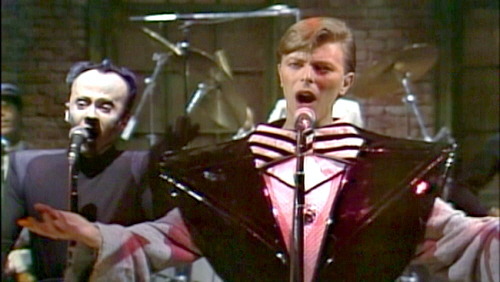
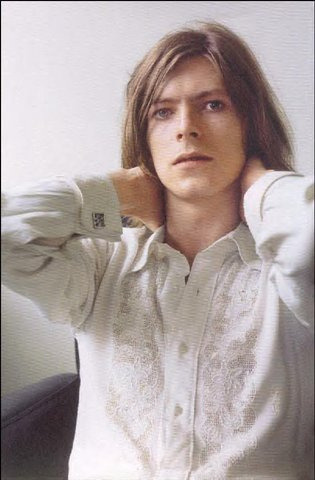
* Which reminds me: As promised, here’s the first installment of The Best of Bowie Loves Beyoncé. I’ve come across a lot of wonderful images during my first week and a half of running this tumblelog, but I think this is my favorite pair of all:

Beyoncé and her team are not here to win news cycles, they’re here to win the election.
And of course, if you’re not in it for the clever juxtapositions, it is of course a blog containing nothing but pictures of two human beings who look like this:


MOME Vol. 13: Winter 2009
Eric Reynolds, Gary Groth, editors
David Greenberger, Tim Hensley, Dash Shaw, Conor O’Keefe, Gilbert Shelton, Pic, Josh Simmons, T. Ott, Kurt Wolfgang, Nate Neal, Laura Park, Sara Edward-Corbett, Derek Van Gieson, Kaela Graham, Adam Grano, Henry Huntington, Casey Jarman, writers/artists
Fantagraphics, November 2008
120 pages
$14.99
Something about this volume of MOME makes it my least favorite in a while. It’s entirely possible that it just caught me on an off day, or that I’m all anthologied out. But while there’s always a tension in MOME between the best material it contains and the lesser stuff, and while that’s always been a big part of why I enjoy the series so much, I feel like we’re starting to see those two qualitative groups coalesce around two separate ways of doing comics. It’s almost like MOME is becoming two anthologies at once, and my problem with that is I’m not sure which one will win out in the end.
On the one hand, you have experimental takes on genre. In this volume, that school is represented by Dash Shaw’s dystopian science fiction, Tim Hensley’s continuing riff on Archie comics “Wally Gropius,” Derek Van Gieson’s Scary Stories to Tell in the Dark-type fable, a wordless journey into space with T. Ott, and Josh Simmons’s latest savage horror comic. It probably doesn’t surprise anyone that this is where my sympathies lie. Shaw’s “Satellite CMYK” comes first, telling the story of a Battlestar Galactica-esque satellite colony of survivors that has become so rigidly stratified that the mere existence of other levels of the structure is the subject of 1984-Brotherhood-style subversive conspiracies. Shaw conveys this idea by using a different color for each level. It’s not quite successful–the sameness of Shaw’s faces makes it harder to follow than it ought to be, and the power of the final reveal image is undercut by needless captions–but it’s as ambitious, imaginative, and emotionally rooted a bit of SF worldbuilding as any of Shaw’s work in this area. Hensley’s “Gropius” stuff continues to fascinate me with its angular character designs, kinetic non-action, and subtext of high-capitalist violence. (Riverdale this ain’t.) Van Gieson’s strip took me a couple reads to figure out that it was, in fact, a strip and not a series of discrete vignettes, but once I grokked what was going on, I really dug (no pun intended) that final graveside kicker, and the Gorey/L’Autrec/Alvin Schwartz watercolor visuals. Simmons, finally, can seemingly do no wrong anymore. I’m having a hard time coming up with any cartoonist whose work is as angry as Simmons’s has been lately. House, Jessica Farm, “Batman,” “Night of the Jibblers,” and this issue’s “Jesus Christ” (!) are breathtaking in their brutal nihilism–it’s horror that aims to punish, to tear down. In this case that’s literally the plot: a gigantic centaur-like Messiah descends from the heavens simply to wreak havoc on the tiny inhabitants of the endless city in which he lands. He’s too big for them to comprehend, physically or mentally, and their lives couldn’t matter less to him. It’s Lovecraft’s cosmic horror by way of the undergrounds’ hyper-detailed art (those buildings! that smoke! that bravura sequence when Jesus regurgitates a flaming sword!), taboo-shattering violence, and full-frontal nudity. Follow it with an equally bleak scratchboard science-fiction parable by Thomas Ott and you’ve got a heck of a one-two punch.
But then. The other pole is whimsy, and here’s where MOME loses me. This issue’s David B./Jim Woodring-style guest star is underground stalwart Gilbert Shelton, who serves up a limp, laughless story about his shitty recurring rock band Not Quite Dead being secretly sent by the government to overthrow the government of a banana republic. Sure, he draws the living shit out of it, but the whole thing feels so far past its sell-by date–a Grateful Dead spoof with jokes about hot-button cultural touchstones Elvis Presley and Madonna? Rock ‘n’ roll using its awesome power to subvert civil authority?–that it doesn’t make a difference. Underground-indebted MOME regular serves up a strange story about a folk singer named Minnie, drawn to look a lot like Phoebe Gloeckner’s similarly named stand-in character for no discernible reason; it’s a story about bein’ down n’ out and just wantin’ to play th’ blooz and it sucks that Greenwich Village is filled with yuppie scum now and blah, blah, blah. It’s nice-looking enough, but I don’t come away from it feeling or thinking anything new. Conor O’Keefe’s McKay-like figurework and Sara Edward-Corbett’s sharp Partyka-bred line (as well as her “Rabbithead”-indebted tiered narrative) cut through the ugly-cute clutter, as does Laura Park’s suite of strips about things she’s done at night (look at that quilt!), so it’s not as though the lighter/zanier material is completely undistinguished…I don’t know, I guess I just wasn’t in the mood. I definitely don’t know why we needed page after page of David Greenberger listing album titles according to the number of syllables they contain, you know? And that kind of decision makes me nervous for the future of the anthology.

1 – Go to Wikipedia. Hit “random”
or click http://en.wikipedia.org/wiki/Special:Random
The first random Wikipedia article you get is the name of your band.
2 – Go to Quotations Page and select “random quotations”
or click http://www.quotationspage.com/random.php3
The last four or five words of the very last quote on the page is the title of your first album.
3 – Go to Flickr and click on “explore the last seven days”
or click http://www.flickr.com/explore/interesting/7days
Third picture, no matter what it is, will be your album cover.
4 – Use Photoshop or similar to put it all together.
SPOILERS BELOW
* Much, much, much stronger episode this time, even with the umpteenth imaginary-friend reveal (which to be fair was better than Romo Lampkin’s cat). I guess I didn’t realize how shaken I was by the lousiness of last week’s ep until I sat down to watch this one and discovered I was dreading it. It was entirely possible that with so few episodes to go, last week could have set a tone from which the show would never recover. Fortunately that wasn’t the case.
* Before I say anything else, my big “whoa” moment from this episode was Athena’s really wrenching and awful cry of despair toward the end of the episode. Holy shit but did Grace Park sell that. Even just watching her underfed form stumble into the briefing room in her underwear, beaten to a pulp–ugh, tough to watch and beautifully performed. Park was just as strong as Boomer, playing the character’s singular mix of longing and deceit like a slow-burning fire. I was really impressed with her, particularly considering she was arguably the ensemble’s weakest link early on.
* Whereas last week felt like a struggle just to string together a conversation that made sense from one sentence to the next between any two characters, this week felt masterfully controlled by the writers–each of the characters upon whom it focused left the episode with us having a clearer understanding of him or her when than when it started. For Chief, this mainly consisted of establishing a through-line for him that connected both his Herculean efforts to save the ship earlier in the half-season with his 180-degree decision to abandon the fleet last week: He’s just badly, badly shaken by the combined emotional assault of discovering he’s a Cylon, realizing he wasn’t super-in-love with Cally, losing Cally, discovering his kid isn’t really his kid, losing Earth, discovering he lived there thousands of years ago, and so on. Unlike, say, Tory, who was instantly gung-ho about being a Cylon, or Tigh, who decided just as instantly that his life as a member of the fleet was the paramount thing to him, the Chief never really had that moment of clarity regarding his life from here on out. This episode showed that in his way, he’s just as adrift as Dee or Kara or Gaeta have been shown to be this season.
* The next character we got more of a handle on was Boomer. In this case the ep was, seemingly at least, deceptive. For the longest time it seemed like she was genuinely contrite about her role in the attempted assassination of Adama, the regime on New Caprica, the betrayal of her fellow 8s in the Cylon Civil War and so forth. Not only had she changed her political tune, but on an emotional level she seemed to have come to grips with the fact that much of her behavior had been a reaction to feeling rejected by the Chief way back when. Even after she went buck-wild on Athena and frakked Helo, I figured this was just the behavior of someone who’s profoundly fucked up, maybe even crazy at this point, but not evil. And even once she kidnapped Hera, I thought it was some shared plot between her and the Chief to keep the kid safe from all the turmoil in the fleet lately or something. Maybe some of this will still turn out to be true–I feel like quite a bit of it might–but as it turns out, Boomer was once again an enemy agent, there to kidnap Hera for Cavil’s side; even freeing Ellen and bringing her to the fleet was a ruse. Suddenly Boomer’s behavior makes that much more sense.
* The final character we learned more about, of course, was Starbuck. I guessed that the piano player was all in her head during his first scene and almost had to admire the sheer chutzpah of this show to dip into that particular well yet again, but I thought all that material was so well acted, well lit, and well scored that I didn’t even mind. So the theory that Daniel the Missing Cylon was her dad turns out to be correct, making her, what, a Cylon-human hybrid like Hera? That would explain why the show’s staff could be so unequivocal in saying “Kara’s not a Cylon” despite the fact that doing so rules out all the previously established ways she could possibly have returned from the dead on this show–she’s a half-Cylon, and for all we know they can regenerate too. Katee Sackhoff, of course, is the show’s big discovery acting-wise; much of her work is simply taking advantage of how she looks on the screen. There’s something really physical and present about her big watery eyes, pillowy lips, and curvy body, and that physical presence enhances all three of Starbuck’s main personality poles–violent, horny, and melancholy (“drunk” rides shotgun with all three at varying times).
* Speaking of Starbuck’s physical presence, that was some shower scene, huh? And despite being glimpsed through the crack in the door of a bathroom stall and the blurry eyes of a concussion victim, the sex scene between Helo and Boomer was hot, surprisingly explicit stuff too. Battlestar Galactica love scenes tend to be pretty memorable, and I’m not sure they get enough credit for that.
* What with all the fine character work, the show was able to elegantly advance the plot to the next stage: Boomer’s deception devastated the Chief but it also brought Hera to the enemy and inflicted a terminal injury on the Galactica; the mystery of Kara’s situation is if not solved than pretty close to it; Roslin’s psychic connection to Hera rears its head again just in time for her cancer to knock her down to the mat for what I assume is the last time. Compare how smoothly all that happened to those weird, stilted conversations last week, or the bizarrely rushed death of Tigh and Caprica Six’s baby, or the forced feeling to Ellen’s attempts to break the couple up. If anything I’m guessing that the character stuff here was so deft that the plot-fans won’t even notice how far downfield the various balls in play got moved.
* Great effects shots toward the end there, as usual. The production value this show gets out of its effects budget is unequaled in television as best I can tell.
Nine Inch Nails – “Gave Up (Live)”
Note the presence of Marilyn Manson and Richard Patrick on guitars and vocals.

Owly Vol. 5: Tiny Tales
Andy Runton, writer/artist
Top Shelf, August 2008
144 pages
$10
This collection of Owly shorts features an eight-panel strip commissioned by Wizard for one of its periodical Wizard Edge indie-comics spotlight supplements back when I worked at the magazine. I remember being slightly amazed when it came in at how well Runton was able to boil down his usual themes–the need to be kind and share, obviously; more subtly, the notion that friendship, or just being a good person to others, frequently requires sacrifice, and that that’s not so bad; and just in terms of the visuals and basic set-ups, the interaction between “people” and nature–to a handful of panels. That’s the pleasure of this Owly book compared to the others: seeing Runton trot his characters and concepts through a succession of scenarios in short order. Maybe it’s just the presence of an appendix filled with early Owly sketches and a pair of the earliest Owly strips (in which Runton’s art is much more angular; the move to curvilinear forms was a smart one) that makes me think about the collection in this fashion, but it seems like practice would make perfect for a strip like this, and that’s what seeing one Owly story after another gives you the sense of–a talented craftsman riffing on a basic idea. The conclusions to several of the strips, like the one where Owly and Wormy meet a family of migrating geese out on a frozen pond, were so cute they made me chuckle and beam; the conclusion of another, about Owly and Wormy’s attempt to help a rabbit make a fancy flowerpot to replace the expensive one she’d gotten as a present for her grandpa but broken on the way to delivering it to him, was so sweet and unselfconsciously loving it actually made me tear up. Yep, that’s right: I laughed, I cried.

