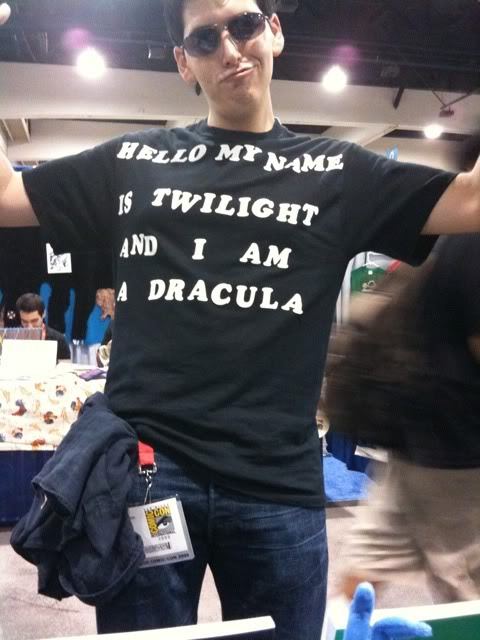
* It’s weird: There wasn’t a ton of news out of Wizard World Chicago Comic-ConFare this year, but what there was was almost all stuff from the corner of the Marvel Universe I’m interested in. To wit:
* Laura Hudson interviews Geoff Johns on Blackest Night for a good long while. Johns waxes philosophical about the Emotional Spectrum, the metaphorical import of the various Lantern Corps, the difference between Marvel and DC–basically a lot more than the usual promo-heavy interviews guys like Johns end up doing.
* Eric Heisserer wrote a multi-site web-fiction horror story called The Dionaea House that scared the shit out of me a few years back. Now I guess he’s a big-shot screenwriter who penned the remake of A Nightmare on Elm Street and is rewriting Battlestar Galactica helmer Ronald D. Moore’s screenplay for the prequel to John Carpenter’s The Thing.Heisserer talks about his Thing to Bloody Disgusting.
* I’m several days late and dollars short on this, but it sounds like Robert Rodriguez really is making a movie out of his Grindhouse faux-trailer Machete. Unlike John Carter of Mars and Red Sonja and Barbarella, this one actually has more people in its officially announced cast than Rose McGowan, so I think it might actually happen. And seriously, the cast is ridonkulous: Robert DeNiro, Michelle Rodriguez, Lindsay Lohan, Cheech Marin, Jeff Fahey, Don Johnson, Steven Seagal, and Danny Trejo. This is giving Stallone’s Expendables a run for its money.
* Colin: A Zombie’s Tale is an independent horror film from the zombie’s perspective. Sure, I’ll eat it. (Pun not intended, per se, but it’s not like I scrapped it and wrote something else, is it.)
* A hearty congratulations to FourFour’s Rich Juzwiak on his forth blogiversary. It’s been a long, long time since I went in for blogger triumphalism, but I think the emergence of a writer who could speak equally eloquently on America’s Next Top Model, the state of contemporary R&B, adorable cat videos, and Cannibal Holocaust was exceedingly unlikely prior to the emergence of blogs, so thank goodness they gave us Rich Juzwiak.
I didn’t laugh once while reading this book. Weird, right? The status of Brunetti’s previous gag-cartoon collections Haw! and Hee! (from which Ho! is largely compiled, though whether as a best-of or a complete collection is unclear to me) as trailblazers in the realm of going-way-too-far comic-book comedy is unquestioned; Brunetti made his bones while Johnny Ryan was picking up cheerleaders. And generally speaking, I’m down for the rough chuckles. In comics terms, I obviously really like Ryan and the astonishingly black comedy (or comic blackness) of Josh Simmons. Meanwhile, my favorite Monty Python movie is the nihilistic Meaning of Life, and among my favorite Tim & Eric sketches are the savagely misogynistic Carol & Mr. Henderson bits, Steve Mahanahan’s Child Clown Outlet, the Lynchian vignette where Casey Tatum gets kidnapped by Mahanahan and vomits in terror, and the “Business Hugs” video in which Leland Palmer instructs us on the best way to comfort a man after his wife suffers her third miscarriage. This shit should be right down my alley.
So what happened? It’s difficult to say why something you don’t find funny isn’t funny to you, particularly in a case like this, where Brunetti is intentionally working with material a lot of people would find anything but funny. But I’m not on their wavelength–it’s not the extreme nature of the gags (and they get fucking extreme) that’s turning me off. I suppose it’s the disconnect between the material and the execution? Brunetti’s impeccable line looks like it’d be more at home in the pages of The New Yorker than Sleazy Slice, which I imagine is the point, but for me at least, this just neuters all but the most vicious jokes–otherwise it’s just a litany of beautifully drawn dick/poop/pedo jokes. One that has likely been robbed of much of its power to shock and entertain by the similar work of Johnny Ryan, whose more buoyant, energetic line and use of the more expansive strip form rather than the one-panel cartoon gives his midnight-black gross-out stuff a brio Brunetti lacks.
To be sure, Brunetti occasionally serves up an amusing twist or wrinkle to the calvacade of horrors. I’m particularly smitten with the gag where a man’s wife walks in on him and the dog in flagrante delicto thanks to his strategic use of frosting; the guy’s sidelong glance and pause for thought before attempting to act shocked (“Um…Bad doggie! Bad doggie!”) is a hoot. The new comics Brunetti includes in the back of the book, drawn in his current, even more simplified style, are a fine show case of his geometric character designs, all round heads and curvilinear arms. For my money, the best jokes are barely jokes at all, but rather virtually unfiltered violence and rage: A man waving goodbye to his baby as he fills its bath with acid, another man shooting a woman in the head and barking “NOW you look sexy, whore,” a pair of men sitting in a bathtub filled with the blood of the dead woman hanging from a meathook above them and agreeing that this is better than sex. It’s enough to make you wonder if the gag cartoon’s potential for horror has ever been fully explored.
* Entertainment Weekly’s Owen Gleiberman pens a nice little paean to The Texas Chain Saw Massacre as “the template for modern horror.” I think that’s true, Dawn of the Dead‘s recent rehabilitation notwithstanding. Romero’s a hipper name to drop than Hooper (not surprising given their comparative oeuvres), his films combined horror and social commentary in the more-or-less explicit fashion mainstream critics appreciate, and there simply couldn’t be a zombie craze without him; but while Dawn was more haunting and/or biting than actually scary, watching Texas Chain Saw for the first time leaves you feeling like you’ve been in a car accident–a feeling aimed for not just by torture-porn standards like Hostel, but everything from The Blair Witch Project to the French horror wave to the modern zombie movies themselves. Tonally, the opening segment of Zack Snyder’s Dawn remake, and the entirety of the two 28 Days movies, owe a lot more to Leatherface than Flyboy. (Via Jason Adams.)
* Jesus Christ, it’s probably been ten years since I last watched Mike Leigh’s Naked, the subject of Scott Tobias’s latest New Cult Canon column for the Onion AV Club. (I have, however, listened to David Thewlis’s tour-de-force apocalypse monologue courtesy of the Orb’s “S.A.L.T.” quite a few times in the interim.) What a movie that was! I feel like the ending in particular is still at work inside me. I wonder how I’d feel about it today.
I can’t pretend to be an unbiased observer of these comics. Matt and Shawn are friends of mine from my bright college years; I’ve collaborated/am planning to collaborate on comics with both of them; I’ve even worked the Partyka table at conventions (though I’ve far more often freeloaded off of them). But this pair of goofy minicomics is as good an excuse as any to explain what I like about their skills as cartoonists and as packagers of their cartoons.
Whiskey Jack is a prequel of sorts to Shawn’s The Would-Be Bridegrooms, which itself was kind of like Kevin Huizenga’s Fight or Run before Kevin Huizenga’s Fight or Run existed. Instead of fighting each other to win the hand of a fair maiden, this time around the titular pair of shapeshifting braggarts fight a giant skunk to save the fair maiden’s life. They make a hash of it and the fair maiden proves more capable than either of them, as you’d expect. Shawn’s a specialist in combat, as Bridegrooms and his collaborative fight comic On the Road of Knives would indicate, but that’s not really the point here–the goal of Whiskey Jack is pretty much to show a Godzilla-sized skunk running around making fart jokes. The pleasure of the thing stems from how well-drawn the fart jokes are–I could watch Shawn’s intricate use of zipatone and his fine geometric character designs play out all the live-long day. I suppose your mileage may vary with a hand-stitched minicomic that culminates in a gigantic shit explosion, but I got pretty far with it.
Matt Wiegle puts out one or two quick gag minis a year, and Monsters & Condiments is his latest. It’s a series of seven monster portraits, presented as dishes from the menu of one Hercule Van Helsing: “Nosferatu with dried bonito flakes over mayonnaise,” “Redcap Dwarfs with trio of dipping sauces,” “Eldritch Horror from Beyond with fresh guacamole,” etc. It’s a treat for all you fans of the creepy-cute out there, that’s for sure, and if Matt did webcomics it’d be highly meme-able–but Matt makes exquisite little minicomics with silkscreened covers instead, so it’s presented with po-faced grandiosity that makes the conceit all the funnier. He’s got a real way with monsters, too (which I’ve taken advantage of in my collaborations with him), and in particular his use of black in each portrait creates pleasing and impressive transitions as you flip back and forth. Stop by the Partyka table at any given small-press show and there are any number of similar pleasures to discover.
Best of all, this interview is just the first in a loooooooooooooong series. When all is said and done, I expect to have interviews up with everyone involved in Strange Tales. As you can imagine this has been no small undertaking, and many thanks to Ryan Penagos, Aubrey Sitterson, Jody LeHeup, Ben Morse, Arune Singh, John Cerilli, and all of the creators for helping to make it happen.
* Heidi MacDonald’s San Diego Comic-Con report contains the most detailed and useful chronicle of the show’s possible security/traffic-management overreach and missteps this year that I’ve seen. For the most part, overreach and missteps are what it sounds like, as opposed to, say, the thoroughgoing lack of planning and dearth of informed staffers that made the first New York Comic Con such a mess. Fortunately, a lot of the problems Heidi describes seem like they could be solved by beefing up requirements for pro and press passes and subsequently really making them mean something in terms of access. Providing guest lists for the panels to the security guards would obviously help, too.
After her rundown of the security issue, Heidi moves on to the Great Hollywood Douchebag Invasion. I complained about this a bit last year myself. It’s not the Hollywood component of the show per se, it’s the (in the immortal words of Tool) smiley gladhands with hidden agendas who go with it that irk. Nothing infuriates the part of me that got beat up in fourth grade for liking G.I. Joe than seeing these moneyed jackasses descend upon my beloved Nerd Nation.
But then Heidi segues to a complaint about the big swanky exclusive Hollywood parties, which she laments that comics people can’t even get into. Here’s the thing: If they’re so full of douchebags, why would comics people want to get into them anyway? Who cares if they’re not inviting Darwyn Cooke?After all, it’s not like Spike TV took over the altcomix beach party and threw Kim Thompson out by the scruff of his neck. Before the Hollywood Invasion, these giant glitzy shindigs didn’t exist, and they’re not ruining anything that did. If comics people want to party so badly, they should throw their own parties. Yeah, they probably won’t be as lavish as the studio soirees, but comics isn’t as big as the motion picture industry, so why would they be that big? I don’t see why comics folks should feel entitled to hang with the Hollywood types just because the Hollywood types have an overactive sense of entitlement. Two wrongs don’t make a right and all that. And in my old age, discovering that other people nearby are having a more fabulous time than I am has ceased to rankle. I’d rather sit around a dinner table and talk to my friends than stand around amid hundreds of people I don’t know and shout to them. (I see Tom Spurgeon had many of these same thoughts.)
* Here’s another thing: I love the Con as a cultural phenomenon and therefore I love giant reports on the Con as a cultural phenomenon, whether as a reader or a writer. I am an all-purpose nerd, and Comic-Con is my Disney World. I think that for many media outlets, combining comics with general geekery is logical and desirable–I pushed for it at Wizard, for example. But here in the Comics Internet, we have the ability to generate giant reports solely on the comics news and comics releases and the overall comics presence at the con–and we should! I think it’d be very useful for more of the comics press to generate big after-action reports that didn’t have a single mention of stormtroopers or cosplayers or Twilight or Iron Man 2 or long lines or the party scene or what the flight was like or anything but interesting comics stuff. Next time I go to a big show I’ll try giving that a shot. If we want the comics component of Comic-Con to get more attention, we might as well be the ones who start paying it!
* Now That’s What I Call Torture Porn: Rick Trembles’ Motion Picture Purgatory tackles Graphic Sexual Horror, a documentary about an extreme, horror- and serial-killer-influenced S&M porn site shut down by the Feds under the dubious contention that porn funds terrorists, or something.
* Matt Maxwell continues to beat the San Diego Comic Con into submission with his word-mace: here, here, here. I think Matt’s perspective is valuable in that he’s a smart guy with articulately argued taste, but also because he’s writing about the show from a the insidery perspective of a seasoned pro, but leavened with plenty of open and honest acknowledgment that he’s still in some ways an outsider. To be frank, most comics commentators are too busy swinging their dicks around to be that candid, making Matt’s observations all the more worth noting.
* Believe it or not, The Blair Witch Project–the scariest movie I’ve ever seen–is ten years old this summer. The Horror Section’s Jay Clarke rounds up reactions and memories from a variety of horror bloggers, and offers up a few of his own. As I say every time Blair Witch pops up among the horror cognoscenti, I’m really gratified to see that the movie appears to have successfully weathered its massive backlash and is on the verge of canonization, if it hasn’t made it there already. (Via Rue Morgue.)
* Wow, cartoonist Lisa Hannawalt is all over the comics internet today. In addition to my review of two of her minicomics, both Scott McCloud and Ken Parille have extremely complimentary things to say about her new comic from Buenaventura Press, I Want You.
* Deep in my mental “someday, Sean, someday” file is a thinkpiece on Tim and Eric Awesome Show, Great Job!‘s use of horror as comedy. We may never get there, but in the meantime there’s this interview with Tim Heidecker and Eric Wareheim at VanityFair.com, in which they explain that for them, the horric awfulness of a disturbing David Lynch scene and the comedic awfulness of an awkward scene from The Office are essentially playing the same notes. (Via Whitney Matheson.)
* I ought to have linked to these before, but Douglas Wolk and Chris Mautner both reviewed David Mazzucchelli’s excellent Asterios Polyp. One thing to keep in mind about that book is that it doesn’t feel like homework at all–it’s a lot of fun to read!
There’s a lot to like about Lisa Hannawalt’s comics/doodles/stream of consciousness/what have you as presented in this pair of minicomics. (A third, Mistakes We Made was one of the Ones That Got Away from me at MoCCA 2009). For starters, she can draw like a motherfucker, with a razor-tight line that lends itself perfectly to manically detailed portraits of nattily attired human bodies with animal or insectoid heads. Those things are sort of like if Matt Furie based his similar work on wintertime Macy’s catalogs from the early ’80s, and could easily make her the toast of a hipster-illustration world that, bizarrely, seemingly can’t get enough of weird animal stuff these days. But she’s also got the mind of a sketch comedian, or perhaps more accurately an observational webcomics cartoonist of the sort who’s equally popular in an entirely different segment of the illustration-appreciating population. Her list-based strips, rolling out her thoughts on topics such as “Ideal Wedding Plans,” “A Typical Week,” “12 Things I Think About on My Way to Work,” and the strip on unlikely things that are sexy that gives the first mini its title, progress in a rewardingly and amusingly haphazard fashion, alternating short-and-to-the-point deadpan entries with lengthy and baroque ruminations that you have no doubt plagued her brain for minutes on end. In that “On My Way to Work” strip, for example, entry #9 is “Car Crashes”; entry #6 is this:
What Does the Factory Where Money Is Made Look Like and How Do They Keep Employees From Stealing It. Paper money is printed in large strips which must be cut by giant scissors. All of the little 20s must be furiously stamped by hand onto every $20 bill. Employees must strip naked and place clear packing tape over their genitals and bodily crevices. They receive excellent benefits and are exempt from paying income tax.
Needless to say, that’s all illustrated, in all its packing-tape-covered-buttcrack glory.
But if the goofiness of the gags conceal Hannawalt’s self-exposure with silliness, other parts of these minis do no such thing. Speaking as someone who suffered through a loooong car commute of his own for several years, I instantly related to her frequently referenced obsession with car crashes, and her unnecessarily detailed drawings of animals and entrails (occasionally combined), all of which I saw and/or thought about way more than was healthy during that time. Her approach to sexuality is similarly infused with a sense of “I just can’t help it”–witness the uncomfortable gag (no pun intended) about how she distracted herself at the dentist by thinking of oral sex, and the shame-tinged images that conjures for her; or the juxtapositions of imagery and text for the strip about things that are sexy, several of them hinging on dominance, submission, or even violence in a disarmingly direct way. (“A healthy appetite is sexy, and so is the act of obediently eating what has been given to you”; “Being patronized or humiliated can be sexy.”) Hannawalt’s skill set is varied and unique; she’s going to be part of Buenaventura’s damn-the-torpedoes alternative-comic-book line, and I’ll be looking forward to it.
When it comes to obsessively policing the “correctness” of works within their chosen genre, nobody beats horror fans.
Sure, sci-fi readers may have us matched when it comes self-defensive knee-jerk reactions to what we perceive as anti-genre bias in the mainstream. But nobody can get as hot when proposing what should and should not be considered as a valid addition to our pet genre. You couldn’t find a mystery fan who, even if their tastes ran towards the hardest of hardboiled crime fic, would not recognize the elegant classics of Elizabeth Daly, the juvenile Nancy Drew series, and the aw-shucks slapstick of Kinky Friedman as all belonging legitimately to the genre. Sci-fi guys regularly lay down definitions RE the scientific rigor of the romances they read, but they know it’s bullshit: Not a one of them wouldn’t count Philip K. Dick among their number and his works are about as scientifically rigorous as The Great Space Coaster. I can’t imagine you hear many romance novel readers say, “I don’t consider romances between nurses and doctors to be real romance. It’s either lusty pirates with good hearts and the clever, but sheltered – don’t forget sheltered, sheltered is the whole thing! – daughters of wealth shipping magnates or nothing!”
Last year there was a lot of kvetching from the nerd press about access, a lot of which I thought was a simple failure to take into account the size and scope of the 21st-century Comic-Con experience. And honestly, I was pretty surprised that Rob’s corporate overlords expected him to cover the thing all by himself–that’s exactly the lack of realistic expectations I was talking about. (They could at least have sprung for a guestblogger to keep the home fires burning with links while Rob was out and about at the show.)
But I also pointed out last year that the show’s press pass is pretty much useless as anything but a regular pass that sometimes can get you into the building, though not the exhibit hall or panels, a little early. When you’re handing out 3,000 press passes out of a total attendance of 125,000, why bother? So I agree with Rob and Tom Spurgeon and (I think) Heidi MacDonald and probably plenty of other people that the Con needs to be way more stringent about press credentials, scale back the number of press passes they issue accordingly, but then scale up the rights and privileges afforded to the press they do let in. I appreciate the show’s egalitarianism w/r/t the pass policy currently, but I think the costs outweigh the benefits at this point.
Meanwhile, the way I was able to get done all the coverage I needed to get done last year was by sitting on the floor and posting stories using the convention center’s free wireless whenever I could. When you’re on deadline in the midst of an event the sheer physical size of Comic-Con, being able to post wherever, whenever as opposed to schlepping to the press room or god forbid your hotel can be the difference between success and failure. This year, not only was the wireless completely unreliable, but I’ve also heard that security would prevent people from simply sitting down in the hallways from time to time. Either one of these scenarios would have been a complete dealbreaker for my ability to get my work done last year, and it’s imperative that the show solve these problems next year.
Finally, between the Iron Man 2 debacle Rob describes, in which the room wasn’t cleared beforehand and therefore thousands of people who spent hours waiting in line in the sun to get in couldn’t get in, and Tom Spurgeon’s anecdote about how halfway through cartoonist Richard Thompson’s panel security started letting in people for the next, very different, panel, it seems that the increased number of security personnel/traffic wranglers didn’t translate into an increased quality of security or traffic flow. Now, moving that amount of people around quickly enough to start things on time is a very difficult challenge; and suppose you really want to see two things in a row, you’re not just in the first thing to save yourself a seat for the second thing, but you’re forced to choose because they clear the rooms each time? So maybe they need to make exceptions with obvious crowd magnets like Iron Man 2, I dunno. But it’s a problem, and in that particular case it seems like it was an anticipatable problem. If they can shuffle around panels on the fly to avoid a Twilight/Avatar collision, surely they can put a little thought along similar lines into everything else going on in Hall H at the least.
* Comic-Con criticism I can’t get behind: Avoiding the usual variations on “Twilight is icky,” Chris Butcher deploys a novel line of attack against that franchise’s presence at the show: 6,000 Twilight fans at Comic-Con only for Twilight take 6,000 tickets for potential comics buyers out of circulation. Which I suppose is true, strictly speaking, but only if you buy the many, many assumptions that go into that statement, which I don’t.
First, how do you know that the majority of fans at the Twilight panels didn’t buy comics–or any of the many, many other products on sale at the Con?
Second, how do you know that if they were all magically vaporized, their thousands of tickets would be snapped up by comics fans, as opposed to people who are just there to see James Cameron or Peter Jackson or the Venture Brothers guys or any of the countless other non-comics fandoms at the show?
Third, now that I mention it, why single out Twilight in the first place of all of said countless other non-comics fandoms? I don’t think Chris is at all on the “ewwww Goths/girls/tweens” tip that lots of other Twilight critics are on, but at the same time, how many members of the 501st Stormtrooper Legion do you see at the Fantagraphics booth?
Now, you could easily answer the above questions like so: “First, I don’t care about the non-comics stuff on sale at the show, only comics matter; second, and third, we should try to reduce the presence of all those other fandoms too.” This is what Chris appears to be advocating with his call for an ideological litmus test to be applied to potential Con exhibitors–an Office Space-style mantra of “Is This Good For The Comics?” This is more coherent point of view than simply singling out the Frowned-Upon Fandom of the Year, but it’s not a terribly valid or useful one.
Comic-Con has always been a cross-media extravaganza–it’s just gotten much better at being one in recent years. It never was and will never be Angouleme, or Heroes Con for that matter. You could look at the Hollywood/videogame/assorted-nerdery component as the tail that wags the dog if you want, but at this point the dog is a chihuahua and the tail is like one of those 200-yard-long Batman capes drawn by Todd McFarlane. It doesn’t make sense on a business level, or on an overall customer happiness level, to start asking Robert Pattinson if he read Asterios Polyp before you allow him to attend the show. And it doesn’t make sense to hold Comic-Con to a “for comics, by comics” standard which has little basis in the fact of the show as it’s existed for years, and which would make it an entirely different and less successful show.
That said, there are a lot of things that can be done to preserve and enhance the comics component of Comic-Con within the Con’s current identity and framework. Most of them involve not penalizing the movie fans and gamers and Klingons and whatnot, but boosting cooperation between the Con and the comics industry, or just within the comics industry itself, to make sure that the art form’s anchor presences at the show are respected and perpetuated. Here’s another idea: Nine Inch Nails is releasing tickets to its final concert tour in three waves–first through a NIN.com members-only presale on the NIN.com website, second through a password-protected presale on the Ticketmaster website, and third through the usual Ticketmaster/box-office procedure, all staggered by a week or two. Plus, most venues hold back a handful of tickets that they release only on the night of the performance. Couldn’t Comic-Con do the same in order to accommodate different demographics with different levels of advance awareness and interest in the event, thus (ideally) giving casual fans who are more likely to swing by and browse for books rather than camp out overnight for the Lost panel a foot in the door?
The point is, pointing the finger at specific fandoms isn’t the answer any more than pointing the finger at all fandoms is. Comic-Con is what it is; it’s easy to go there and have a tremendous show as a comics reader; it’s harder but still eminently doable to make the comics component of the show stronger and more accessible. Twilight has nothing to do with it.
* As you probably discovered yesterday, which was when I meant to post this, the trailer for the Coen Brothers’ upcoming movie A Serious Man is pretty terrific.
This is pretty much exactly what the minicomic was invented for: A lovely little object designed as a showcase for an entertaining idea expressed through formal play. It’s a comic book, not a graphic novel or an anthology, and you get the sense that Mark Burrier, a talented illustrator who’s been serving up gorgeous minis like this for some time, wouldn’t have it any other way. Content-wise, it reads like a stand-up comedy version of Anders Nilsen’s Monologues characters–barely-there stick-figure outlines falling apart, only instead of spouting philosophical snippets in order to show the inadequacy of such frameworks in light of their plight, they’re just being dicks to each other. Various legless characters say things like “You think you’re better than me?” or “I don’t feel like getting up today,” while the more fortunate in the leg department either self-deprecate (“You only love me for my leg”) or condescend (“I’m so embarrassed for you”). My favorite gag, however, is a non sequitur: Standing on his single remaining leg and speaking into a microphone, one figure says “This is such a surprise! I don’t want to forget to thank anyone.” Maybe that’s a statement about how even the elite have their inadequacies, or maybe it’s just a funny thing to do with a one-legged stick figure. Who cares when the cardstock covers have such a killer endpage design? This is a slight thing, but it’s the slightness that makes it feel like your 300 pennies were well spent.
* Nothing has made me regret missing the San Diego Comic-Con this year more than taking a gander at Rickey Purdin’s eye-melting gallery of his Watchmen sketchbook haul for the show. Gabriel Ba, Ross Campbell, Travis Charest, Jordan Crane, Nathan Fox, Matt Furie, Sammy Harkham, Derek Kirk Kim, Fabio Moon, Tom Neely (not pictured for NSFW reasons), Johnny Ryan, Jeff Smith, Mark Todd, Esther Pearl Watson…insane.
* CBR’s George A. Tramountanas has posted a report on the Lost panel. It sounds like Damon Lindelof and Carlton Cuse (and Jorge Garcia and Michael Emerson and Josh Holloway and Nestor Carbonell and Dominic Monaghan) primarily designed the panel as a comedy-hour payback for the SDCC faithful^. It’s a smart way to go, given how pretty much anything they could really reveal about the final season of that show would be a spoiler by necessity–the season is short and the dangling plot threads that need to be tied up are so many that it will probably occupy every available second of airtime. Anyway, the panel sounds like a scream, particularly the gratuitous dig at Heroes, which I still resent for its mercifully brief but grossly exploited and ultimately ridiculous and unsustainable eclipse of Lost in the fickle hearts and minds of nerddom circa Lost Season Three and Heroes Season One.^^
* Holy smokes, check out the partial table of contents for The Comics Journal #300. In conversation: Kevin Huizenga and Art Spiegelman, Sammy Harkham and Jean-Christophe Menu, Dave Gibbons and Frank Quitely, David Mazzucchelli and Dash Shaw, Alison Bechdel and Danica Novgorodoff, Ho Che Anderson and Howard Chaykin, Denny O’Neill and Matt Fraction, Zak Sally and Jaime Hernandez, Ted Rall and Matt Bors, Jim Borgman and Keith Knight, Stan Sakai and Chris Schweizer. Seriously, holy smokes.
* Writing for the Onion AV Club’s “Gateway to Geekery” column, devoted to giving newbies starting-point recommendations for various nerd-beloved but daunting series and oeuvres, Leonard Pierce tackles Love & Rockets in what strikes me as an inaccurate and ill-advised fashion. For one thing, the comic hasn’t been “reputedly monthly” in years, so it’s weird to even discuss it in those terms. But more importantly, if you’re trying to give people a starting point, why recommend the gigantic, unwieldy, expensive hardcovers (don’t get me wrong, they’re awesome, but they’re not for beginners) when both Gilbert and Jaime’s work has now been collected in a less expensive, more complete, more welcoming series of softcover digests that can give you a taste without breaking either the bank or your back? Try reading the Palomar or Locas hardcovers on the subway, I double-dog dare you. For pete’s sake, the place to start with Gilbert/Palomar/Luba is Heartbreak Soup, the place to start with Jaime/Maggie/Hopey/Izzy/Locas is Maggie the Mechanic, and the place to start for both brothers’ other stuff is Amor y Cohetes. You’re welcome, world! (Link via Curt Purcell.)
* The AV Club acquits itself more admirably with Scott Tobias’s latest New Cult Canon column, on Tim Burton’s Beetlejuice. Pre-Hot-Topic-hackdom^^^, Tim Burton really was a wondrously inventive and funny director–his first Batman film is still the best superhero movie ever made by a comfortable margin–and Beetlejuice was really a doozy. (The Missus and I wonder aloud why Otho isn’t an oft-quoted cult hero on a regular basis.) I was particularly intrigued by Tobias’s linking of Heath Ledger’s performance as the Joker in The Dark Knight to Michael Keaton’s turn as the title character here.
^ Being in the audience for the sneak preview of the show’s pilot episode at Comic-Con 2004 remains one of me and the Missus’s great geek claims-to-fame.
^^ I was in the belly of the nerd beast at that time, running WizardUniverse.com’s weekly roundtable discussions of Lost, and the way some of the company’s, let’s say, “aesthetically challenged” staffers kicked the show to the curb in favor of slobbering all over the Save the Cheerleader nonsense was enough to make you chew your own foot off.
^^^ This is not a slam on Hot Topic, which I love. But you know what I mean.
* Fantagraphics’ Eric Reynolds walks back his perceived gloom and doom about the state of Comic-Con and the role of the small press and retailers in it. He notes that Fanta has reduced its SDCC presence in the recent past without noticeable detriment to itself or its consumers, and any future reduction next year or whenever will likely be similarly seamless. He also says that though this year’s sales were a drop-off from last year’s, last year’s were probably their best ever and not plagued by the recession that began in earnest last fall. But he warns that there’s a lot of grumbling in altcomixville.
* The Robot 6 crew runs down 15 SDCC announcements they’re excited about. JK Parkin catches something I’d missed, namely that Kurt Busiek will be taking Astro City monthly following the completion of the loooooong-running Dark Age megastory, and will also be launching a new American-myths series called American Gothic.
The most inscrutable of the Cold Heat Specials thus far, which is saying something, this second Santoro/Milburn CHS collaboration in a row is also the least action-oriented thus far. In its 17 story pages (I tend to count minicomic covers for the official page count up top), Cold Heat heroine Castle putters around a castle, appropriately enough. As light from a fireplace, a candle, and eventually dawn illuminates her and her surroundings, she gazes upon a painting and into a mirror, whereupon the figure from the painting appears to come to life…or does he? Whether the sword-wielding horseman is a ghost or just a figment of her imagination is immaterial: The point is to use Castle and her surroundings to evoke the experience we’ve probably all had of being up late at night, alone in the barely staved-off dark, our thoughts running wild in the emptiness.
With each page done in a two-color silkscreen riff on Cold Heat proper’s pink and blue color scheme, the book is a thing of beauty–unsurprising, for comics-makers of Santoro and Milburn’s obvious talents. What is surprising is Milburn’s proficiency for this sort of tone-poem of a story. Most of the Closed Caption Comics veteran’s work that I’ve seen thus far has been geared toward the monstrous, so watching him work off Santoro’s layouts in an experiment to see how best to convey firelight and insomnia is a treat (even if I had to read the thing twice to make sure I understood what was happening–or what wasn’t happening). As is frequently the case with PictureBox products, the price point appears designed to actively punish the casual reader, but to be fair this is about as geared toward someone whose bookshelf’s only graphic novel is Maus as Final Crisis Aftermath: Ink is aimed at someone who bought The Dark Knight off an endcap at Wal-Mart. It’s for we few, we proud, we artcomix aficionados, and lucky for us.
1) “A successful convention rarely leads to increased industry success because the infrastructure is damaged in fundamental ways — or has a hitch step — that keeps this from happening.”
Tom’s right that the San Diego Comic-Con offers an ability to put comics-friendly asses in seats, to make mainstream-media waves, and to provide people with an enjoyable experience that runs the gamut of comics as both an art form and a cultural phenomenon, that is not just unequalled but completely unapproached by the comics industry and its organs for the other 51 weeks of the year. This isn’t really a criticism of cons, and actually Tom’s not really phrasing it as such. But there’s not much to disagree with there, either in general or in the specific areas in need of improvement that Tom cites.
That said, this is just one thing I’m focusing on out of many that I totally agree with, but I think Tom curiously downplays the ability of online retail to compensate for the lack of a real, durable, nationwide, catholic comics retail infrastructure. To cite a similar case, it’s a shame that there are entire regions of the country where the only record store around is the odiously censorious Wal-Mart, but assuming people in those regions have an internet connection, or a library card that gives them access to that library’s internet connection, they actually have better access to every piece of music in the world than I did back in 1994 when I could roll into Halo Zero and pick up whatever KMFDM singles they happened to have in stock. By that same token, it’d be nice if everyone had a Jim Hanley’s or a Comix Experience or a Beguiling within biking distance, but everyone does have an Amazon.com. Perhaps I lack the nostalgia gene for the ideal comics shop experience–I loved my local shop when I was buying supercomics in high school, and they steered me to things like Sin City which was nice, but I don’t remember seeing much Love & Rockets there. But I think the new generation of potential comics readers is going to be accustomed to shopping online anyway. Are we losing something that could be provided by a vibrant Direct Market rather than the two-publisher tango we have now in all but a handful of stores? Absolutely, the same way we lost a lot when mom-and-pop video stores staffed by knowledgeable movie buffs were destroyed by Blockbuster–only in comics’ case, there’s no Blockbuster either! In terms of developing lifelong consumers of comics, I’d imagine that even Amazon’s best sales and marketing program isn’t worth one Chris Butcher or Brian Hibbs or Vito Delsante. But I wouldn’t simply consign “shopping online” to a list of things people are unfortunately forced to do because of the inadequacy of America’s Android’s Dungeons. Online is a vibrant market of its own. And as digital comics increase in prominence, that market will only grow more robust.
2) “Conventions are growing in popularity not because of their subject matter but because of the intensified nature of social interaction with the advent of on-line communication.”
Well, yeah, but since that social interaction stems from a shared love of comics, isn’t it kind of six one way, half a dozen the other? Also, hasn’t the purpose of cons always been social interaction with your fellow travelers? Perhaps what Tom’s saying is that if you come to Comic-Con with “I can’t wait to hang out with my friends I never get to see anywhere else” as your priority, your dollars are more likely to be spent at Dick’s Last Resort than at Comic Relief, your time more likely to be passed at Jeff Katz’s party than at Lewis Trondheim’s panel. I’m not sure if I’m 100% persuaded of that. Every year I’ve gone, I’ve spent plenty of time and money on both.
I do appreciate Tom’s call for a more curated, festival-style approach to be incorporated into the big shows, however. Obviously there’s an effort made along those lines at the small-press shows, while I think Dustin Harbin’s altcomix outreach at Heroes Con 2008 might well have qualified in terms of the mainstreamy mid-level shows. On the other hand, you can obviously write off all the cons run by the Shamus Brothers and their current and former associates. For all intents and purposes that leaves the shows run by the Comic-Con organization and Reed, and you know what? I think there’s potential for both if someone seizes the initiative and works his or her ass off for a festival component. That’s really worth thinking about.
3) “The more successful a convention becomes, the more it may preach to the choir.”
Last year, pre-Twitter (or at least pre-me-on-Twitter), I would have agreed to this without hesitation. 2008’s five-day sell-out and dire hotel-vacancy situation indicated that in the future, the only people who could rely on even getting into the Con at all were the people who knew enough about it and were sufficiently motivated about it to buy tickets weeks, even months, in advance.
This year, though, clicking on the Comic-Con trend tag on Twitter revealed tons and tons of “civilians” who seem even more interested in Comic-Con now that it’s become a Cannes-style phenomenon. Obviously we’re probably mostly talking about people who are interested in the Hollywood component of the show rather than checking out what Boom or Buenaventura have at their booths, but at the very least the awareness of the show is at an all-time high.
Whether that will translate into non-lifers buying their passes in March or whenever it is they go on sale is another issue. The show, and comics as an entity, probably ought to try to ensure that they will. Perhaps the show could reserve a sizable block of tickets for day-of purchases, or at least for advance purchases that are nevertheless within a reasonable time frame for non-nerd awareness of the show to peak.
To back Spurge up wholeheartedly, though, there’s Eric Reynolds’s sobering con report. Eric explicitly states that the increased attention to the Hollywood component of the con is both keeping people who might be interested in the small press’s wares away from the show altogether, and preventing those who are at the show from using their time to do anything but wait in line for and attend Hollywood panels, thus leading to a surprising and shocking sales drop-off on Saturday–once the busiest sales day of the show by a country mile, it’s now seeing the merchants crushed by competition with the big-ticket studio and network presentations. I know that by “festival component” Tom means an arts-celebrating aspect of the show divorced from mercantile concerns, but I can’t help but feel that the former would help the latter here.
4) A flea market is still an odd way to meet the world.
That’s true. It IS weird going up to heroes like, I dunno, Los Bros Hernandez, people who you just wanna shake hands with and say hello to and stand in awe of, all the while cognizant of the nearby pile of their books and employees (or even the creators themselves!) ready to take your cash in exchange for those books. Then again, with the exception of that country music Fan Fest, is there any other art form in the world that provides this level of access to the giants of the field? I’ve long said that going to a small-press show in particular is a bit like going to a family reunion where every time you end up making smalltalk with a distant cousin, you have to pay him five bucks for his minicomic, but to me that awkwardness is a small price to pay to be able to get a Seth sketch of David Bowie for free.
Still, this is entirely unobjectionable and admirable:
The only thing I might suggest is that the wider culture and industry entire make it a goal at their major shows that the experience be worth having if not a single dime is spent on purchasing anything once within the walls — paying close attention to programming, bringing in more festival aspects, having focused signings that aren’t in a commercial context and may even feature giveaways.
It’s important to remember that Tom isn’t one to pronounce Comic-Con “nerd Altamont,” nor share in Chuck Rozanski’s annual obituaries for the event, nor kvetch about how Comic-Con is a misnomer due to the presence of Twilight or Lost. Just take a look at his regular con report, where he trumpets the various extremely comics-y news stories that broke at the show (from Nancy to Parker to Wilson to Marvelman to Bone) and rightly points out that if you have a mind to do so, you can have an absolutely kickass comics experience with minimal effort. Somewhere between cheerleading and doomsaying lie the posts and policy prescriptions we’d do well to take heed of.
* Many of my friends aren’t yet back and/or mobile following Comic-Con, but the consensus seems to be that it was a slow-news con.
* Marvel’s Marvelman announcement, though light on details regarding the character’s most contentiously litigated material, seems to top the comics list. I’d imagine a lot of folks are excited about Fantagraphics’ plans to reprint Ernie Bushmiller’s Nancy, and I was pretty struck by Daniel Clowes’s move to Drawn & Quarterly with Wilson. DC’s biggest announcement appeared to be the foregone but welcome conclusion of Geoff Johns writing an ongoing All Flash series.
* That said, I haven’t heard much grousing at all. The main complaints I’ve heard–aside from the usual aesthetic/philosophical objections about what Comic-Con has become, some of which strike me as reasonable, others like a race to be the first person to stop applauding–seemed to be overzealous security, an overcrowded floor on Preview Night (due to the lack of an aggressive programming track in the panel rooms), dauntingly long lines for even more things than usual, and an organizational clusterfuck at the Iron Man 2 panel. It’s still early, though, and maybe we’ll get a wave of press-access complaints like we did last year, perhaps backed up with more specifics this time.
* The biggest and best news I hadn’t heard in any official capacity is that the great Eric Reynolds has been promoted to Associate Publisher of Fantagraphics. I guess when you promote your PR guy, your PR may momentarily suffer, but now that I’ve heard this, I couldn’t be happier. Is there a person in comics who’s better at his/her job, or more universally beloved, than Eric?
* A very busy boy indeed, Kiel also spoke with Comic-Con PR maestro David Glanzer about this year’s show. I was interested to hear Glanzer’s response to Kiel’s question about press run-ins with security couched in terms of dramatically increasing the number of personnel to help manage traffic. It does seem to me, however, that press passes probably need to be afforded more privileges, perhaps accompanied with more stringent guidelines as to who can get them.
* By popular demand, Chris Butcher liveblogs the July 2009 Previews catalogue. It’s very funny and angry as usual, particularly regarding Marvel’s decision to give work to serial robber of freelancers Pat Lee, but sprinkled in there are a couple of genuine news items (at least they’re news to me), namely that Ex Machina is ending with #50 (less than a year from now if it resumes a monthly schedule) and original artist Cory Walker is replacing subsequent mainstay Ryan Ottley on Invincible.
With the release of his Fantagraphics graphic novel The Squirrel Machine slated for this fall, perhaps Hans Rickheit’s days with the most lopsided talent-to-recognition ratio in alternative comics are nearing their end. Or perhaps not. “Alternative” certainly describes what he does but does not do it justice; “underground” comes closer, as it does with Josh Simmons, who in recent years has become the closest thing to a comparable figure to Rickheit that exists. Actually, “somewhere between Josh Simmons and Jim Woodring” wouldn’t be a horrible way to describe Rickheit’s work. Like those artist, Rickheit’s comics are often exploratory in narrative, with guileless naifs–Rickheit’s Cochlea and Eustacea, and his anonymous teddy-bear-headed protagonist; Simmons’s Jessica Farm, Cockbone, and the House guests; Woodring’s Frank, obviously–wandering through a wondrous, slightly nauseating, frequently eroticized, even more frequently horrifying environment seemingly constructed with raw shards of the artist’s own unconscious. In place of Simmons’s squalor and Woodring’s psychedelia, Rickheit has fused together a singular amalgam of Victoriana and body-horror, like Videodrome gone steampunk. His elaborate structures and machines are frequently revealed to be of inscrutable purpose and surrounded by vast expanses of nothing in particular, outposts of a forgotten or unknowable civilization. His line is crisp, perfect for the ornate detail of his machinery or the endless desert of rocks that surround them; his character designs, from Cochlea and Eustacea’s revealing tutus to the teddy-bear man’s natty ascot, gloves, and boots, are rock-solid; his environments and action are always easy to parse; and his central images, from a skull-headed rabbit towering about on giant Cloverfield/The Mist legs to a floating bed tethered to a tower to keep it from soaring away to countless instances of tiny worlds hidden within orifices, are dreamlike in the most direct and impactful sense. He’s one of my favorite cartoonists. If you’re curious about The Squirrel Mother and looking for Hans Rickheit 101, buy this minicomic and your search is over.