Her is a movie in which a nebbishy dotcom writer named Theodore Twombly dates Amy Adams, Rooney Mara, and Olivia Wilde and falls in love with a computer voiced by Scarlett Johansson. I promise you, I fucking promise you, no matter how many five-star reviews and best-of-the-year lists you come across: Whatever picture you have in your head of what such a film will feel like, that picture is correct. None of the film’s strengths — most of which, from Joaquin Phoenix’s feature-length Michael Stuhlbarg impression to some cute 120-minutes-into-the-future costume, game, and tech design, are minor; one of which, its frank and explicit treatment of sex as a component of love, is mitigated by pretty goddamn goofy voice-overacting; only a few of which, namely a small handful of its many many many conversations about falling in and out of love in the context of long-term relationships, have any heft behind them — make it worth seeking out before it winds up on Netflix Instant, or pretty much watching at all if you suspect you’d rather just rewatch Eternal Sunshine of the Spotless Mind (scripted by director Spike Jonze director Spike Jonze’s collaborator Charlie Kaufman) instead. Its biggest problem is baked right into its premise: Samantha, the computerized “her” of the title (which weirdly forefronts this computer program’s nature as a nonspecific and inscrutable female, which should set off alarm bells for you right there) is a creature of pure thought and speech, so nearly everything of note in the story is told rather than shown. With the ironic exception of a single, memorable, lengthy cut to black, the film basically never allows its visual component to do any heavy lifting. All the pretty colors, the L.A. cityscapes, the fancy simulated operating systems and video games — it’s all window(s) dressing.
Movie Time: Her
Movie Time: Inside Llewyn Davis
Or Introducing Bruno Delbonnel, stepping in for MIA cinematographer/genius Roger Deakins and (re)creating the grey winter awfulness of New York City so convincingly it felt less like a lighting scheme and more like a ceiling you might bump your head on. Inside Llewyn Davis, for all its subwaying and roadtripping and general peripateticism, is a claustrophobic film, a film about how having no commitments can root you to the spot just as surely as a square life. It can be seen as the third film in the Coen Brothers’ Trilogy of Calamity, with Barton Fink and A Serious Man, but here the calamity is ongoing, not a new thing that starts with a move to Hollywood or the sudden caprice of Hashem. (I suppose you could even squeeze No Country for Old Men in there too if you want, but again, no stumbling across drug money.) Llewyn Davis has been in a folk-scene funk for some time, a depression he shows no signs of exiting. Indeed, a clever bit of editing that could be taken as showing us a pivotal sequence out of order is ever so slightly recut so that we could simply be witnessing subtle variations on the same unending cycle — Sisyphus, Groundhog Day, the Möbius. Certainly the presence of a key figure at film’s end indicates Llewyn’s career will only go so far. The funny thing, the different thing, is that he’d more or less resigned himself to it by that point anyway. He’s not a delusional man, nor does he react to his plight with especially outstanding rage. He’s difficult but not impossible, cruel at times but only when driven to exhaustion by the failure of kindness to produce amicable results. He’s neither a delusional hack nor a tortured genius — he’s a talented guy who knows the limits of his talent but hopes to catch a lucky break. None is forthcoming. Joel and Ethan Coen have made much blacker movies than this one; Inside Llewyn Davis is the Coen Brothers at their greyest.
Movie Time: The Hobbit: The Desolation of Smaug and The Wolf of Wall Street
There’s an invented scene in Peter Jackson’s second Hobbit movie (SPOILER ALERT, I GUESS) where Thorin & Company fire up the forges of the Lonely Mountain while dodging an awoken and enraged Smaug the Golden. River-like torrents of molten gold pour into a mold of (presumably) Durin, the ur-Dwarf, that’s about the size of a medium-sized office building. Smaug stares at it enraptured until the heat causes it to break form and gush golden death all over the dragon. Wealth, weaponized. Find all the metaphors for a three-film Hobbit adaptation you like in that scene, go ahead, knock yourself out. Certainly this film’s herky-jerky rhythm, and its need to surround every emotional turning point with an invented ten-minute action sequence, will give you plenty of fuel for the fire. But ultimately Smaug rises again from that lake of fire, bellows a mockery of the Dwarves’ attempt at revenge, flies up into the night sky gilded with real actual gold, shakes it off into a million droplets like a sheepdog drying off after a bath, and flies off toward Laketown to burn it to ashes while shrieking “I AM DEATH.” If I get to see something like that at the movies, Peter Jackson can melt down all the rivers of gold he wants.
Wolf was more fun than Good, and I say that as someone whose favorite Martin Scorsese movie is Casino. One of the reasons it feels a bit light in the end is that we never meet any victims of the penny-stock scams at the heart of the thing, just the scammers and their trials and tribulations. In a sense, that’s Scorsese’s approach with GoodFellas and Casino as well, but in those films the characters frequently turn on and kill each other, so you’re made to understand that the criminality has real-life consequences even if only on other criminals. You see victims; they just happen to be the victimizers as well. This, on the other hand, is just DiCaprio and Jonah Hill being really funny for three hours, with tons of naked women and quaaludes. Which I liked, don’t get me wrong, but it’s almost like Scorsese and Terence Winter (Boardwalk Empire impresario, hence a couple of notable BE castmember cameos) went out of their way to reduce the working-class schlubs DiCaprio and his merry men and women stiff to disembodied voices on phones. (EDITED TO ADD: The major exceptions are Belfort’s toddler daughter, whom his inebriated behavior terrorizes, and his second wife, whom at his nadir he physically and sexually assaults; but the rhythm of the sequence in which that occurs is such that its impact is diluted first by her turning her own rape into a way to best and humiliate her husband, then by a transference of Belfort’s threat from her to the kid. Moreover she’s portrayed as so slight a person — no Karen Hill, no Ginger Rothstein — that it’s weirdly unclear how much she’s ultimately fazed by it.) Still, as I said, really funny. A lot of it is a love letter to the grossness of Long Island, which I enjoyed, and of course the idea of just doing a one-to-one transfer of his mafia-movie style and story structure over to Wall Street is scathing and hilarious. Rob Reiner’s introductory scene had me convulsing with laughter, which I’d forgotten is a thing. Jon Bernthal erases the stink of The Walking Dead every second he’s on screen, so wholly does he commit to his ridiculous Jewish-goombah drug-dealer character. There are close-ups of Hill’s face, and an entire ‘lude-dosed fight scene, that could have come straight out of Tim & Eric’s Billion-Dollar Movie. It’s a pleasure to see Scorsese work with DiCaprio in full charismatic movie-star mode versus the aging-babyface anger he forefronted in, say, Gangs of New York and The Departed. And he’s making an argument that the best sociopaths extend their little reality bubble outward to a few trusted associates — do that and you can get away with almost literally anything. Wolves hunt best in packs.
Spurgeon/McCulloch/Collins
Over at The Comics Reporter, Joe “Jog” McCulloch and I talked about the year in the alternative comics business (as opposed to the art form) with Tom Spurgeon. Note: The end of the interview was cut off—it should read “we cannot get out. The end comes soon. We hear drums, drums in the deep. THEY ARE COMING”
Boiling that leather
Go ye and listen to the landmark 25th episode of The Boiled Leather Audio Hour, in which Stefan Sasse and I discuss the recently released preview chapter for The Winds of Winter. War, huh, good R’hllor y’all, what is it good for?
Comics Time: Exorcise Book and Habit #1
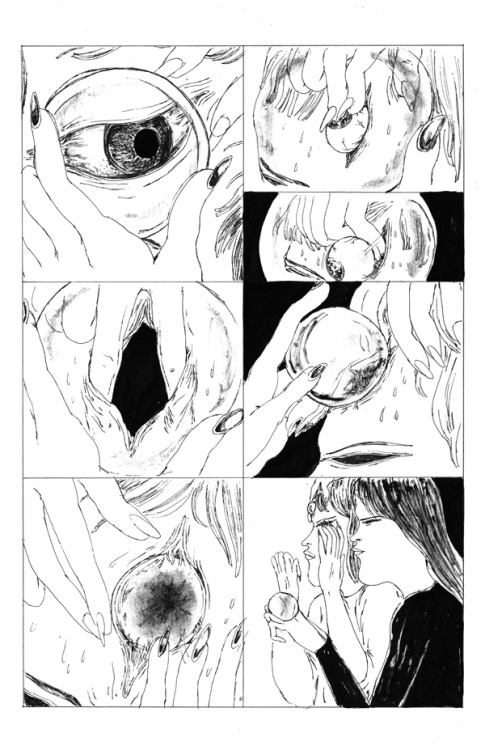
I wrote about two of my favorite comics from 2013, Heather Benjamin’s Exorcise Book and Josh Simmons’s Habit #1, for Zainab Akhtar’s year-in-review series at Comics & Cola.
Before they bring the curtain down
I’ve started a tumblr called Badge where I’ll be aggregating incidents of police brutality/overkill/overreach in America without comment.
“Homeland” thoughts, Season Three, Episode Twelve: “The Star”
I reviewed Homeland‘s season finale for Rolling Stone. An exercise in undercutting what little value the show still had.
I’m livin’ on the air in King’s Landing
I think I’ve neglected to mention it for a while now, but my comrade Stefan Sasse and I have resumed episodes of our podcast on George R.R. Martin’s A Song of Ice and Fire, the Boiled Leather Audio Hour. You can find the new episodes here — the one that went up today discusses Martin’s new novella set 200 years before A Game of Thrones, “The Princess and the Queen, or, the Blacks and the Greens.” Enjoy!
Relocation
All my Vorpalizer posts about comics and genre art are now housed at http://seantcomics.tumblr.com and http://seantculture.tumblr.com . Thanks.
FLASH FORWARD FOR SALE
A limited number of copies of Flash Forward, my new minicomic with Jonny Negron, are available via Jonny’s bigcartel store. If you’d like one you can buy one for $4.
BIEBERCOMIC
Michael Hawkins and I have completed BIEBERCOMIC, our comic about Justin Bieber. You can read the whole thing on one page at the link. We hope you enjoy it.
“Homeland” thoughts, Season Three, Episode Eleven: “Big Man in Tehran”
I reviewed last night’s episode of Homeland for Rolling Stone. Juuuuust about had it with this thing.
Fantagraphics and PictureBox
Fantagraphics is the greatest comics publisher of all time. No company, in any field, has made products that mean more to me than Fantagraphics’. Their co-publisher Kim Thompson died too young and took a lot of counted-on revenue with him, so they launched a Kickstarter that’s in its final hours right now. The rewards are almost parodically plentiful, varied, and worthwhile; I’ll be getting a customized pair of Chuck Taylors, naturally. I urge you to give if you haven’t already — it’s basically shopping, not giving, but either way, the company that basically created alternative comics could use your help.
PictureBox is the greatest comics publisher of the 21st century. Any one of several projects published or edited by publisher Dan Nadel would make him and PBox a publisher for the ages: the work of Japanese experimentalist Yuichi Yokoyama or prescient Providence art-comics collective Paper Rad, editing the canon-disrupting classic-comics collection Art Out of Time or the paradigm-shifting magazine of alt/genre comics criticism Comics Comics. PBox also did a huge service for alt/art comics by situating them in the larger context of visual culture — in publishing collections by everyone from Richard Kern to Hipgnosis to the Hairy Who to Destroy All Monsters in addition to the best-ever books by, say, Brian Chippendale and Renee French, Nadel was making a case for commonalities that might otherwise have gone un-remarked upon. Now Dan’s closing up shop to take a more stable full-time job in the book world, so PictureBox is having an inventory-liquidating 50% off sale on everything it sells. I put together a quick list of some of the publisher’s more narratively straightforward works for a friend who was looking for recommendations along those lines.
POWR MASTRS: I suspect this seminal CF series is destined to be forever unfinished, at least in terms of its original conception as an eight-volume epic or something, but it’s basically an NC-17 Adventure Time.
COLD HEAT: Another Unfinished Symphony, though much less dramatically so; in fact you’re better off skipping the final double issue, which makes this weird huge tonal shift away from the rest of it, the rest of it being “What if someone transformed Loveless by My Bloody Valentine into a young-adult fantasy?” Co-creators Frank Santoro and Ben Jones were tentpole PictureBox franchises.
KRAMERS ERGOT 8: In some ways this is the least innovative of the super-duper-influential Kramers anthologies edited by Sammy Harkham, even the least successful, but it’s the most straightforward in terms of the emphasis on nice lengthy narratives from the contributors, and the most thought-provoking in terms of trying to suss out what was included and why, and the coolest-looking in terms of that far-out ’70s science-textbook look.
NEGRON: A great little showcase of the comics and pin-ups of the postmillennial Vaughn Bode.
EVERYTHING TOGETHER: This is a collection of all the short stories by Sammy Harkham, an alternative cartoonist in the grand Fanta/D&Q tradition.
GARDEN: There’s no story here, per se — it’s just a bunch of people in strange costumes navigating an enormous manmade amusement-park-like garden complex and discussing what they see. But Yuichi Yokoyama’s art is just super super appealing to me — he makes every movement seem as dynamic as a Jack Kirby spread, and the overall effect is like going on a strange guided tour of a depopulated Super Mario Galaxy.
It’s worth contemplating how the death of Kim Thompson forced Fantagraphics to crowdfund its continued existence, and how a life change on Dan Nadel’s part shuttered PictureBox entirely. The alt/art comics infrastructure depends on the heroic efforts of individuals; lose them and the loss can rarely be weathered, with the recent shift of the Brooklyn convention currently called CAB to an exclusively Gabe Fowler-run enterprise from one he shared with Nadel and Bill Kartalopoulos being a rare counterexample.
That said, altcomix is very good at rising from the ashes. Tom Devlin’s Highwater Books, the most direct aesthetic antecedent for PictureBox in terms of their books’ high-end design flourishes and signal-boosting of the Fort Thunder/Providence scene, spawned any number of publishers after it folded: Secret Acres and Bodega Books were both founded by former Highwater employees, Devlin himself went on to partially Highwaterify Drawn & Quarterly, and so on. Dan keeping the doors open at PBox long enough to place as many of his artists and projects with other publishers as possible tells you an awful lot about the quality of his character as well. So, we shop, and we hope.
“Homeland” thoughts, Season Three, Episode Ten: “Good Night”
I reviewed last night’s Homeland for Rolling Stone. The dictionary definition of “mixed bag.”
“Boardwalk Empire” thoughts, Season Four, Episode 12: “Farewell Daddy Blues”
* I think there’s long been a sense that Chalky White, and Michael K. Williams, and by extension African Americans, have been underused on this show. From what I gather from post-finale interviews with Terence Winter, he realized this was true at some point, and this season was conceived in part as a corrective. From an in-world perspective one solid way to demonstrate the vitality of this character is to have him sneak back into town with a small handful of strangers and quietly level the entire defense force surrounding Nucky Thompson’s beachfront redoubt. Like, by rights this episode should feel elegiac regarding Chalky, and to an extent it does — it’s his last best failed attempt to retake the throne. But he remains formidable until the moment Richard Harrow pulls the trigger.
* “So he your nigger now….So you HIS nigger now.” Chalky’s spite is righteous, even if misdirected.
* “Wearing another man’s clothes,” he spits, complaining of his situation. No, this isn’t a guy who’d take well to usurpation.
* THE NEXT DAY in big block letters was my thought when we cut from the standoff between Nucky and Chalky to Knox’s meeting with Hoover in DC the following morning. It let us know that the two of them lived through the night, no matter what else its purpose was. A curious choice, but that’s kind of how the show works.
* I love the audible sneer quotes Hoover places around “organized crime.” I’m actually quite excited to see if Hoover becomes a major character, since in the end he’s easily the most dangerous and destructive person historical figure we’ve encountered so far. (I suppose you could make a case for Lansky & Luciano, but that would require extending a lot more kindness to Hoover than I’m inclined to impart.)
* Are we to take it that the state used a prosecuting attorney with a facial deformity in part to normalize star witness Richard Harrow? Or is the purpose more extradiegetic, a reminder that there are a lot of Richards out there in one sense or another?
.
* “They keep my face on.” Gasps from the crowd. Richard must be miserable being the center of attention like that. Even as a sniper he operated from a remove from the target audience.
* “I was in love! I was tricked! How can that be right? I’m not allowed to speak. I’m not allowed to live. Why does a man get to do anything he wants!” Cheering! Gillian Darmody, proto-Solanis.
* “You have a brother, Knox? Whatever fuck your name is. Family?” “That’s none of your business.” “Fuck you. You too, you smug son of a bitch.” There’s really no better Eli than end-of-his-rope Eli. Remember when he beat that ward boss to death in his garage when the guy started wimping out of the anti-Nucky conspiracy?
* “Weiss. With Bugs Moran and Schemer Drucci. Sure, after that O’Banion thing? Who else could it be?” One thing I really enjoyed about this episode is that by the time the smoke clears, it’s no clearer who was responsible for the various assassination attempts on Capone and Torrio than it was at the start — to us or to them. I mean, you can read that final scene in the hospital as Torrio and Capone basically acknowledging they’d each tried and failed to have the other killed, they feel bad about it, and Torrio’s bowing out gracefully. I mean, as best we can tell from history that’s not in fact what happened — the North Side mob really did try to hit them both. But look at this as a more effective version of the sleight-of-hand the show pulled last season with Luciano and Lansky trying to strike out on their own as heroin suppliers and Masseria and Rothstein colluding with corrupt cops to teach them a lesson. You can color within the lines of history but still use an unexpected palette.
* This just occurred to me: ex-lawmen Nelson Van Alden and Eli Thompson are going to be two of the gunmen who dress up as cops to perpetrate the St. Valentine’s Day Massacre on Al Capone’s orders, aren’t they.
* Sign #1 that Nucky was wise to Eli: Eli knew nothing about Nucky’s trouble with Chalky the previous night.
* LOL at Mickey Doyle giving Richard the hairy eyeball.
* If somehow an anonymous source were to disclose to the authorities the whereabouts of Jimmy’s body, what would you do for that anonymous source.” “I would do whatever you asked.” I’ll tell you what, the awe in which all these seasoned killers hold Richard Harrow’s ability to kill strikes some very deep chords in me. That is such a menacing, magnetic dynamic.
* “If that’s Darmody, then who’s the other one?” I love when Boardwalk does the anonymous-reporter-voice-in-a-crowd thing. And Christ, that overhead shot of the burial site, the path worn through the field. Our final glimpse of Jimmy Darmody is one of people feeding off him.
* “I’m the mayor.” “I’ll change that if it’s the last thing I do.” Poor Mayor Ed. Backed the wrong horse, guy.
* “Endings have been attempted, have they not, on all sides.” I was just about to say “I’m gonna miss Narcisse,” but I’m not, am I? He’ll be back.
* “I don’t have friends. I have partners.” Nucky sums himself up. And yet…
* “I don’t ever want to worry about that spook coming at me in the dark again. Do we understand each other?” “We do. At long last.” We know this isn’t a legit sellout of Chalky because Nucky doesn’t talk that way.
* “That singer. He says he knows where she is.” That’s the kicker.
* “What are we, paupers? I want artichokes for Christ’s sake.” Been there, Johnny! And then another nice Godfather-style hit, just to scratch as many of your itches as this show can. Fuckin’ Boardwalk Empire works really hard for your ungrateful ass.
* Knox is nervous with the bug in the room. He’s getting bugsy, if you will.
* “Pop! Pop, it’s Uncle Nucky!” “We should walk in together. Present a united front.” The saw-playing. Willie eyes the phone. Marvelous stew of sights and sounds in that one little plot-advancing phone call from Nucky to Eli.
* Richard has a brother-in-law now, lol. I guess the sister settled!
* “Tommy. I love you.” Oh no.
* “I will see you in three days.” Messiah!
* Eli walking up to the camera and past it to go to Nucky’s house.
* “Hello? Nuck?”
* “I’m leaving town. Heading to Cuba with Sally. As soon as I finish what I need to do. I intended to tell you now. There is no meeting. I saw to that. There are names on a hotel register with three empty rooms, and you, and me.” Eli, you really do suck at this and always have.
* “Nucky, I–” “‘Nucky I’ what. ‘Nucky, I’m sorry?'” “What’s it matter what I say?” “You have a lot to lose.” “Me? I don’t have anything. Sooner or later you wind up taking it all. Can’t help it. I’m ready. Are you?” Re-reading that dialogue…you know, I wasn’t sure another Nucky/Eli confrontation, or another season-finale facedown between Nucky and someone he once loved and vice versa, was going to hit all that hard. But it does, doesn’t it? There’s a weariness to it that we in the audience can feel along with the brothers precisely because we have been here before.
* I do wonder what would have happened had Willie not burst in. I wonder what would have become of all three of them.
* “Nothing will fill that hole you got inside. Don’t you know that yet?” And maybe here we see what separates Nucky from, let’s see here, Tony Soprano, or Walter White, or Don Draper, or Jaime Lannister: He’s not tortured inside. He’s unhappy, but his response is to try to make himself happy, not to wallow. And that’s how Eli gets his number here.
* Hahahahahahahahaha NO MEETING FOR YOU, KNOX, NO MEETING FOR YOU, YA PRICK! “You’ve been duped, Jim. Let’s face it.”
* “How you feelin’?” “I’m okay.” “Never heard you say that before.” Aw, Al and Johnny, you lovable mugs ya.
* “This is a young man’s game. I’m not gonna fight. It’s yours, Al. Take it.” “Take what?” “The whole operation.” “You win, kid. I’m outta your way. It’s Europe for me.” Al kisses the ring. What I’m curious about is whether we see Johnny again. The show aged him up considerably — though he was indeed Capone’s boss and mentor, he wasn’t yet 40 years old when prohibition started. But eventually, in real life, he took on an elder-statesman role and helped broker the alliance that eventually became the Commission, working closely with Luciano in the process. I hope he sticks around for that, which is what I kind of assume the whole show is building to.
* Here, in their entirety, are my notes about the fight between Eli and Knox:
My partner Agent Selby. He thinks I’m crazy. Do you think I’m crazy, Eli?
I’ll
Playing the saw,
Eyeball
MY SON MY FUCKING SON
DADDY PLEASE DADDY PLEASE
Sort of the show’s Dan Dority vs. Captain Turner, wasn’t it. Breathtaking.
* “Stay rightchea and don’t raise no fuss.” “Don’t like it.” “Not meant to be liked.” Chalky has a lot of confidence in the plan.
* “A daughter for a Daughter.” “I understand I rocked her right. That was some sweet jelly.” “Behold the noble savage.” “That me. Bankroll in one pocket and pistol in the other. And all the rest? I never did give a fuck.” “A nod from me and she’s gone. I’d say that makes us even.” These right here are two men who haaaaaaaaate each other. Narcisse is to Chalky what Gyp Rosetti was to Nucky: a force of nature our hero had the misfortune to attract and aggravate. The only difference is…well, it’s Richard, isn’t it?
* My notes on the sniper sequence, in their entirety:
There’s richard.
DO IT RICHARD
DO IT
DO IT
DO IT
DO IT
Oh shit.
Richard.
Richard.
Richard.
Even if he were to survive, Richard would not survive this. Chalky, a man who couldn’t stand wearing another man’s clothes, likely couldn’t weather this either. And Maybelle White, a character I was just two weeks ago saying could have been fascinating, is lost to us. This was an ugly scene.
* Narcisse arrested. Everyone’s getting rolled up because Eli killed Knox — and Hoover’s using it to come at Marcus Garvey, not any of the world-historical criminals tangentially involved in the murder.
* “Truth is what those in power wish it to be.” Lord Valentin of House Narcisse, ladies and gentlemen.
* “I am a businessman and a follower of Christ.” Beneath Narcisse’s narcissism is a deep-rooted need for these things to be true, of course.
* “Yes…sir.” Now that’s a comeuppance.
* “Your father is safe with friends out west….He’s your father. My brother. And I’m not the person you think I am.” Or that I thought he was, for that matter. Once Eli popped up in the next scene I knew where he’d be and who’d be picking him up, but until he popped up I figured he was dead. Nucky surprised me.
* Eli and Van Alden, together again. Gillian’s nicked. Rothstein shows Margaret to her lush new apartment hahahahaha. Sally stood up. Chalky out to pasture. Daughter singing in some shithole. And Richard’s on the train, thank christ
oh no.
no, please.
Took me about 17 hours from when it aired, but I cried my fucking eyes out over the death of Richard Harrow. Thank you for bringing this magnificent character, responsible for my all-time favorite line of dialogue and my all-time favorite TV action sequence which ended with a shot that made me instantly cry harder than anything I’ve ever seen in a show or film, into my life, Jack Huston, Howard Korder, Terence Winter, Boardwalk Empire.
* This is a very, very, very, very, very good show. See you next year.
“Boardwalk Empire” thoughts, Season Four, Episode Eleven: “Havre de Grace”
* Owls. The moon. Poetic for no reason at all, poetic just because it’s nice to be poetic.
* Bold choice, I thought, to introduce the concept of Chalky’s mentor, stunt-cast him, introduce him, and kill him off in the space of a single episode.
* “There’s a skunk in your cellar.” Boardwalk Empire‘s answer to “Bonponsiero…he’s wired for sound.”
* I’m not convinced Gaston Means understands how bargaining works. As your position worsens, you ask for less money. But Means must believe his possession of greatest value is Gaston Means, and the prospect of losing it drives up its price.
* Not that I blame him. A man who responds to getting busted by asking “Who has sent you grim-visaged thugees?” is a pearl beyond price.
* “Ain’t that water lucky?” Ha, you know, fine, I can see how this show could read as pompous and hamfisted. A honeyvoiced Southern lady drawling that kind of line plaintively? Yeah, that could be a real embarrassment. But it’s not because the show goes there all the time, with no fear. An owl, a moon.
* I laughed hard at the big intro line for Chalky’s mentor: “I know what you thinkin’. ‘Fuck happened to him?'” Lou Gossett Jr.!
* He had Daughter’s number, too, although he dialed it maybe a bit too emphatically. “Had me a blue-tick coon once, and didn’t call him ‘Hound.'”
* Oscar, the blind and aged one-time crimelord, lives in a weathered old plantation house with the paint peeling off everything. Just in case you thought Boardwalk Empire was gonna go subtle on you!
* Note I regret writing but will post here just to keep myself honest: “Don’t trust the nephew, Chalky!”
* Leander’s back! “Well, maybe I’ve changed.” “That rarely occurs.” In retrospect the venom in his voice makes sense, as does the fatalism. And man what a fabulous line for anyone to say, for any reason.
* “He talks about peace — he doesn’t mean it. He never has.” Eli’s not wrong about Nucky and grudges, and that of course is the problem for him, as Knox points out. “Whatever your excuse, you and I are down this road together. Explain that to a man who never forgets.” The irony is that Nucky has given Eli a pass for turning on him, to the point where later in the episode he talks about passing him the empire. I mean, that forgiveness is legit. So both Eli and Knox seized on something that Eli’s continued existence belies, at least in part.
* Tommy Darmody remembers his mommy and daddy. Between this scene and the frequent mentions of the Commodore, there were quite a few ghosts haunting this episode.
* It’s good to see Richard and Gillian together again if only as a reminder of how much Richard must hate her. And he’s not a character who hates.
* It was also good in that it gave Gillian a chance to accuse Richard of planning the whole thing and thus shows how hard it is for Gillian to think of anyone’s actions as anything but a scheme — which in turn indicates what a tremendous force of effort it must have taken her to trust Roy Phillips so entirely. Sigh.
* Gillian gives Tommy Jimmy’s dog tags. I hope that has meaning somewhere down the line; I hope Tommy’s a character at some point.
* “You’ll both take good care of him.” Whoa — she’s giving up. Didn’t see that coming at all.
* Note I don’t mind having written: “The strange angles, the fade, the sounds…I don’t like Gillian’s odds.”
* “Lovely day for the beach” says Mrs. Eli Thompson, surrounded by gunmen. LOL
* Chalky will get no help from Oscar because he has none to give.
* Gillian to Phillips: “I’m free. I’m finally free.” Of H? of the house? of Tommy? All of it, it seems she truly believed.
* “We squeaked by last time. You ready for that again?” Yeah, you know, Eli raises an important point: Is the show ready to revisit a seat-of-your-pants all-out gang war for control of Atlantic City one season after the last one? I doubt it.
* “He’ll be better off. He will be. It hurts to say it but I know it’s true.” Whoa, Gillian, turning over a new fucking leaf. “You made the right decision. I’m happy for ya.” Phillips backing her up also surprised me, though it winds up making perfect sense obviously.
* “I hate when things end.” Ugh.
* “Have you been lying to me?” “About what.” “Your wife.” “I didn’t lie about that.” Ugh.
* “I’m not saying goodbye. I do have to leave. I want you to come with me. I want you to marry me. Really marry me.” Another regret among the notes: “Oh please do it, Gillian, do it!” Ugh ugh.
* “What’s stopping you from asking?” “Hell, I thought I just did!” I chuckled at that. Now it seems like he just kind of forgot his lines. Ugh ugh ugh.
* Eli’s wife brings up the insurance salesman and he loses his shit. “Just shut your goddamn trap for once, okay? Just shut it.” Oh Eli. You really do suck at this. Remember how bad he was at bullying his underling in the police department into silence, how the attempt just ensured the guy would talk? He coulda just let it slide and Nucky would have thought nothing of it, most likely.
* “Got me’s a rendez-vous in Ballmer.” Really happy to be hearing Maryland accents in close proximity to Michael Williams again.
* Another note, and I stand by this one: “These guys can be his new crew. Maybe. Or not. Who knows. WTF.” The show did a super-solid job of making it difficult to read how Oscar’s underlings were going to react to Chalky’s presence.
* Jesus fuck, what gorgeous lighting on Chalky and Daughter as evening falls. Preposterously good, varying according to whether we’re looking toward or away from the setting sun, alternately golden and blue. Good Lord.
* Parking lot notes: “What is going to happen here oh my god oh my god are they going to blow him up what is happening what is happening
Oh shit. The drunk.
huh.”
In retrospect, the plothammered, stagey way in which this incident took place was, of course, a reflection of, well, the plothammered, stagey way in which it took place. It was a ruse, a performance. But I would have eventually been willing to swallow it for the same reason Gillian did: It just seemed like the kind of thing that happens to and around Gillian.
* “It’s always been pretty easy to get your father’s goat.” You can say that again, Nucky!
* Willie HAD seen Eli’s “babyfaced insurance guy.” I never realized that before. But he musta been at the warehouse when Willie picked up the liquor from Mickey Doyle, right?
* “The day come everybody gonna run out of road.”
*Oscar’s not a fan of his nephew, nor of Daughter. What I like about his advice to Chalky to ditch Daughter, as well as his advice about not trusting Nucky or white people generally, is that it’s both valid, even sound, and also something where you could take the opposite side and have that be valid and sound as well. You so rarely are presented with that kind of thing in drama, unless it’s a Sophie’s choice someone has to ostentatiously wrestle with.
* Nucky reciting the poem Eli wrote to his middle-school crush. Eli getting a kick out of it. Genuinely adorable.
* Alright, so Nucky wants to do the big meeting NY/AC/FL meeting and have Eli put it together. “I think it’s the best way out of this,” says Eli, and for certain definitions of “this” he’s even telling the truth.
* But Willie managed to signal to Nucky to beware, if Nucky’s got his receivers out to pick that signal up, and that’s a big question about the finale, one that the closing exchange with Sally about wanting out only makes tougher to answer.
* Now that we know what we know, we also know that Ron Livingston was given a very specific and very weird role to play during what I can only assume will be his sole season on this show, one during which he was billed in the opening credits. But I’m a big fan of the work he did here, a hugely endearing riff on Jimmy Stewart’s dramatic roles. Get a load of his line readings during his supposed struggle with his conscience, of where he places the emphasis: “I don’t know what he was GONNA do. It wasn’t a gun. I killed a MAN. I took his life. How do you do this?…*I* saw me. GOD saw me.” The words he leans on tell the story he wants to tell.
* Here’s another magnificent thing about this extraordinarily strange storyline: When Gillian confessed to him, I wrote the words “GILLIAN JESUS CHRIST” just like that because it seemed like she was so besotted with this guy that she was oblivious to how her murderousness would play to him. And watching him react, it at first seemed like I was right, that it was a terrible idea, that he was going to reject her, maybe even strike her. Then he asked “Who was he?” as if he was teasing out more information in order to come to grips with it, and I thought “Wow, he’s going for it.” Then he said “You get that?” and I immediately wrote “He’s a fucking PINKERTON!”
* Leander sold her out! “I owed Louis something. I’m sure you can understand that.”
* Notes: “Careening camera. overhead shot. Madness. Sickening. Holding her down. Christ, jesus christ. jesus christ. crying. wow. wow. wow.
The fall of the house of Darmody.”
That was the toughest scene to watch in the history of this show. Fitting that it came as the closing curtain on the storyline most explicitly about artifice on a show that, ever since those luminous CGI boardwalk shots and Scorsese throwback aperture opening and closings in the pilot, has itself been about artifice.
* So Daughter runs, Oscar dies, and the nephew and the hat guy come through on Chalky’s behalf. He’s got his strike force if he wants it.
* “I want out.”
* The Capones and Van Alden and Torrio. Rothstein and Anaconda Realty and Margaret. Rothstein and Mickey Doyle. I think those are all the storylines that need to get wrapped up in the finale in addition to the ones this episode explicitly set up, i.e. Nucky and Eli, Nucky and Sally, Chalky and Nucky, Chalky and Narcisse, the meeting of all the crimelords, Eli and Knox. The finale’s title, by the way? “Farewell Daddy Blues.”