
27. John Williams – Star Wars Episode V: The Empire Strikes Back (1980)George Lucas’ Star Wars was an absolute blast—and still is, anytime you’re flipping through channels and catch the Death Star attack run. For the sequel, Lucas and company went a bit deeper, got a bit darker, and added more mystical light and romantic heat. So did Lucas’ go-to composer.Between Jaws, Close Encounters of the Third Kind, Superman, and, of course, that first Star Wars, John Williams was already responsible for some of the most recognizable film music ever recorded, combining a pop musician’s ear for hooks with a sense of scale commensurate with galaxies far, far away. In Empire, he expanded the sonic template he established for the original film, creating his richest and most varied set of compositions yet. Foremost among these is “The Imperial March,” the brassily sinister martial theme associated with Darth Vader. “Yoda’s Theme” is its opposite—soft and sweet, its melody seems to slowly levitate. A swoon in musical form, “Han Solo and the Princess” is an intensely romantic theme for that literally tortured love affair. Empire is the definitive Star Warsscore, featuring songs so intrinsic to Lucas’ fictional universe, it’s hard to believe they weren’t there from the start.
The 50 Best Film Scores of All Time
051. Tableau III (Nipple to Nipple)
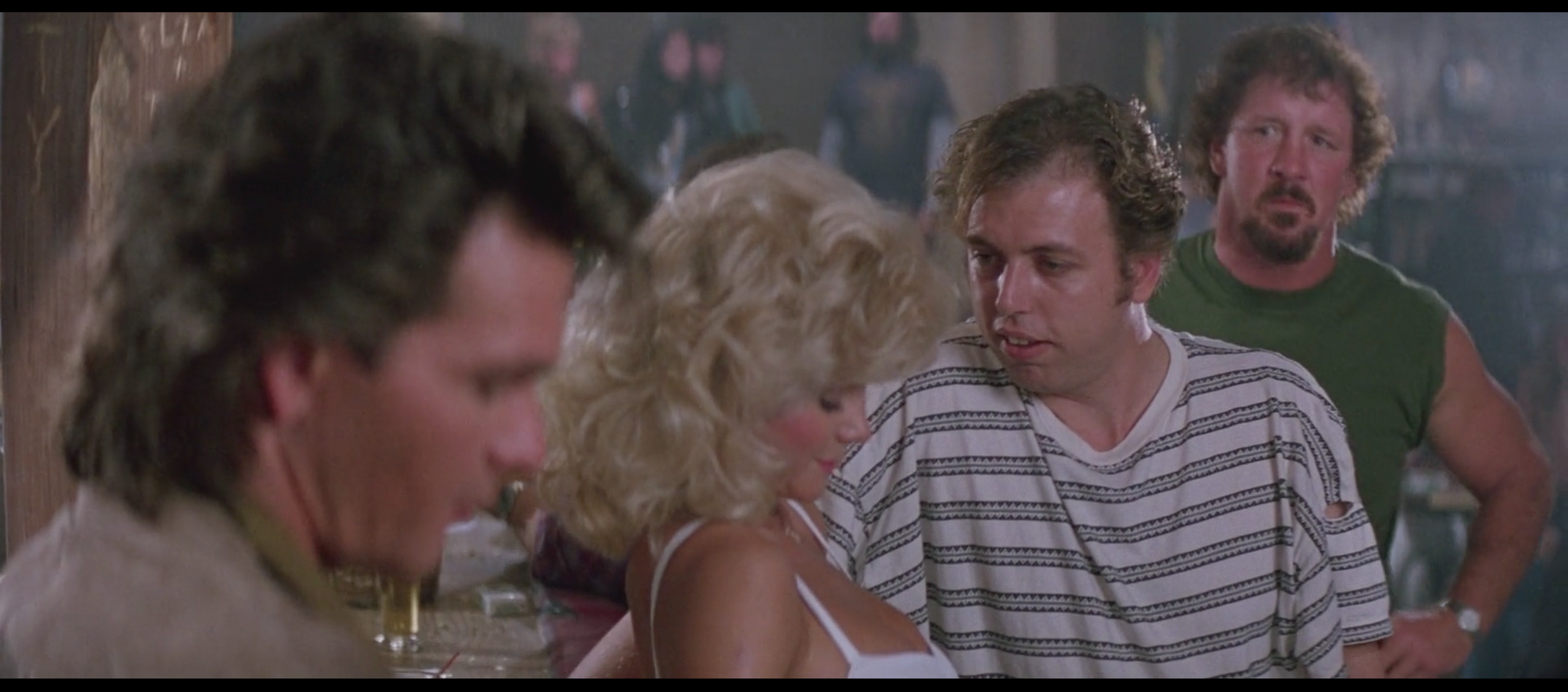
Here in the Double Deuce, after Dalton’s arrival, prior to The Agreement and the subsequent bar-destroying brawl, things are proceeding as one assumes they always proceed. Denise, Jasper’s sole indication that there is a non-Jasper culture out there to which one can aspire, glides up to the bar to ask Pat McGurn (John Doe, cofounder of X, lest we forget) for a “vodka rocks.” Enter the Barfly, and this is actually how he’s credited, “Barfly,” played by Frank Noon. In a film teeming with barflies he is selected as the representative specimen. This absolute slob, I mean maybe the most gormless motherfucker in the whole film, this asshole sidles up to her and says “Hey, Vodka Rocks, what do you say you and me get nipple to nipple.” I hesitate to call this pickup line a euphemism, because it’s actually much more vulgar than describing the sex act outright. Getting nipple to nipple is a phrase that can only make one feel bad about having sex, or wanting to have sex, or being capable of having sex, or being part of a species that propagates itself by having sex. It embarrasses me anew every time I hear it. Goof coming out of his well armed with his quip to slutshame mankind. Point is it’s not happening for this turkey. Denise looks down in contempt, unconsciously mirroring the way Dalton, whose hair is only slightly less magnificent than hers, looks down in disapproval. Then she looks up and, this being Road House, shoots the guy down in the strangest possible way. “I can do that without you,” she says, before turning away and giving Dalton an appreciative once-over (more like a thrice-over actually, she is hot to trot for our hero) in the process. The reasonable interpretation of this rejoinder is that Denise can somehow aim her breasts at one another so that her nipples can touch, a pincer movement if you will. I choose to believe she thought fast and decided to shoot this goofy down by saying something even weirder than he did. Either way, and I hope you’re sitting down for this, he does not take rejection well. See Morgan back there? He’d been leaning on the bar in the background unseen until the dirtball mooselipped chickendick made a pass at Denise. (Do people make passes at other people anymore? When I was a kid Three’s Company and The Golden Girls had me believing that’s all anyone did as an adult. “He made a pass at me” is something I’ve never heard a human being say outside of a multi-camera sitcom. Anyway) The moment after “nipple to nipple” dribbles out of his mouth, Morgan pops into the frame from behind, like a fucking jack-in-the-box. It’s one of my favorite little moments of abject stupidity in the movie. On his worst day in the ring, Terry Funk couldn’t oversell a bump half as hard as he oversells Morgan overhearing someone hit on his secret boss’s girlfriend and getting mad about it. Of course Morgan is always mad. He’s an orneriness elemental. And he puts it to good use when Mr. Nipple angrily grabs Denise by the shoulder. Morgan grabs him by the shoulder, punches him in the gut, and tosses him into a table full of patrons, spilling him and them and the table and the drinks on it and several bystanders to the ground in the process. Why this doesn’t lead to an apocalyptic bar-wide battle royale is beyond me given that The Agreement ends in a nearly identical fashion, but at the very least it gives Dalton, serene and detached, an eyefull of Morgan’s modus operandi. This is clearly a bouncer who will need to be bounced. So! Beautiful, slightly weird woman. Ugly, very weird man. Angry, very angry bouncer. Knocked-over tables. Knocked-over patrons. Pat McGurn. The malign influence of Brad Wesley behind it all. Dalton has just gotten nipple to nipple with the Double Deuce. It’s not pretty.
050. The Third Rule
“This is the new Double Deuce,” says Frank Tilghman. We are at the start of an all-hands staff meeting, and Tilghman is pointing to the concept art for the bar’s redesign. But standing nearby is his latest hire, Dalton. It is through Dalton, with Dalton, in Dalton that the new Double Deuce will be achieved. Dalton embodies the new Double Deuce. He is its future.
When Dalton takes over as cooler he becomes more than just the chief bouncer. His role is not to handle a series of discrete incidents, but to institute sweeping reforms that will eliminate such incidents forever. “It’s going to change,” he states—not a threat, not a promise, a fact. His bouncers, too, must change for this to take place. As below, so above.
Bouncing on the Dalton Path is a matter of following “three simple rules.”
This is the third.
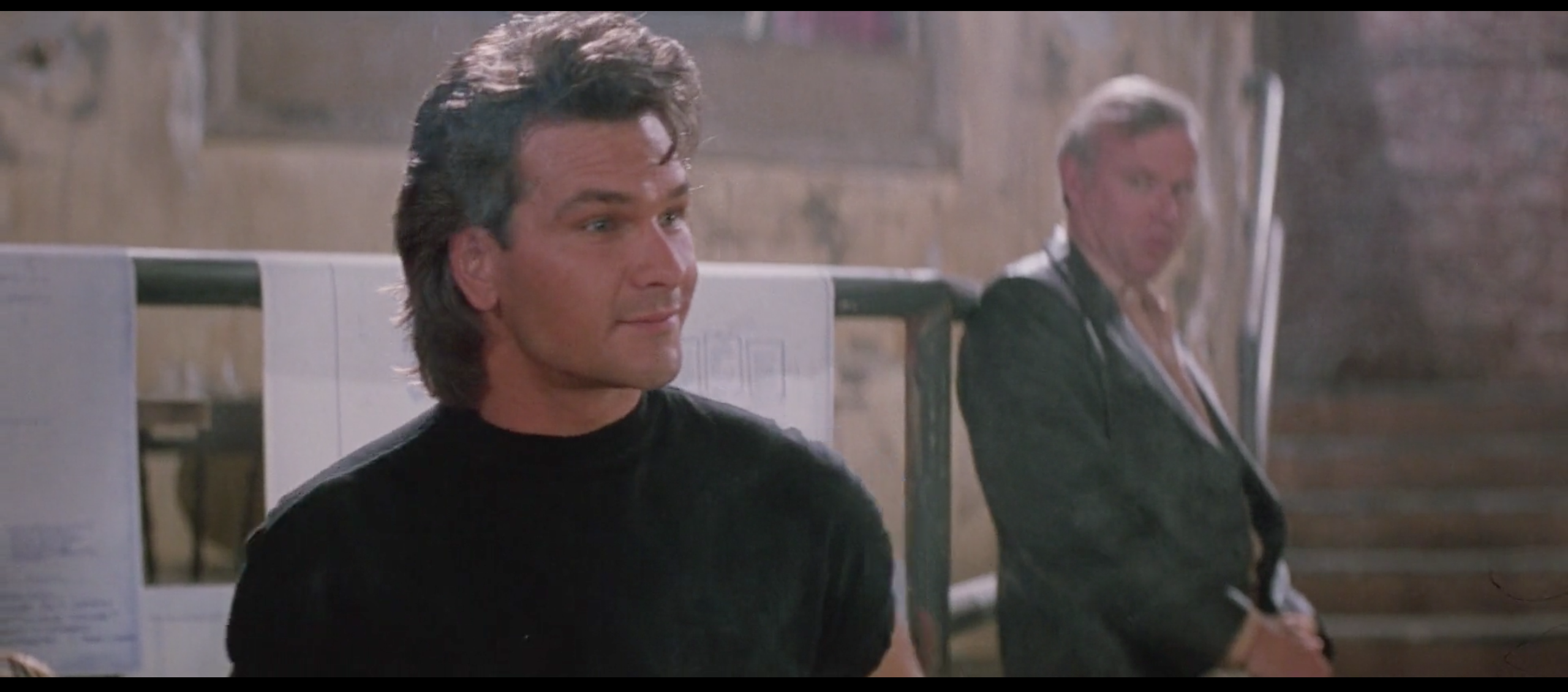
3. Be nice.
The three simple rules for bouncing my Jasper road house all contain and account for their own direct contradiction. More than that, they depend on the aspirant’s ability to formulate that contradiction to be fully understood. Thus “Never underestimate your opponent; expect the unexpected” conveys both that chance will always break in the enemy’s favor and that a true brother bouncer—the unmentioned ally in a rule nominally covering the adversary—leaves nothing to chance at all. “Take it outside; never start anything inside the bar unless it’s absolutely necessary” is as much about one’s headspace as it is about one’s physical space, such that participation in a fight that takes place within the building is a requisite condition for obeying the rule in the first place. Even Dalton’s prefatory statement “All you have to do is follow three simple rules” is best thought of through the formulation of the philosopher Linda Richman: They are neither three nor simple nor rules nor followed.
So. The Third Rule. It is the shortest rule, and it requires the most explanation. It is the least practically minded rule, and it is illustrated with the most practical applications. It is a rule about being kind to others, on the surface at least, and it is the rule greeted—and at times delivered—with the most open incredulity, even hostility.
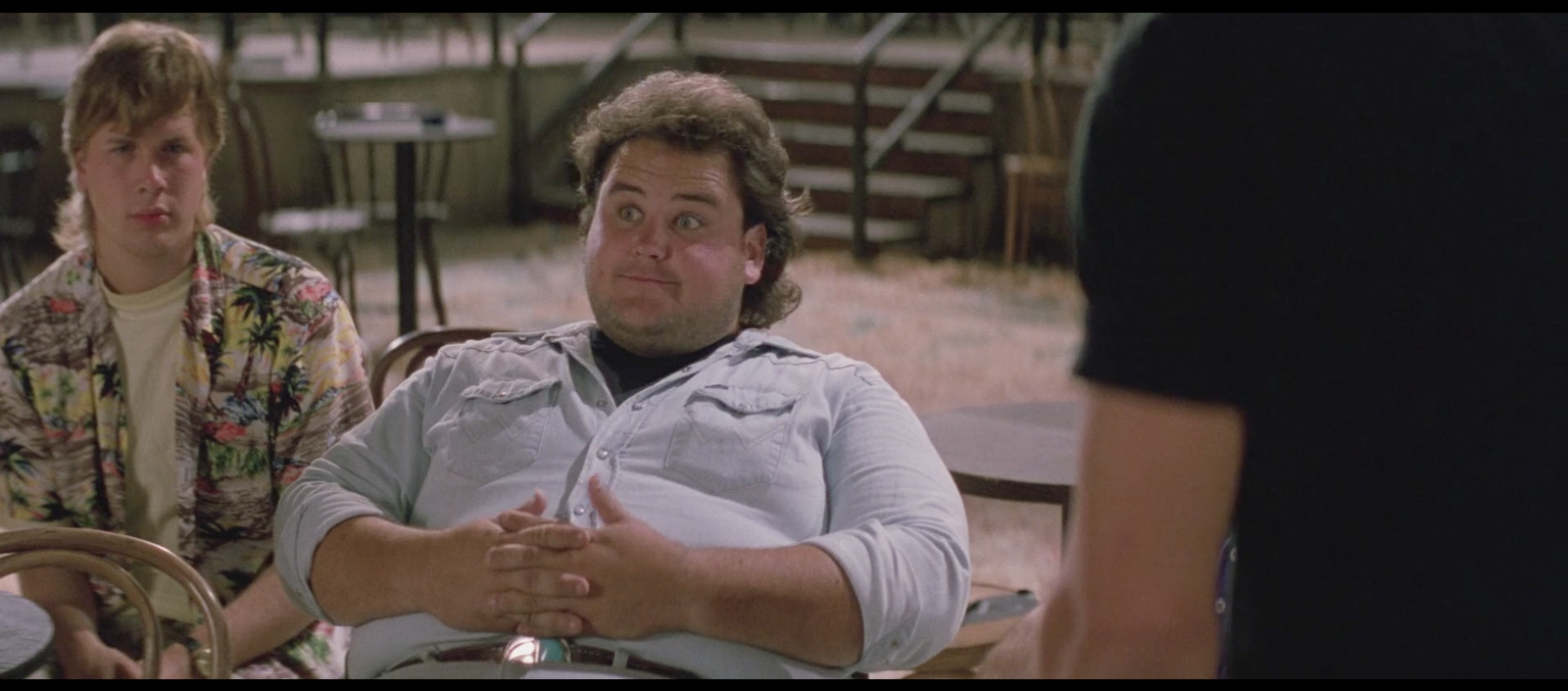
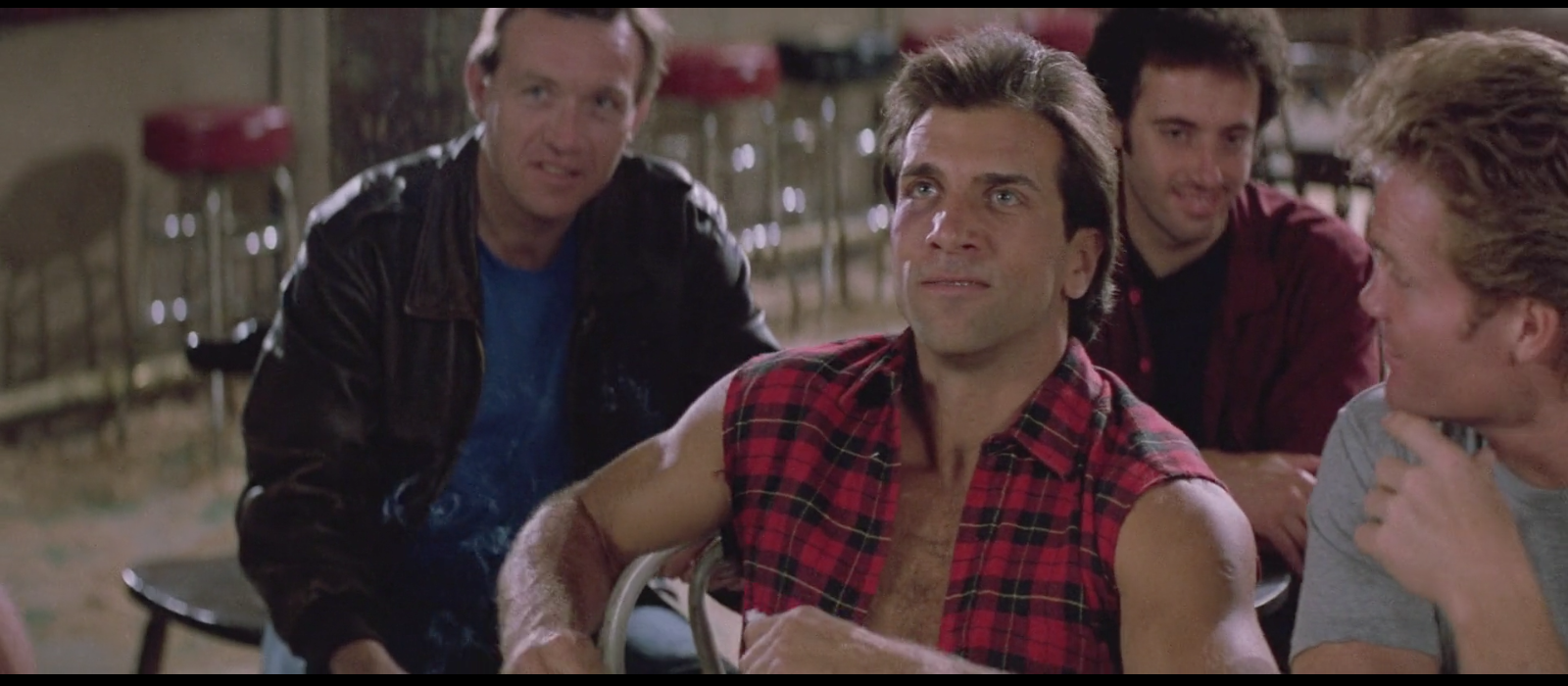
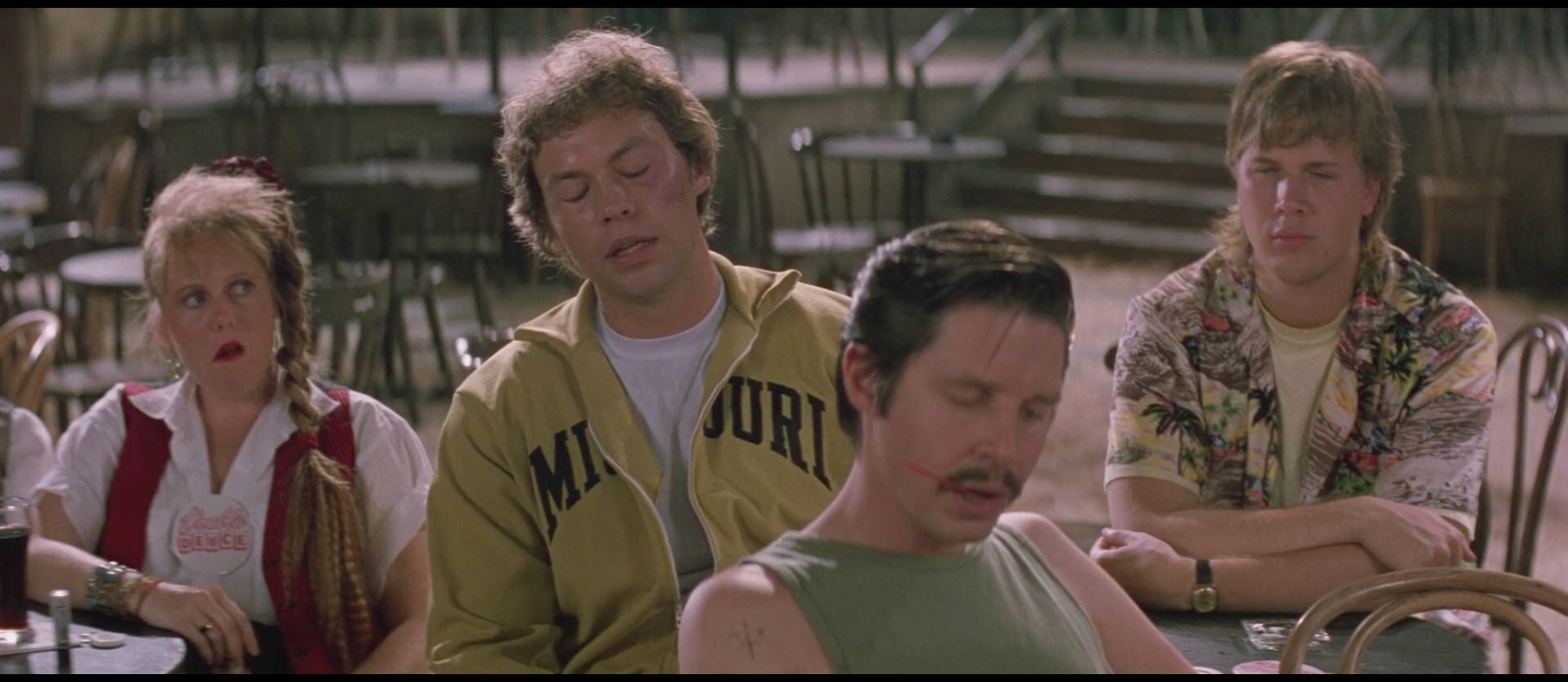
All this is necessary. One must see the complicated clockwork mechanism behind the simplest maxim. One must learn that on the Dalton Path, all philosophy is applied philosophy. One must be goaded into anger to understand the nature and value of its opposite. These things the Third Rule anticipates, mandates, births into being. This simplest of the three simple rules is alone in meriting a fuller and more complex reformulation from the Giver of the Rules, a new testament to unlock the old. It is the Great Commandment. It is not come to destroy, but to fulfil.
3. Be nice…until it’s time to not be nice.
to be continued
The 50 Best Film Soundtracks of All Time
46. Paul Giovanni – The Wicker Man (1973)
The Wicker Man is never what you expect it to be. Like its hero, a Scottish police sergeant trying to find a missing girl in a pagan community, the New York musician Paul Giovanni was a stranger to the old Celtic folkways he was hired to investigate for Robin Hardy’s haunting horror film. His outsider’s ear for both the then-booming British folk scene and its ancient antecedents made the music he composed the ideal mirror for such a twisted journey. The opening song is a tightly harmonized adaptation of Scottish poet Robert Burns’ “The Highland Widow’s Lament,” nearly abrasive in its mournful mountain-air beauty. Sex is a frequent topic for the film and music, rendered in forms both profane (the absolutely filthy drinking song “The Landlord’s Daughter”) and sacred (“Willow’s Song,” the set’s dirty-minded but gorgeous standout). Rousing community singalongs and sparse hymns of ritual sacrifice weave conflicting narratives of their own. It’s a soundtrack that casts strange shadows and remains ungraspable, like a tongue of flame.
049. Jimmy, or The Laugh
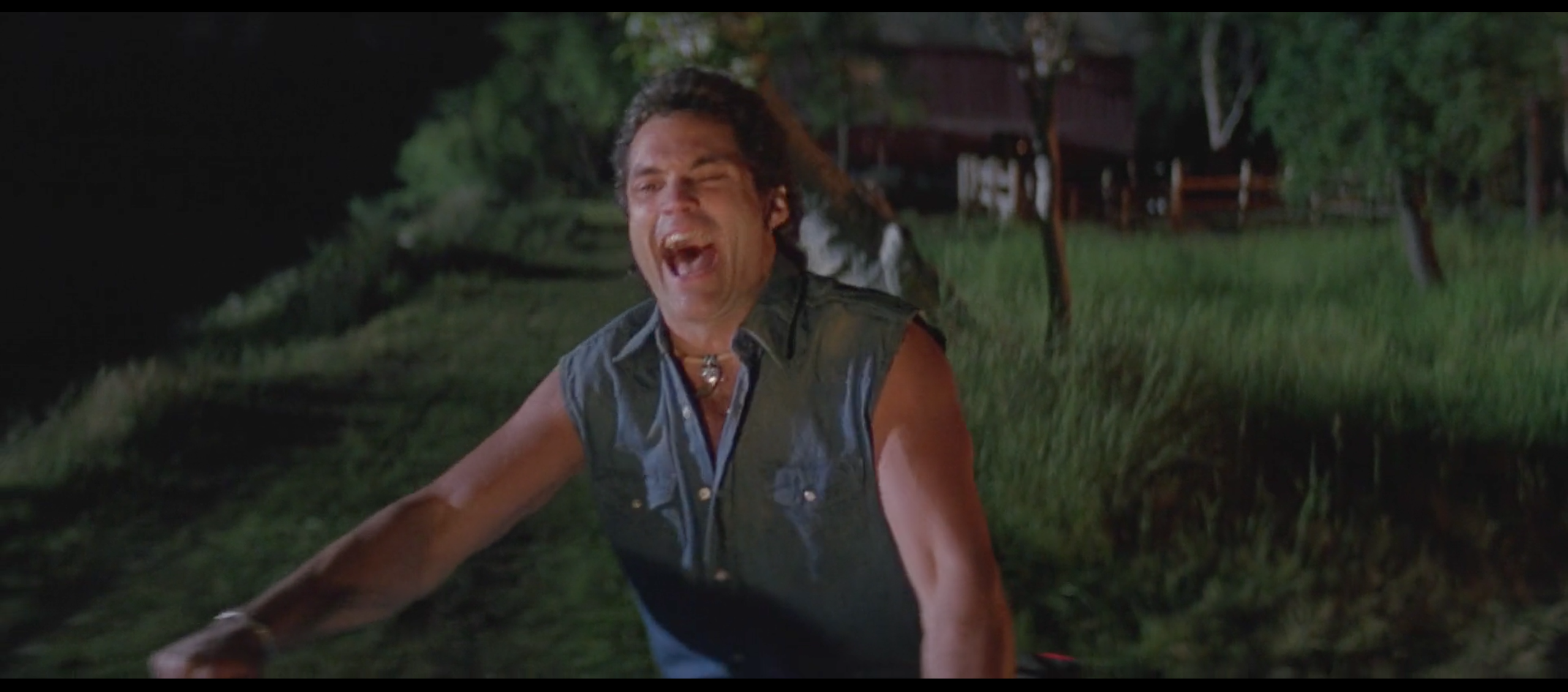
It’s not all fun and games. No, it’s not all fun and games. We joke here at Pain Don’t Hurt, we laugh here, because Road House is a fun and often (nearly always) funny movie. But the Dalton Path leads inexorably toward darker days and nights.
This is Jimmy, Brad Wesley’s right-hand man, chief enforcer, and bastard son. (Non-canonically.) We’ve met him before during the nearly fifty days I’ve been writing about Road House, but he has remained a liminal presence, his dark eyes and blue denim looming in the background like a pale man at a party in a David Lynch film. He accompanies Wesley to Red Webster’s store for their weekly payout but doesn’t say a word. He drives Karpis (unnamed handsome man, in the parlance of the film itself) to fuck the store up later on but never gets out of the car. He laughs as Wesley beats O’Connor for bleeding too much but never throws a punch. He scoffs at Dalton and the Doc as he and Ketchum (the other unnamed goon) spy on them but doesn’t make a move.
It’s at the precise moment when Jimmy is finally set loose, battling Wade Garrett and the entire Dalton-led bouncing staff of the Double Deuce after Dalton cruelly shuts down Denise’s Wesley-approved antagonistic striptease (?!), that things go bad.
Brad Wesley, who moves through life grinning wryly at virtually everyone and everything he sees, has taught his boys well. All of them, even Tinker, have learned to laugh at the misfortune of others, and at nothing else. But Jimmy is Brad’s best boy, and his is the deepest laugh, the fullest laugh, the loudest, the longest—and the last.
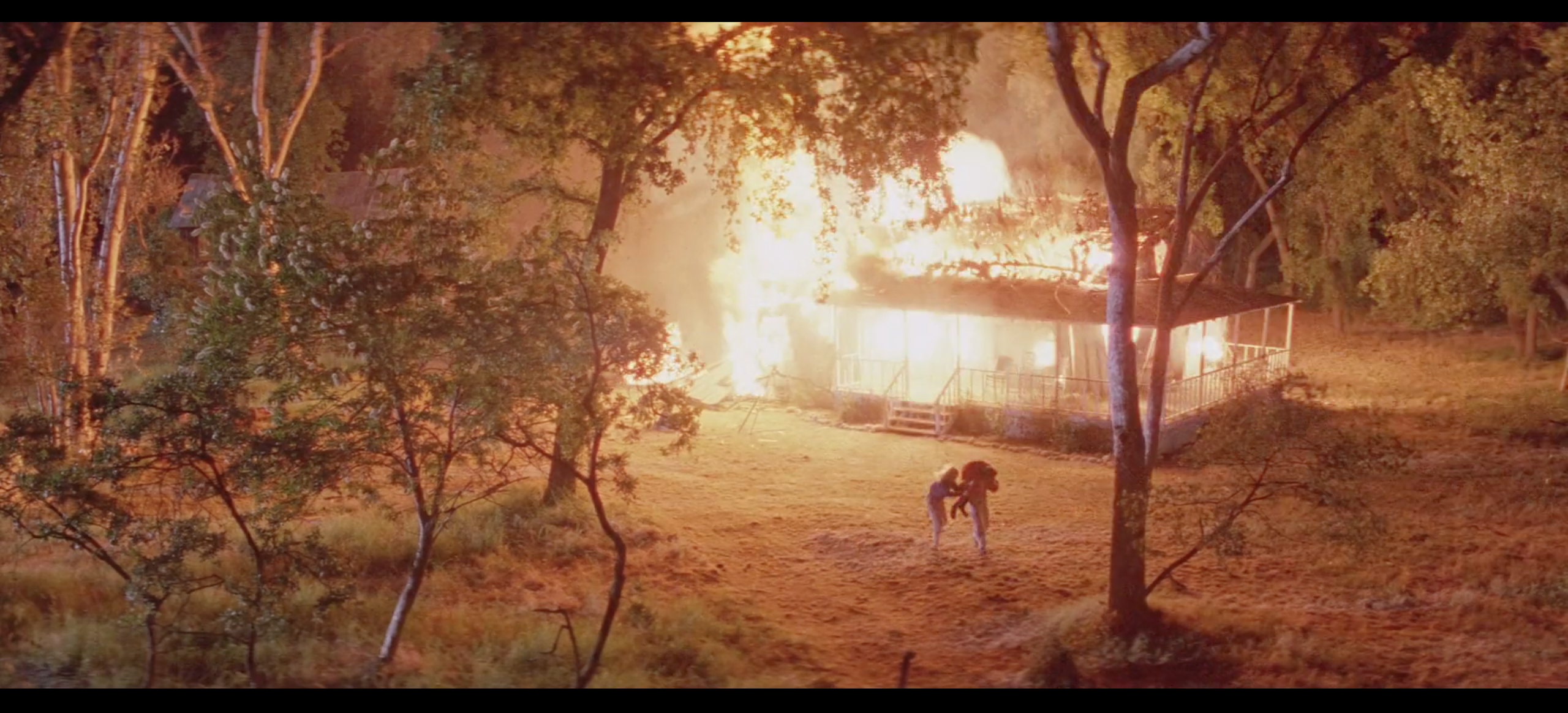
Jimmy emits this piercing and preposterous peal—the supervillain laugh to end them all—after blowing up the shack where Dalton’s landlord Emmett lives (and, judging from the size of the explosion, cooks meth) in the middle of the night. So delighted is he by the night’s mean work that he actually stops his getaway motorcycle to look back, take in the extent of what he has done, and enjoy the moment to its fullest. He laughs like a man not acquainted with the concept in any context where the smell of blood and cordite is not on the night wind.
In this moment, Jimmy exhausts the good humor of the Wesleyan Goons with one titanic cackle of pure, joyous malice. No longer are they the cocky cut-ups who run over car dealerships with monster trucks or get beat up in bars. From here on out they exist to kill. Jimmy inhales horseplay and exhales murder. And Dalton is the man who breathes that fire back in.

048. The punchline
For want of a nail the shoe was lost.
For want of a shoe the horse was lost.
For want of a horse the rider was lost.
For want of a rider the message was lost.
For want of a message the battle was lost.
For want of a battle the kingdom was lost.
And all for the want of a horseshoe nail.
—traditional
“Hey buddy, what are you doin’? Are you gonna kiss ’em or not?”
“I can’t!”
“What do you mean, you can’t?”
“I ain’t got twenty bucks!”
—Road House
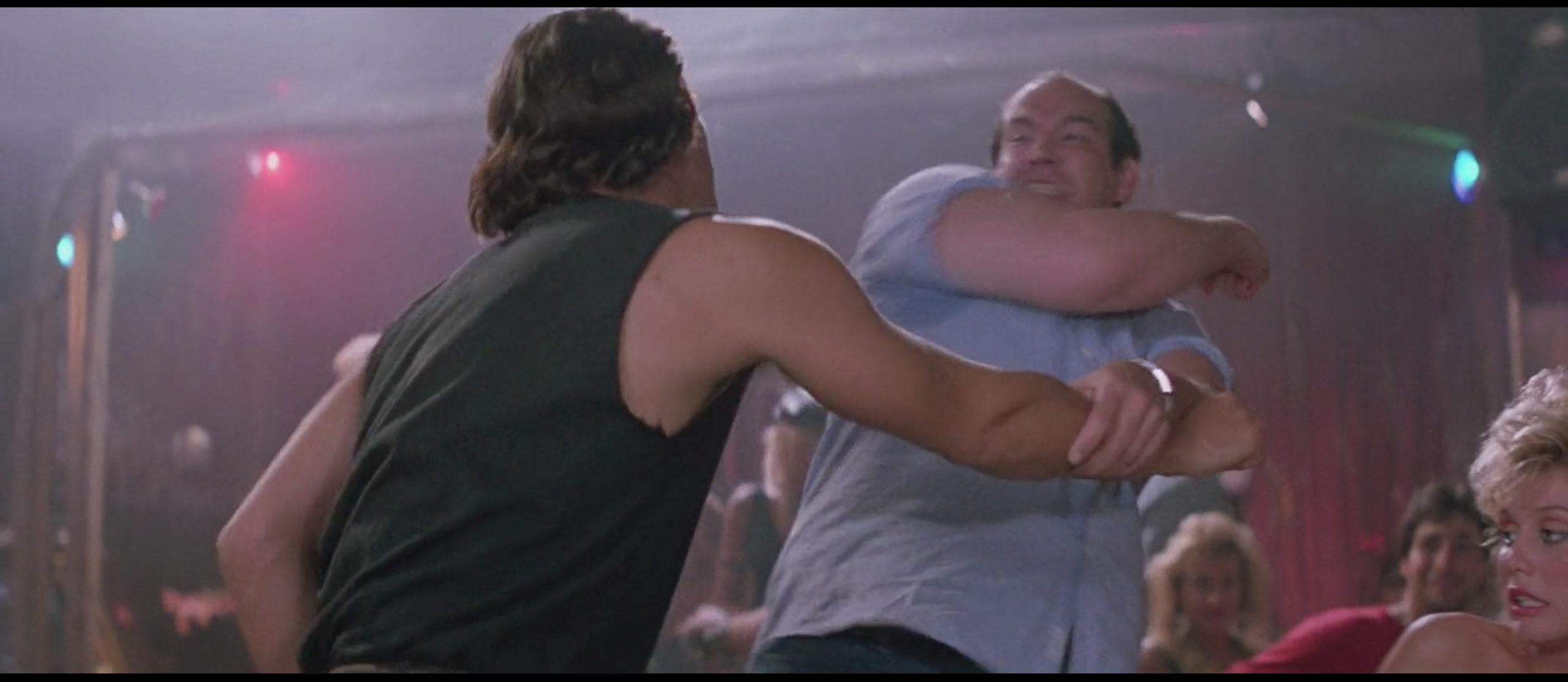
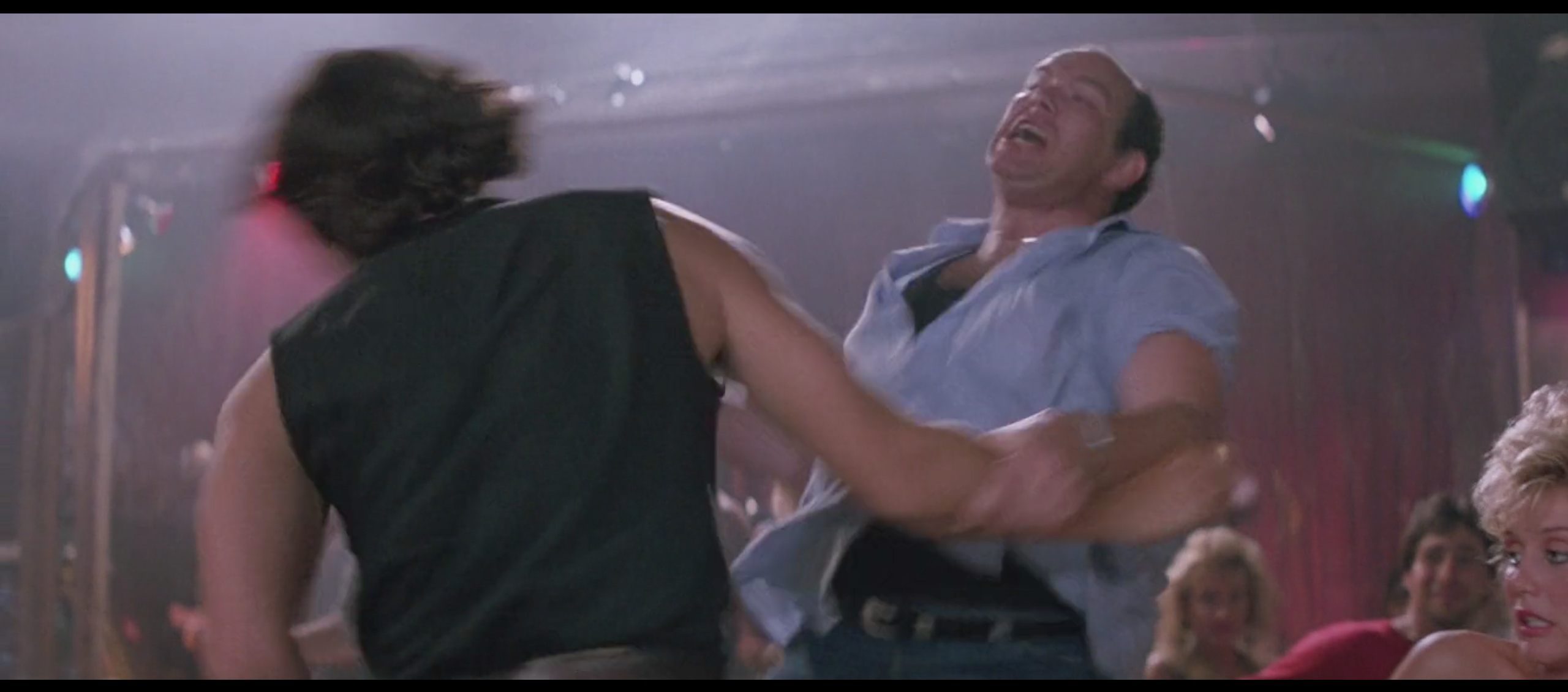
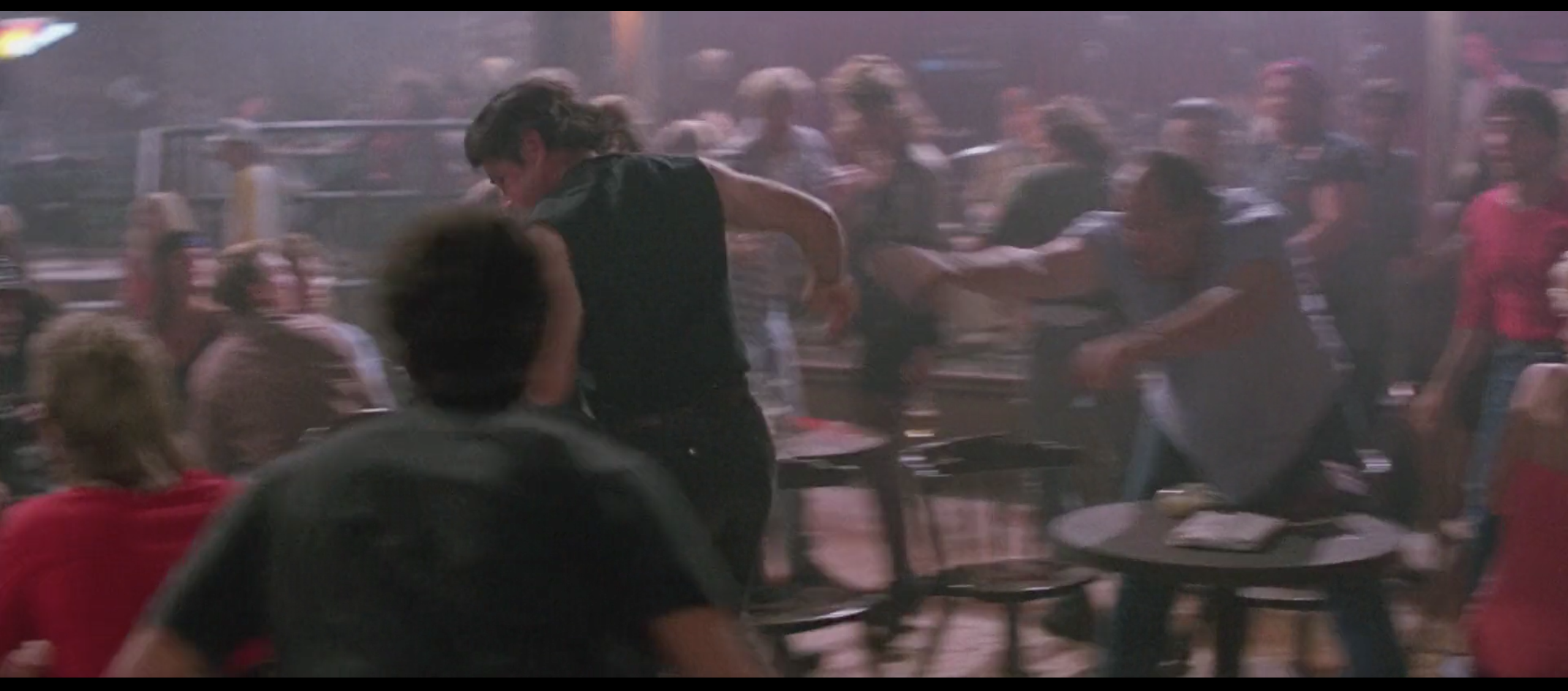
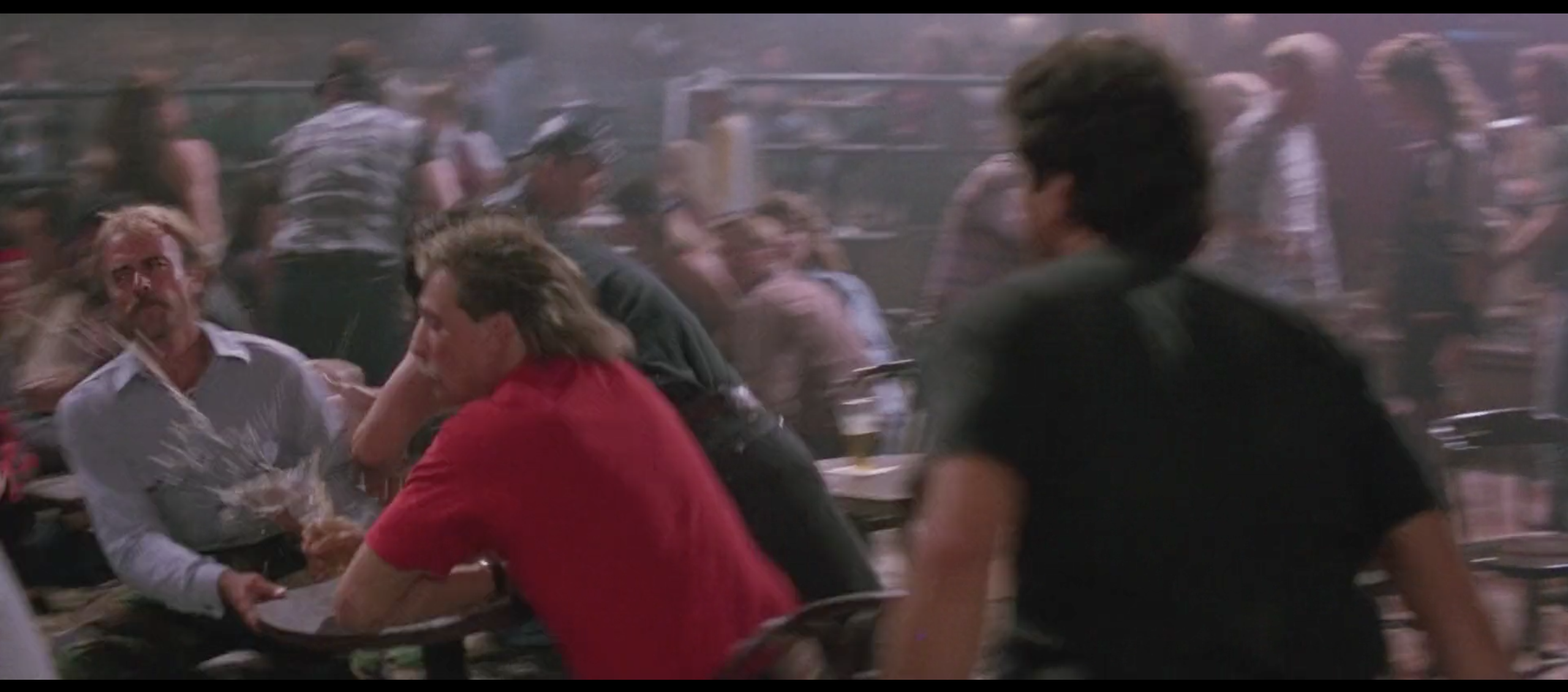
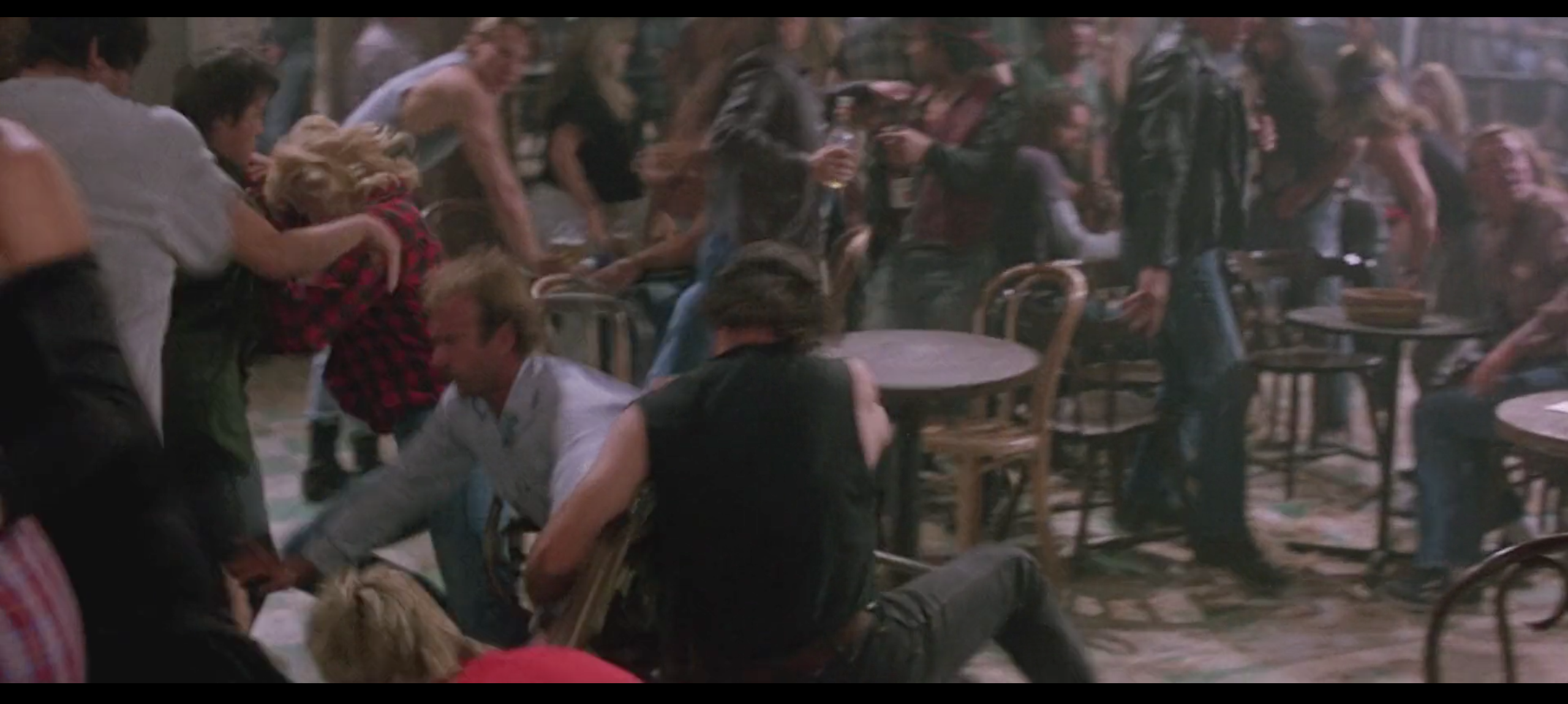
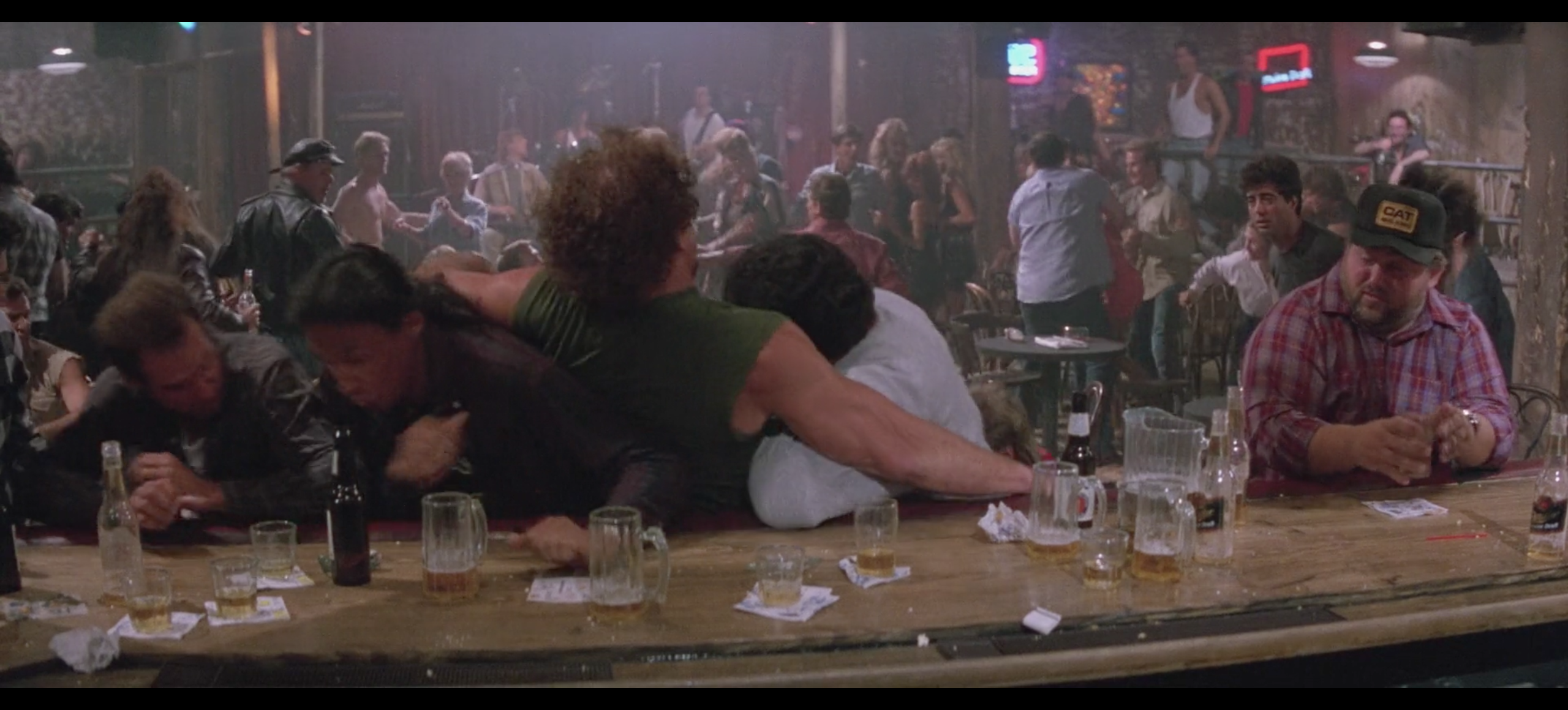
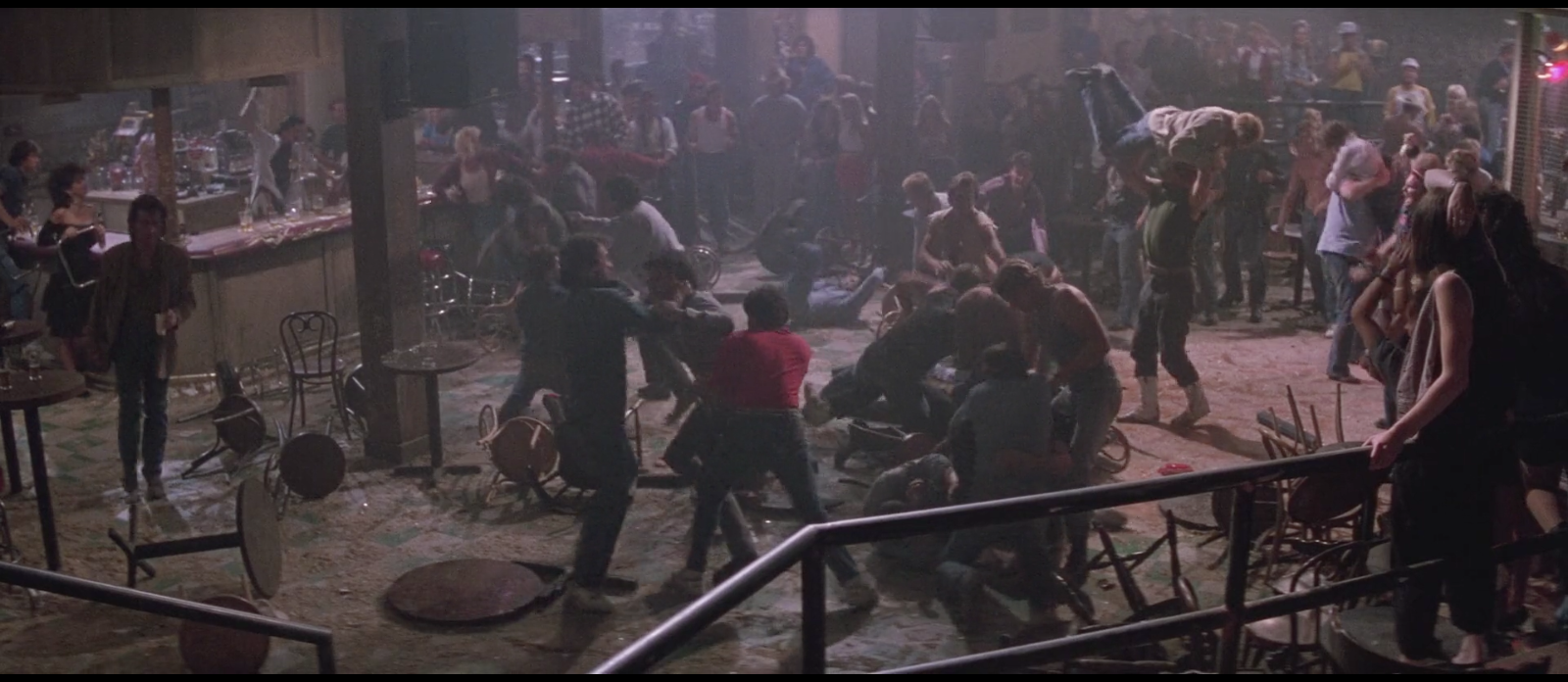
This concludes “The Agreement,” a seven-part special Valentine’s Week series. Thank you for reading.
047. A Dream
Part Six of “The Agreement,” a special Valentine’s Week series
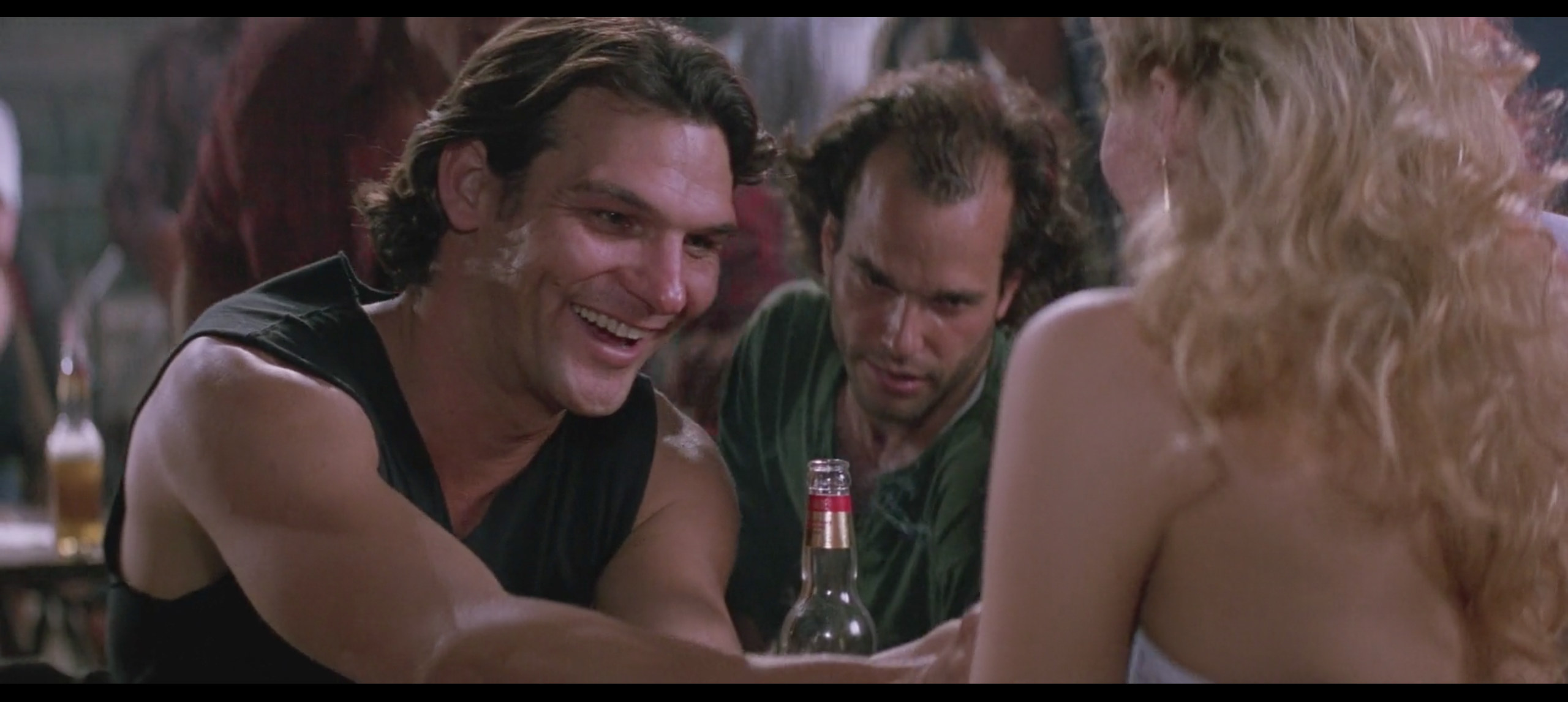
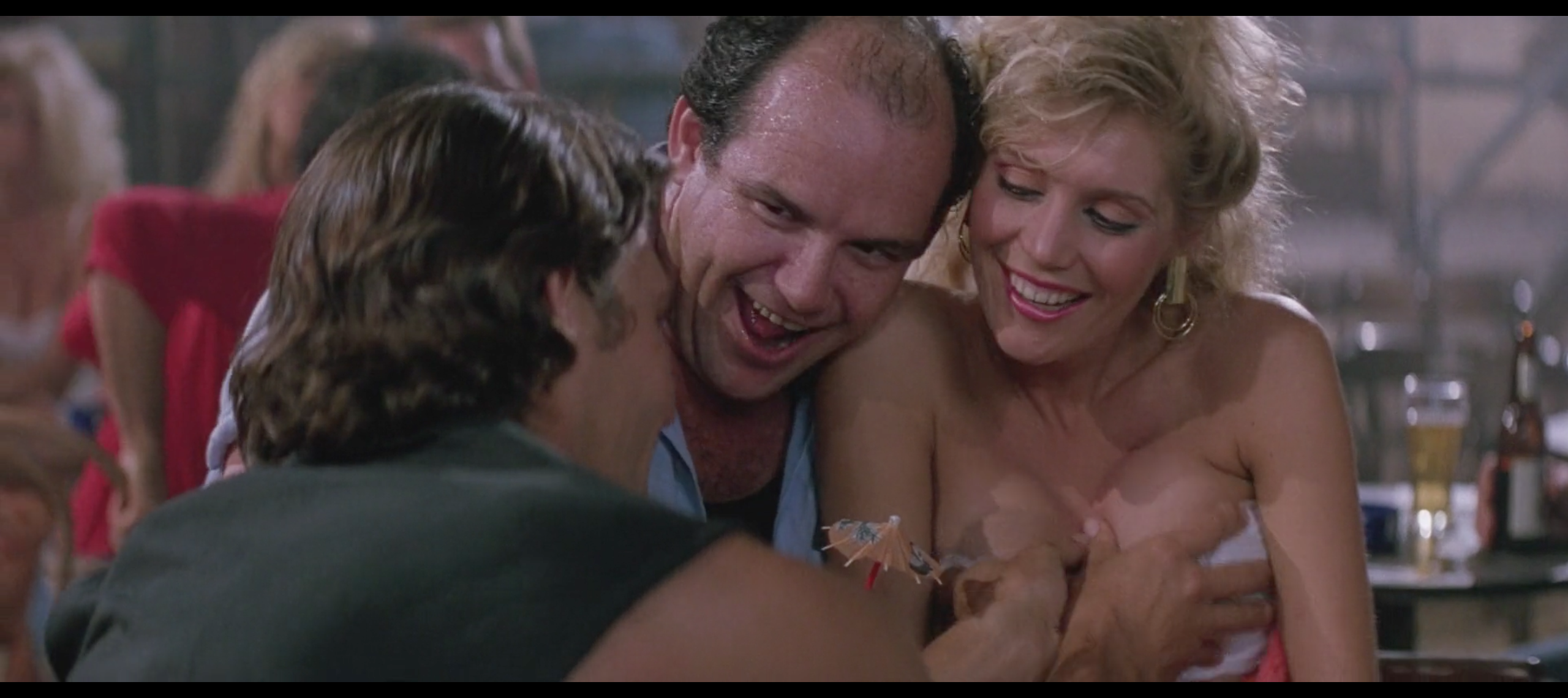
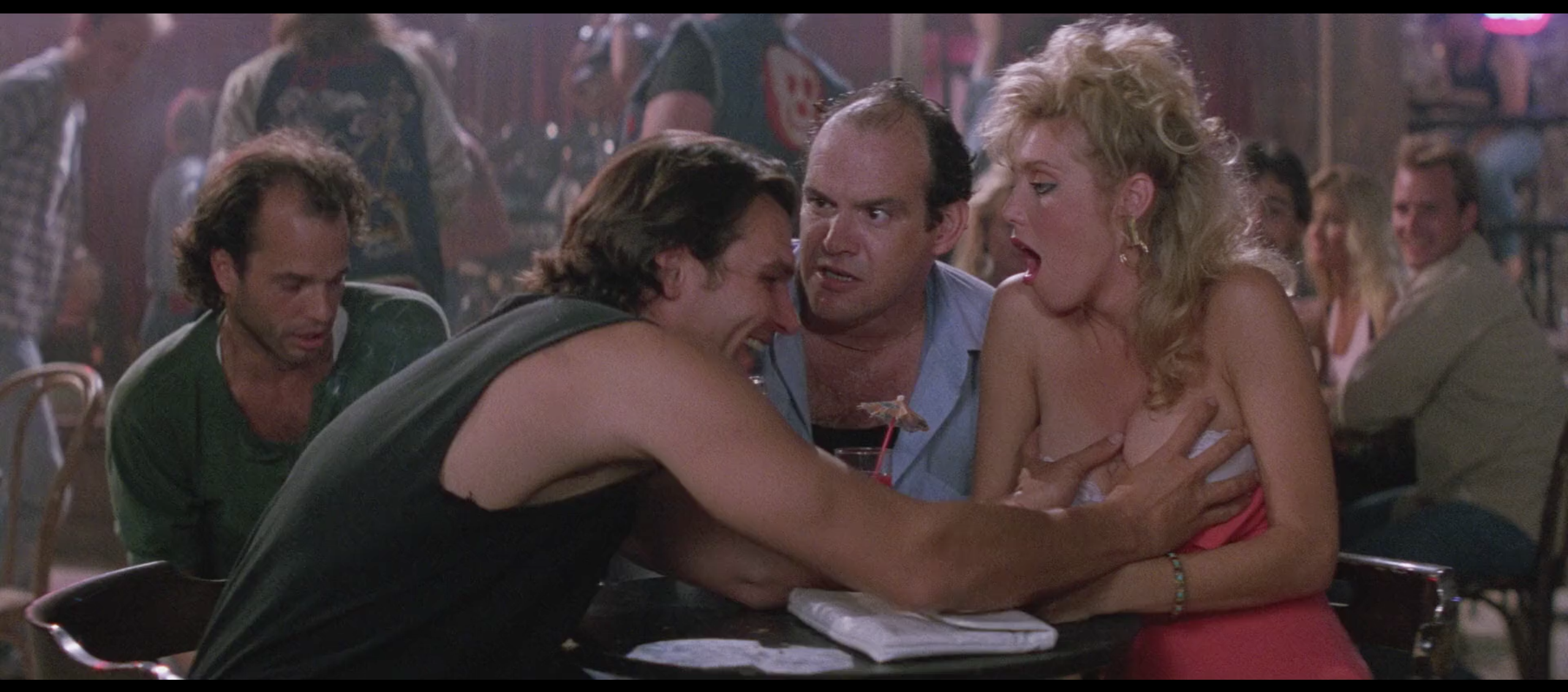
The Agreement is as follows: For the price of twenty bucks (specifically ten a kiss, though the phrasing of The Agreement implies that each breast is to be kissed once rather than one breast kissed twice), Gawker may kiss the breasts of Well-Endowed Wife, with both her and Sharing Husband’s enthusiastic consent. Gawker’s consent to The Agreement appears—appears—to be no less enthusiastic. On the contrary, it’s possible that at the moment he says “ARE YOU KIDDING?!?” no one has ever been more enthusiastic, about anything.
The Agreement brings forth a spirit of joie de vivre in all who participate in or observe it. Gawker, hands full of Well-Endowed Wife, is happy. Well-Endowed Wife, liberally coated with Gawker, is happy. Sharing Husband, by name and by nature, is happy. Heckler…well, Heckler looks like he’s watching The Agreement be fulfilled primarily to keep himself from sliding off the face of the Earth, but whatever part of his brain still functions certainly seems to be happy.
The Agreement is not only happy, however. The Agreement is sweaty. Get the most high-resolution copy of Road House you can find, get a good look at our cast of characters in this scene, and you can smell the salt of physical exertion, the alcoholic tang of beer-induced perspiration, the slightly acrid pit-stink from Gawker’s sleeveless underarms, the how-about-this-heat hail-fellow-well-met forehead dew of a jocular neighbor who seems to be more barbecue grill than man during the warmer months of the year on the noggin of the Sharing Husband, the chemical (or alchemical, if you happen to swing this way and be moved by this kind of thing) interaction between Well-Endowed Wife’s perfume and hair product and moisturizer and makeup her own body’s barely perceptible production of its natural coolant.
What I’m trying to say about The Agreement is that they’re not just having fun, they are into it, man. The absurdity of the whole situation masks this somewhat. My advice? Don’t let it.
Enter the Double Deuce on its own terms. Treat the concerns of its patrons and staff as valid and real. It’s what unlocks the whole film, turns it from “so bad it’s good” to, to, to this. It’s like knocking down some drywall and finding a whole other room, or like finishing The Hobbit and discovering the existence of The Silmarillion. Road House can be enjoyed in any number of ways but the rewards of this approach are—I was gonna say immeasurable, but all of us can count to 365. I know I can. And here, on day forty-seven, you can read the rewards of The Agreement all over its participants’ smiling faces.
Unfortunately, when it comes to the success of The Agreement, there’s only one measurement that counts: twenty American dollars.
Remember these moments, friends. Remember this sweathog happiness. Remember what we had, and could have had, before the bill comes due.
There was a time when men were kind
When their voices were soft
And their words inviting
There was a time when love was blind
And the world was a song
And the song was exciting
There was a time
True Detective Season 3 Is Twin Peaks’ True Heir
True Detective season three is about the fate of the Purcell children, yes. But it’s also about the prejudice and PTSD that drove Native American Vietnam vet Brett Woodard to spark a lethal firefight after his neighbors tried to lynch him for a crime he didn’t commit. It’s about the mysterious one-eyed man who gave the Purcell kids a doll he purchased from a racist parishioner at the local Catholic church, then resurfaced a decade later to harangue Amelia for profiting off other people’s suffering. It’s about the black neighborhood that understandably reacts to a visit from the police like an invasion by outside occupiers. It’s about the three random metalhead teenage assholes who nearly get jammed up for murder because they’re surly and wear Black Sabbath shirts in a God-fearing southern community. It’s about Tom Purcell, driven to alcoholism to dull the pain of life in the closet. It’s about his wife, Lucy, who employs drugs, drink, and promiscuity in much the same self-medicating way after a childhood of abuse and incest. It’s about the contemporary true-crime boom, and how well-meaning filmmakers and podcasters and writers can get us closer to the truth but do a lot of damage on their way there. It’s about the way wealthy men and their allies in government and law enforcement can collude to treat the communities they rule with the kind of impunity that would make a feudal lord envious. It’s about an old man with Alzheimer’s, whose own life is fast becoming as big a mystery to him as the case he could never quite solve, and whose loved ones are slowly slipping into anonymity the same way the real killers and kidnappers did.
In this respect, True Detective season threehas learned lessons not only from its own direct predecessors, but from the ne plus ultra of small-town murder mystery television: Twin Peaks. And it’s learned the right lessons, too.
046. Tableau II
Part Five of “The Agreement,” a special Valentine’s Week series
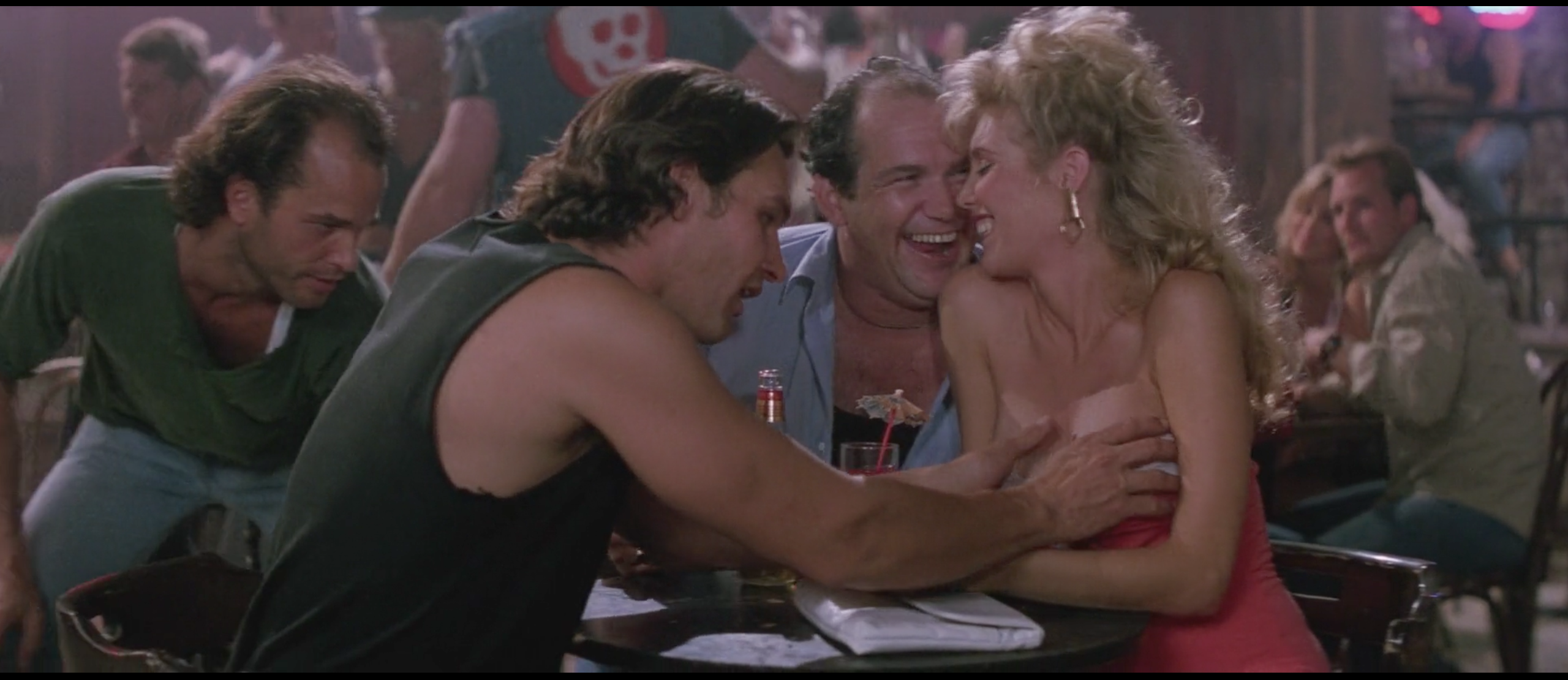
I’m sitting in a bar writing this. The bar’s name is Duggan’s. Duggan’s is one of five Irish pubs within a one block radius of my apartment. (Jameson’s, McCarthy’s, Cork & Kerry, and Fallon’s are the others. Arps Tavern too, if you wanna get a little creative with your geography. This does not include the five non-Irish non-pub restaurants with a liquor license in the same area.) What you’re seeing above is not a scene that takes place at Duggan’s, young and dumb and full of cum as its clientele often is. On the kinds of nights when people who are young and dumb and full of cum go out and socialize, anyway. It’s otherwise the province of the shrieking Irish-American racists whose every breath is a betrayal of the Irish liberationary socialist tradition they all believe they support, sans the socialism. Anyway. Duggan’s boasts a relatively genteel crowd even at its most raucous compared to McCarthy’s, the bar whose parking lot abuts my apartment building. I’ve stepped inside there a grand total of once, to see if anyone belonged to the car in the lot with its headlights on. (They did not. At least not that they could remember.) McCarthy’s produces a nightly brawl like Kander & Ebb. I wish I were kidding. Every single night there’s some…what is the Long Island Irish equivalent of the word “guido”? because there really should be one, and “paddy” doesn’t quite cover it. Anyway—every single night there’s some moronic Hibernian, some bog person whose great-great-great-grandma snuck past Ellis Island despite Thomas Nast’s best efforts, screaming “HOLD ME BACK BRO, HOLD ME BACK BRO” or “MY FUCKING SISTER BRO, MY FUCKING SISTER” or “COME BACK COLLEEN, COME BACK COLLEEN” at the top of his lungs about fifteen away from MY HOME where my wife-to-be sleeps and my children play with their toys. McCarthy’s is the kinda place that they sweep up the eyeballs after closing. That’s not where I’m, currently, at. The distinction I’m attempting to draw is that what goes on at the Double Deuce during our first visit to the Double Deuce is intended to be unique to and representative of the Double Deuce. So let’s revisit the image above, and let’s do it from right to left, like we’re reading manga or the Torah. You have Well-Endowed Wife, eyes closed and smiling, thrilling to the sensation of a gormless stranger’s hands on her tits and her husband’s attention and affection resulting from same, I mean she’s transported by it. You have Sharing Husband, cackling with glee, simply could not be happier and more entertained by the spectacle of other men enjoying his wife’s body and his wife’s body enjoying other men. You have Gawker, now and forever Groper just like Donald Merwin Elbert became now and forever The Trashcan Man when he blew those oil tankers in Powtanville (Hey, Trash, what did old lady Semple say when you torched her pension check?), as riveted by this woman’s tits as the first men on the moon were by the earthrise. And—and this is key—you have Heckler, played by Charles Hawke, previously remarkable in this film for hollering “HEY YA PAID TA PLAY PLAY!” AND THROWING A excuse me and throwing a beer bottle at the Jeff Healey Band for the crime of announcing they’re going to take a brief break to urinate in the bathroom rather than piss themselves on stage, and throwing it with sufficient force to shatter it against chickenwire looser than Steve the bouncer’s ID requirements, and saying this with Noo Yawk accent that makes about as much sense in its Jasper, Missouri setting as the idea of famous bouncers, and I’m sure we’ll return to him eventually, but for now let’s look at this miserable bastard, transformed by the spectacle of the tripartite Agreement between Sharing Husband, Well-Endowed Wife, and Gawker/Groper from a belligerent cut-up to fucking Saul on the road to Damascus, transfixed by the sight, blinded by the light, revved up like a deuce another runner in the night, just completely fucking poleaxed by watching one idiot feel up another idiot’s wife. You don’t see that—you might still see it in the desert—but you don’t see it at Duggan’s, and you don’t see it where Dalton is at work. Beautiful in its idiocy as it is, the world Tilghman is building has no room for it. The Elves sail West and the Gawker and Heckler and Sharing Husband and Well-Endowed Wife disappear and so help me god the bar as I sit here writing this the bar is playing “I’m Shipping Up to Boston” by Dropkick Murphys and where is Dalton and Thomas Nast when you need them.
045. ARE YOU KIDDING?
Part Four of “The Agreement,” a special Valentine’s Week series
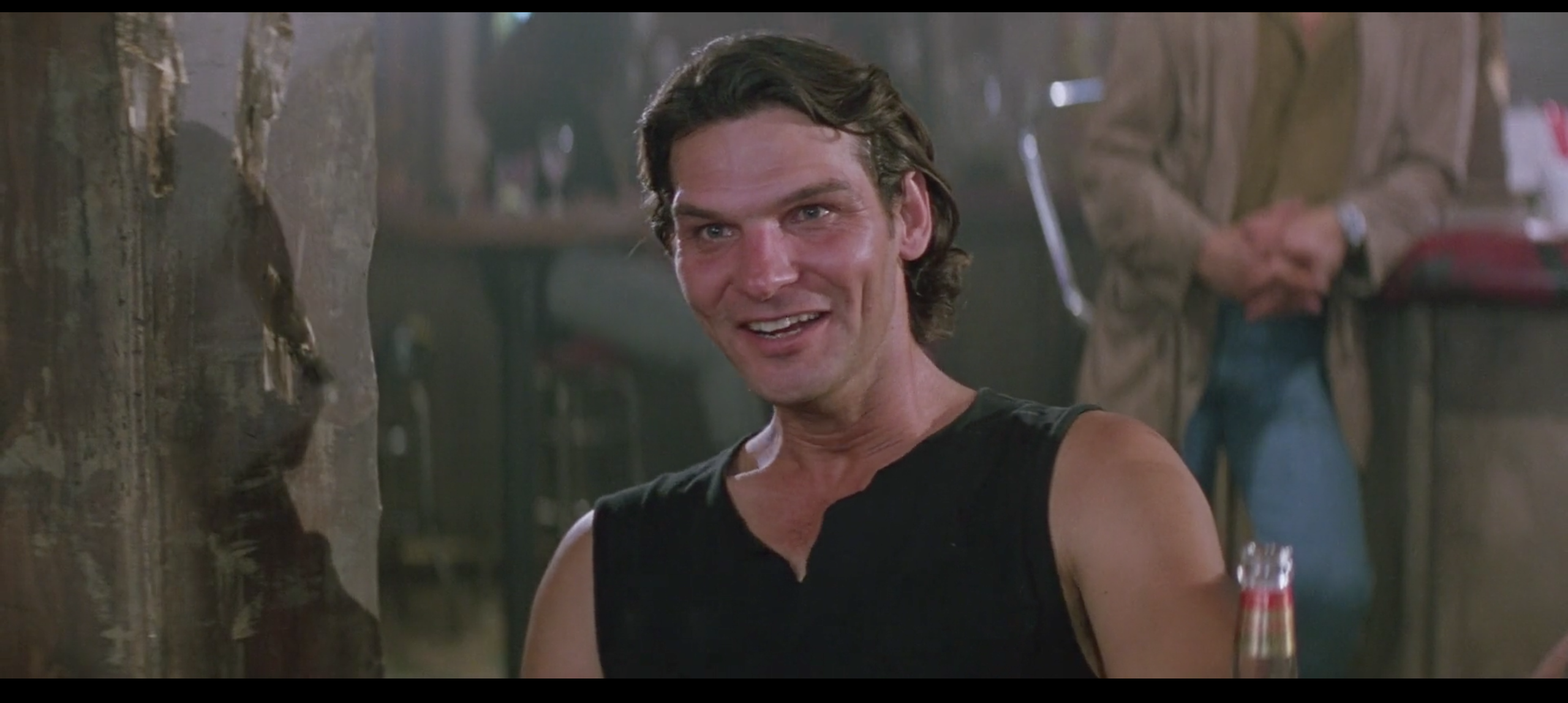
“ARE YOU KIDDING?” All caps. No question about it. Actually: “ARE YOU KIDDING?!?” Emphasis in the original. Phonetically, “URYEW KHIHDDINGH?!?”, the first two words slurred into one, the third fired out of a shotgun. An incredulous gasp and a barbaric yawp. The voice of the world’s happiest man, at the very moment he becomes the world’s happiest man, and realizes he’s become the world’s happiest man, simultaneously. The instant when the Gawker crosses the threshold to become the Groper, a three-word doorway he creates and passes through, pulling it shut behind him. A sound effect that accompanies a fantastical contortion of the facial muscles responsible for grinning, taxed to their limit. The noise of a large head on a large neck, jutting forward, physically penetrating the barrier between the potential and the actual. The cry of sweepstakes winners, of hidden-camera prank-show targets, of people who’ve been told this one’s on the house. When you both can’t believe it and you gotta believe! A sound like none heard before or since. An uncommon expression of a familiar sentiment. A singular verbalization of a universal sensation. A sleeveless shirt of a sentence. A microphone held to beer-moistened bluejeans. A line reading greater than any other in a film full of the best line readings in the action-movie canon. The calling card. The fanmaker. The callback generator. The line most likely to be repeated by the inebriated audience. The equal and opposite reaction to “Pain don’t hurt.” A record-player needle dropped into the Venn diagram overlap of drunk, dumb, and horny. A death-row pardon for a man sentenced to never whack it again. The end of “A Day in the Life” but with belches. “Yakety Sax” with a Tristan Chord. Cleavage synesthesia. Happiness is a warm pair a’ attitudes. All you need is twenty dollars and a wet dream. Actor Michael Wise as Gawker in the film Road House, responding to the news that he can kiss the marvelous breasts of a total stranger, provided he pays her husband twenty bucks for the privilege. Perfection.
044. The offer
Part Three of “The Agreement,” a special Valentine’s Week series
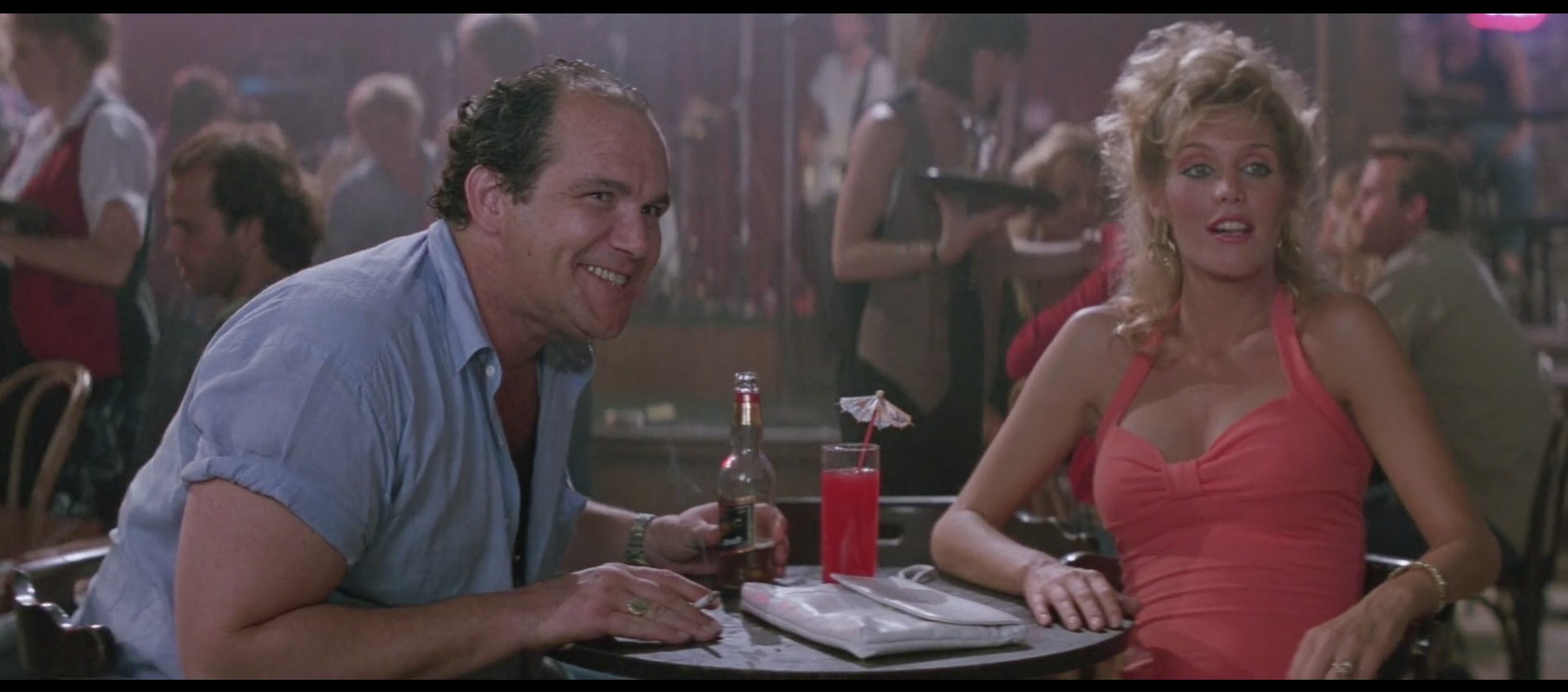
When you write an essay about Road House every day for a month and a half and counting, you learn some wonderful things. As mentioned earlier, Sharing Husband is played by one Christopher Collins (no relation). What I did not know until a reader kindly brought it to my attention is that Mr. Collins was also a voice actor under the name Chris Latta. Not just any voice actor, either. The same guffawing bumpkin who asks “Ever seen a better pair a’ attitudes?” is the voice (screech? wail?) of Starscream from Transformers and Cobra Commander from G.I. Joe, two of the most distinctively abrasive villains in the entire pantheon of early-to-mid-Eighties boy-oriented action-figure commercials in children’s-entertainment form.
Cobra Commander in particular was for me the sound of an entire school of childhood villainy, and a very popular school at that: the chickenshit heel who looked much cooler than he actually was. (Skeletor is the other go-to here.) Any time I had access to a Cobra Commander action figure I felt behooved to swing in the opposite direction and make him competent and fearsome—the lack of respect shown him by his own goons, much less the Joe Team, bothered me that much. Anyone with a mask collection that rad, I reasoned, deserved better. Yet such was Latta’s skill in voicing the character that I maintained the same timbre to the best of my ability even as I substantially changed his skill set. This was not a voice you could shake so easily.
To be sure, the voice Latta/Collins provides for Sharing Husband is less distinctive and more easily imitated than Starscream or Cobra Commander (or the even more eardrum-annihilating D’Compose from Inhumanoids, the …And Justice for All to the other villains’ Ride the Lightning and Master of Puppets). Latta also voiced some of the Simpsons characters during the cartoon’s first season; his Mr. Burns, an instantly recognizable voice that Harry Shearer was nonetheless able to recreate perfectly and play for the rest of the show’s 78-year run, is a creation closer to Sharing Husband’s mark. But learning that Collins was a voice actor by trade, rather than a stuntman as I’d assumed, made his marvelously cartoonish delivery of this scene’s central offer easier to contextualize.
“Tell you what,” he says to the Gawker as the man ogles Well-Endowed Wife and her pair a’ attitudes. “For twenty bucks…you can kiss ’em!”
The offer itself is a wonderfully dumb surprise, of course. It’s “Take my wife—please” with a pricetag. His subsequent repeated elaboration that this amounts to “ten a kiss” implies that either there’s a cheaper option on the table, like going to Subway and getting the six-inch instead of the foot-long, or perhaps that you save if you buy in bulk off the individual price of $15 per breast. The whole thing somehow manages to be both salacious and childish, like if the graffiti on the wall provided a number for neither a fuck nor a Buick, but the opportunity to “check out my weiner.”
But as you might expect from an actor with Collins’s bonafides, it’s all in the delivery. His eyes shine with twinkle straight out of Looney Tunes. A wolfish grin borrowed from Tex Avery spreads across his broad sweaty face. His eyebrows move with exaggerated Groucho Marx mischief. After being relatively deliberate with tell you what and for twenty bucks, he whips through you can kiss ’em in a pair of rapid up-and-down inflections, like if he says it fast and forcefully enough it can be fired directly into the brain of his mark, so he’ll think it was his own idea.
I make a lot of hay out of a lot of minor Road House moments, because they often communicate much more than intended. That isn’t the case here. This is a minor Road House moment that does exactly what the expert performer behind it set out to do, no more and no less. He wanted to seem funny, horny, eager, slightly stupid, and wholesomely sleazy. Unlike he perpetually failing Cobra Commander, he got what he wanted.
043. Good times with good friends
Part Two of “The Agreement,” a special Valentine’s Week series
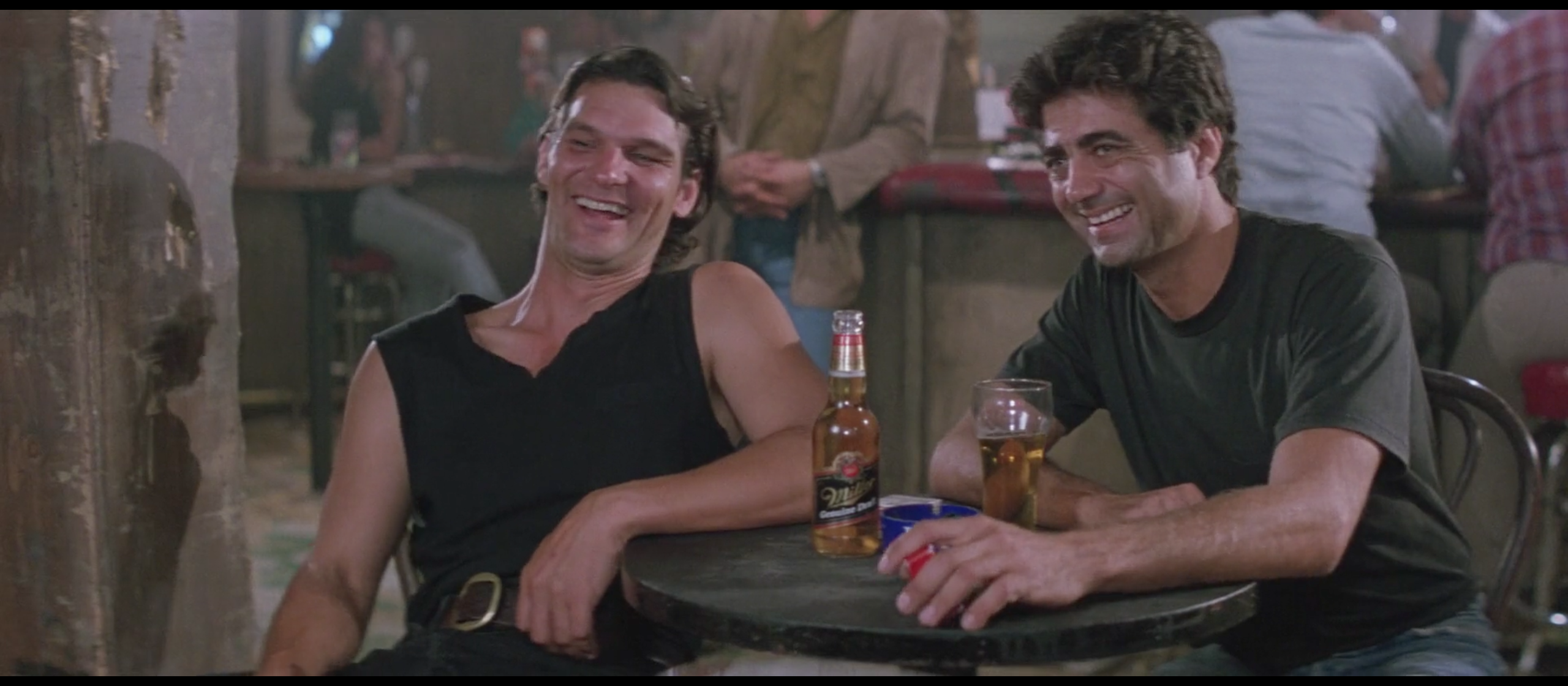
These two fellows are out for a night on the town, and their evening has brought them to the Double Deuce. There they can enjoy the musical stylings of the Jeff Healey Band, watch a shirtless man dance, interact with such luminaries as the Laughing Man and Mr. Clean, watch two brothers fight each other until they’re rolling on the ground near the pool table, potentially get beaten up by a bouncer with anger management issues, buy drugs from a waitress, throw beer bottles at a chickenwire fence, watch a bouncer pick up underage girls, buy a Buick—the world is truly their oyster. They’re sharing a drink they call Miller Genuine Draft, but it’s better than drinking alone.
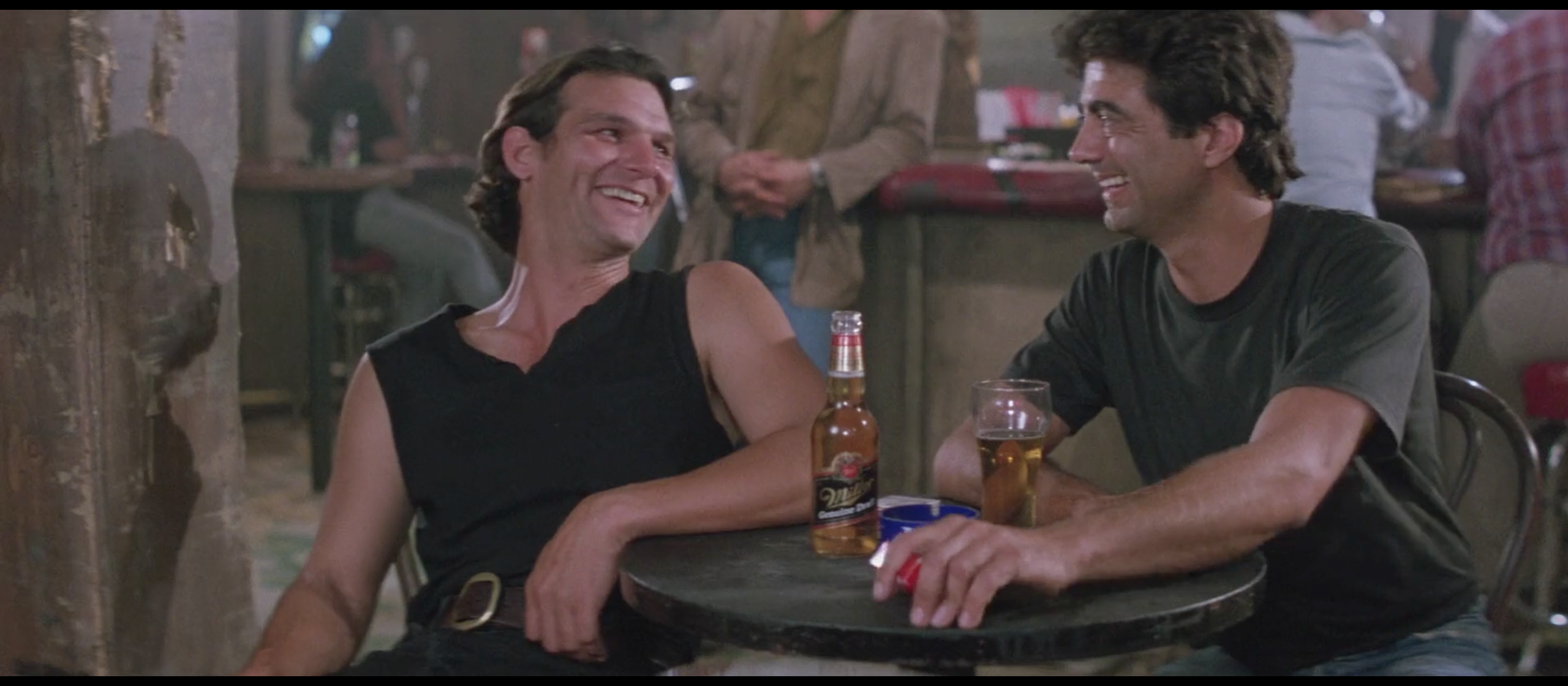
And what a pair a’ attitudes they are! Our friend on the left, known to posterity as Gawker (actor Michael Wise), has the glee-squinted eyes and three-mile smile of a guy whose inebriation has enhanced his personal sense of good fortune tremendously. As well it might! He’s being inveigled to observe the excellent breasts of the Well-Endowed Wife by her Sharing Husband, an invitation he has gratefully accepted. “Fine, ain’t they?” Sharing Husband asks rhetorically; look at Gawker’s face and see if you can guess the answer.
His unnamed and uncredited pal is a delight as well. With bright eyes and bushy brows that both a) make him look like the wacky horny best friend in any number of ’80s sex comedies and ’90s Skinemax flicks, and b) appear as if they got spooked by Gawker’s smile and migrated to the next face over to avoid the space crunch, he plays a similar role in relation to his gawking friend that SH plays to WEW. He is there to beam approval, to offer encouragement, to generally egg things on. He too is clearly tickled pink by Well-Endowed Wife’s namesakes, but his gaze is reserved as much for Gawker as it is for her. He wants to see his friend seeing the thing they’re both seeing.
This is more common in Road House than you might think. In this film, it is often not enough to experience events on one’s own. An audience is required to confirm that the thing that has happened really has happened. It makes sense given the subject matter. When you’re a famous cooler hired to clean up an absolute cesspool of a nightclub, it won’t do to bust a few heads anonymously. The word needs to get out, to both the nice people and the ne’er-do-wells, that things have changed. By the same token the bad guys need their fellow goons’ laughter and howls of approval to make them feel their actions are justified, and they need not just their direct victims but everyone else to see what happens when they are defied. By the back end of the film Brad Welsey’s terroristic attacks on businesses who resist his protection racket take place for virtually no other purpose.
Gawker and friend aren’t keeping each other in a fashion anywhere near that brutal. But as we asked yesterday regarding Well-Endowed Wife and Sharing Husband, would the events that are about to unfold have taken place if Gawker had gone to the Double Deuce solo that night? Or is the presence of a friend, to exchange knowing glances and exclamations of pleasure, to verify and reify the spectacle, required to fully enjoy that spectacle? And is that not unlike the act of watching Road House itself?
042. Attitudes
Part One of “The Agreement,” a special Valentine’s Week series
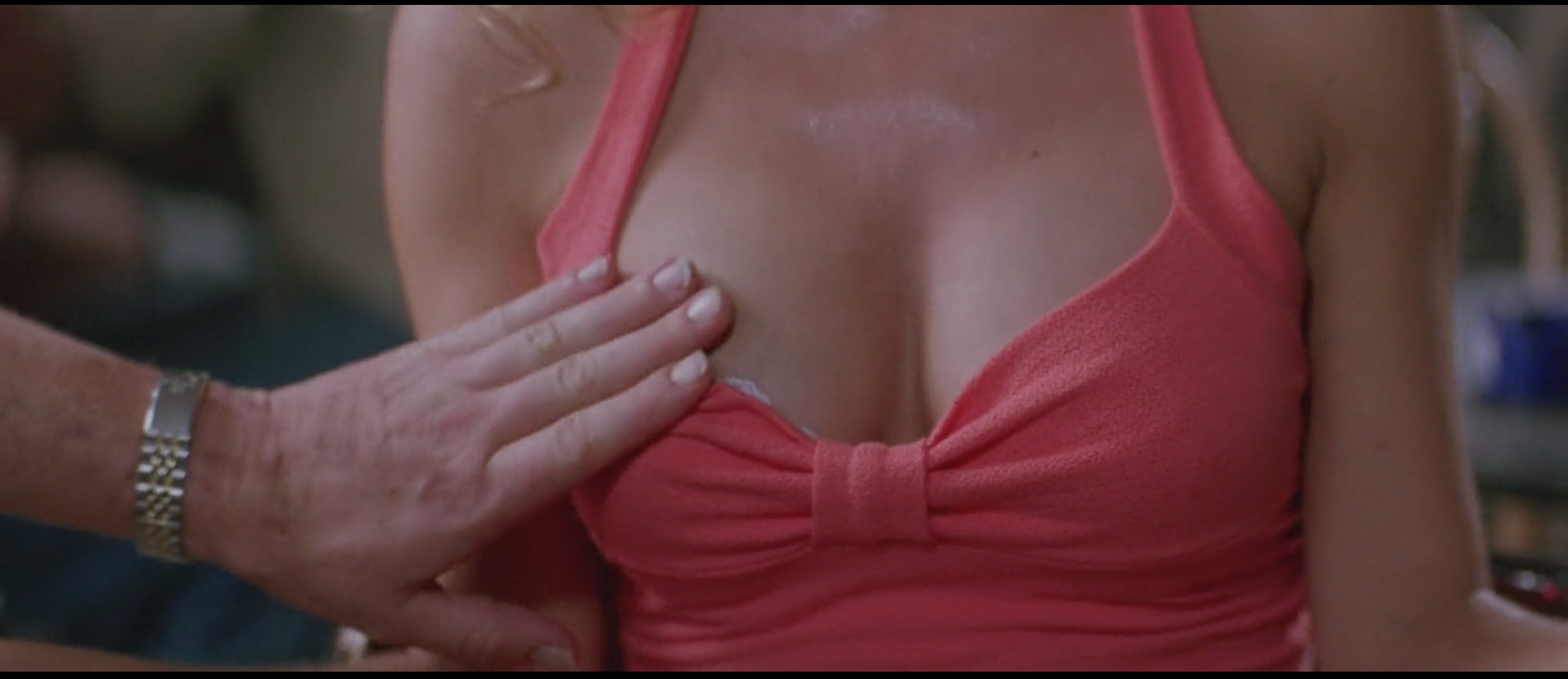
“Ever seen a better pair a’ attitudes?”
Even for a film that has already introduced us to “dirtball” and “moose-lips” (though “chicken-dick” is still a ways away), Road House still enters uncharted linguistic territory with the euphemism the person on the left of the above photo uses for the breasts of the person on the right. This is of course the right, perhaps even the calling, of screenwriters David Lee Henry and Hilary Henkin. If your goal is to make an audience that is quite possibly already inured to chuckleheaded idiocy sit up and take notice when a large, sweat-soaked gentleman, whose first line of dialogue is the kind of guffaw you’d write out as “HAW HAW HAW HAW HAW!” like he’s Pete from the old Mickey Mouse cartoons, proudly displays the body of his special lady for particularly besotted onlooker…I mean, admittedly the bulk of the work has already been done for you. Still, in a language with more slang terms for tits than tits themselves, “attitudes” doesn’t hurt.
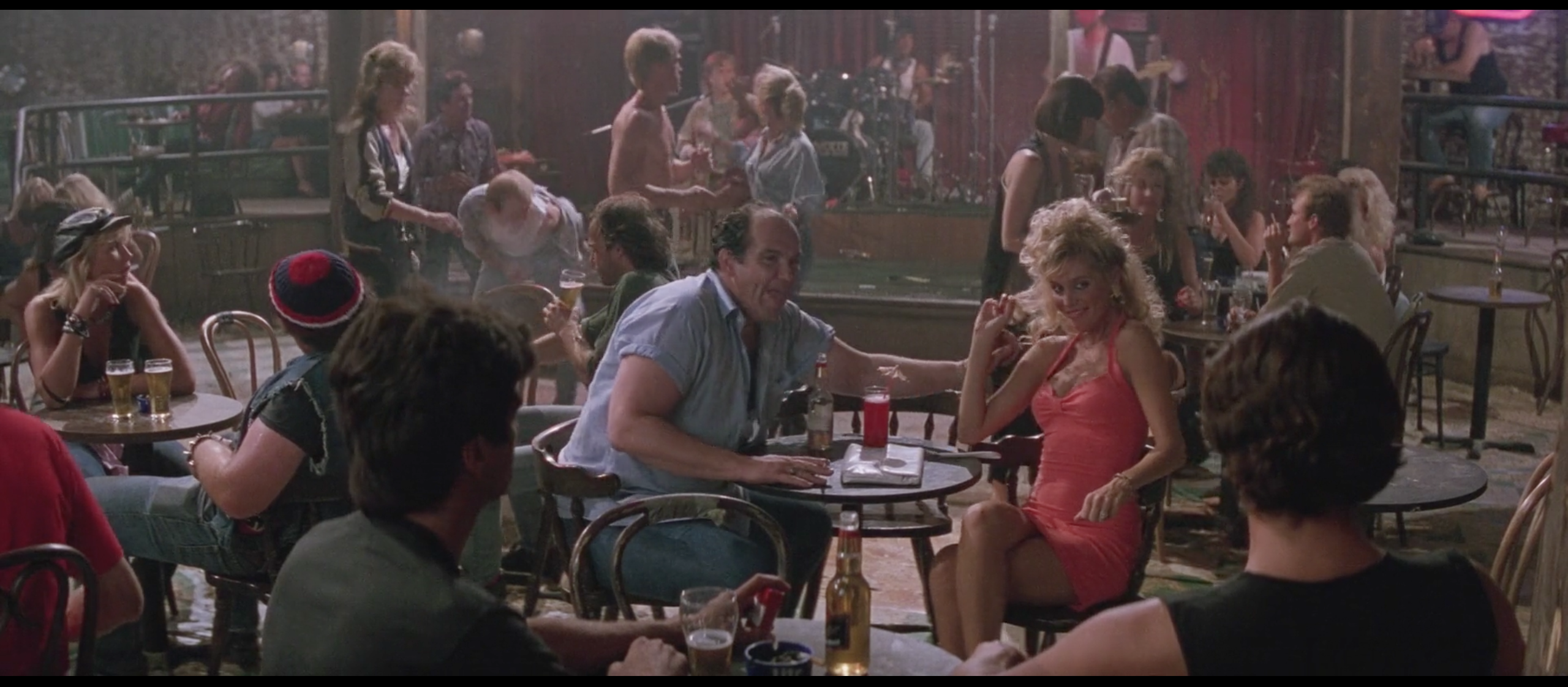
Our new friends, billed in the credits as Sharing Husband (Christopher Collins, no relation) and Well-Endowed Wife (Cheryl Baker) may have hit on something more than skin deep with this coinage, however. One look in the eyes of Well-Endowed Wife will tell you that her attitude is, indeed, half the fun of engaging with her in a bit of shitface-drunk barroom repartee. It’s in the way she smiles, twirls her hair, angles her body toward the audience, and on and on. As we’ve said before, arousal is lovely, desire is lovely, and by that standard Well-Endowed Wife is lovely. It don’t mean a thing if it ain’t got that swing, and to borrow the words of a great man, Well-Endowed Wife is swingin’ on the front porch, swingin’ on the lawn, swingin’ where she wants cuz there’s nobody home.
But the use of “pair” is unintentionally revealing. (That’s the last time you’ll hear that phrase used to describe this scene.) The joy on Sharing Husband’s face and in his voice as he proudly draws attention to Well-Endowed Wife’s unabashed sexual self-confidence is unreconstructed and pure and palpable. (Not as palpable as some other things in this scene, but still.) Without his Wife’s endowments, Sharing Husband would have nothing to share. She’s the reason he is who he is, in a sense so literal it scrolls up the screen in black and white at the end of the movie.
And now we come to the heart of the matter. Would either of them look like this, act like this, feel like this without the other across that table? For while her happiness clearly fuels his, we may conclude from their conduct, and from the words chosen to describe the situation, that the reverse is also true. Just as Sharing Husband requires the endowments of his Wife to thrive, Well-Endowed Wife relies on her husband to share those endowments to maximal erotic effect. To give the complexities of cuckoldry, polyamory, and swinging as thorough an examination as they deserve would distract us from walking the Dalton Path. But while there are certainly varieties of each in which the presence of both partners is not necessary to achieve the desired sexual frisson, that does not appear to be the dynamic in play here. They exist in tandem, and it is in tandem that they must be observed. They take that sawdust-strew stage together.
Sadly, they are given reason to reconsider the particulars of their arrangement by scene’s end, in this respect and many others. For now, though? The whole is greater than the sum of Sharing Husband and Well-Endowed Wife. They are pandrogyne, the two-in-one. Ever seen a better pair a’ attitudes? Can’t say that I have, sir. Can’t say that I have.
041. Breaking a table with a human face
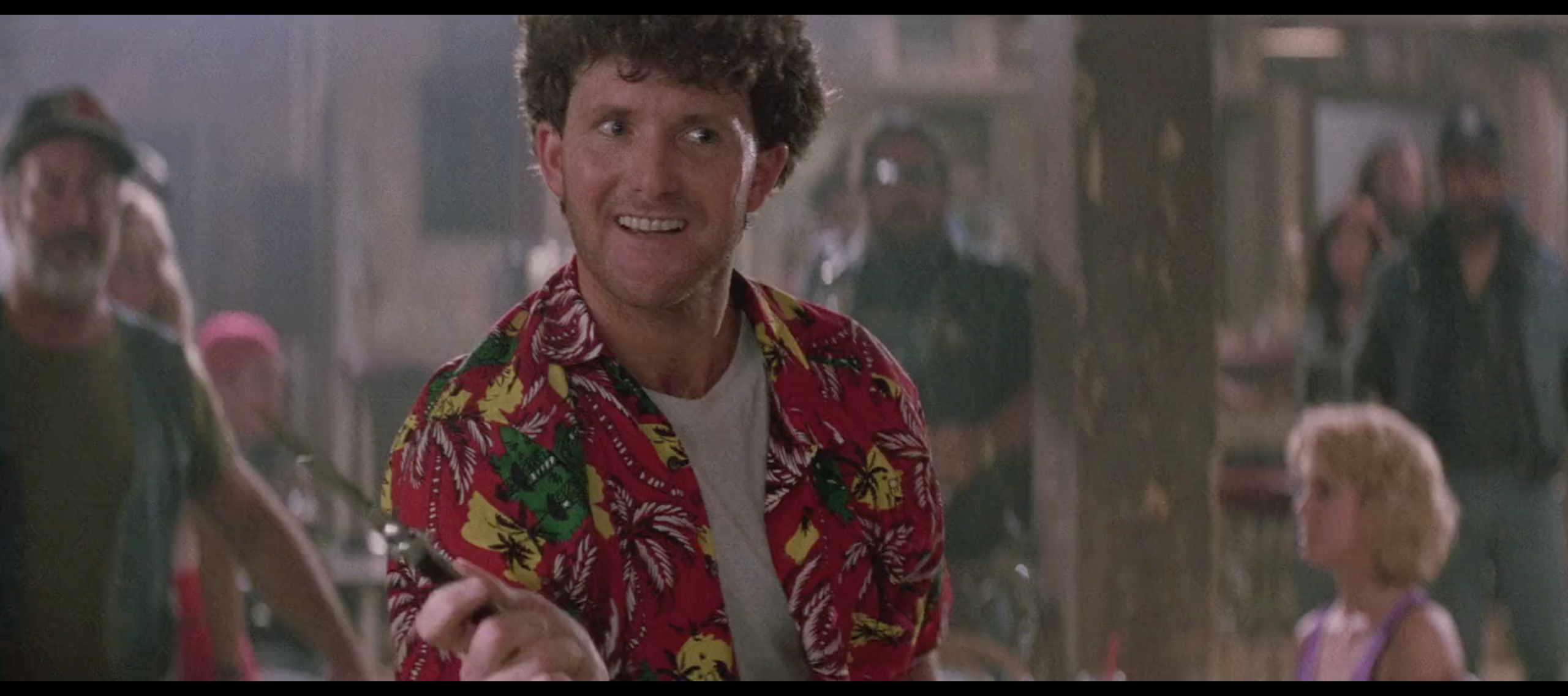
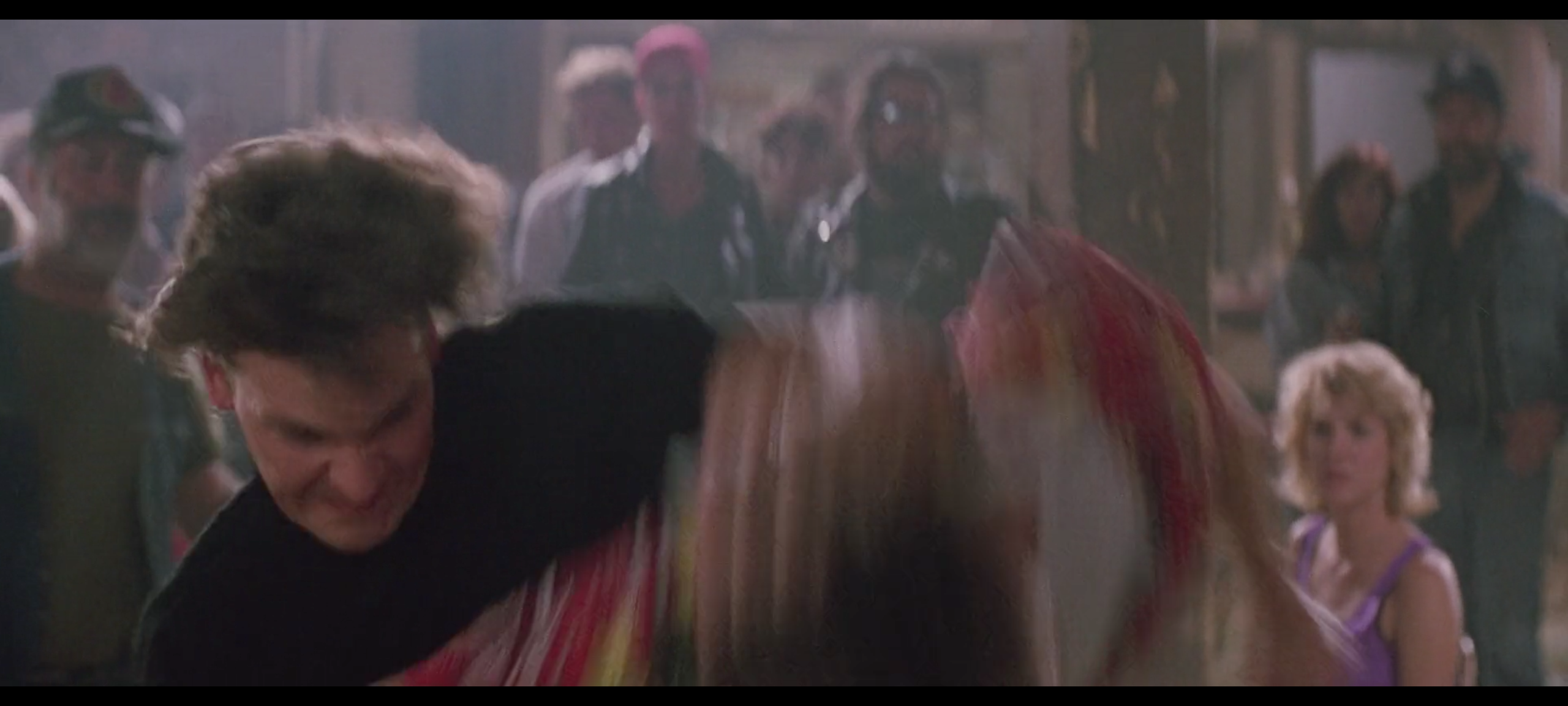
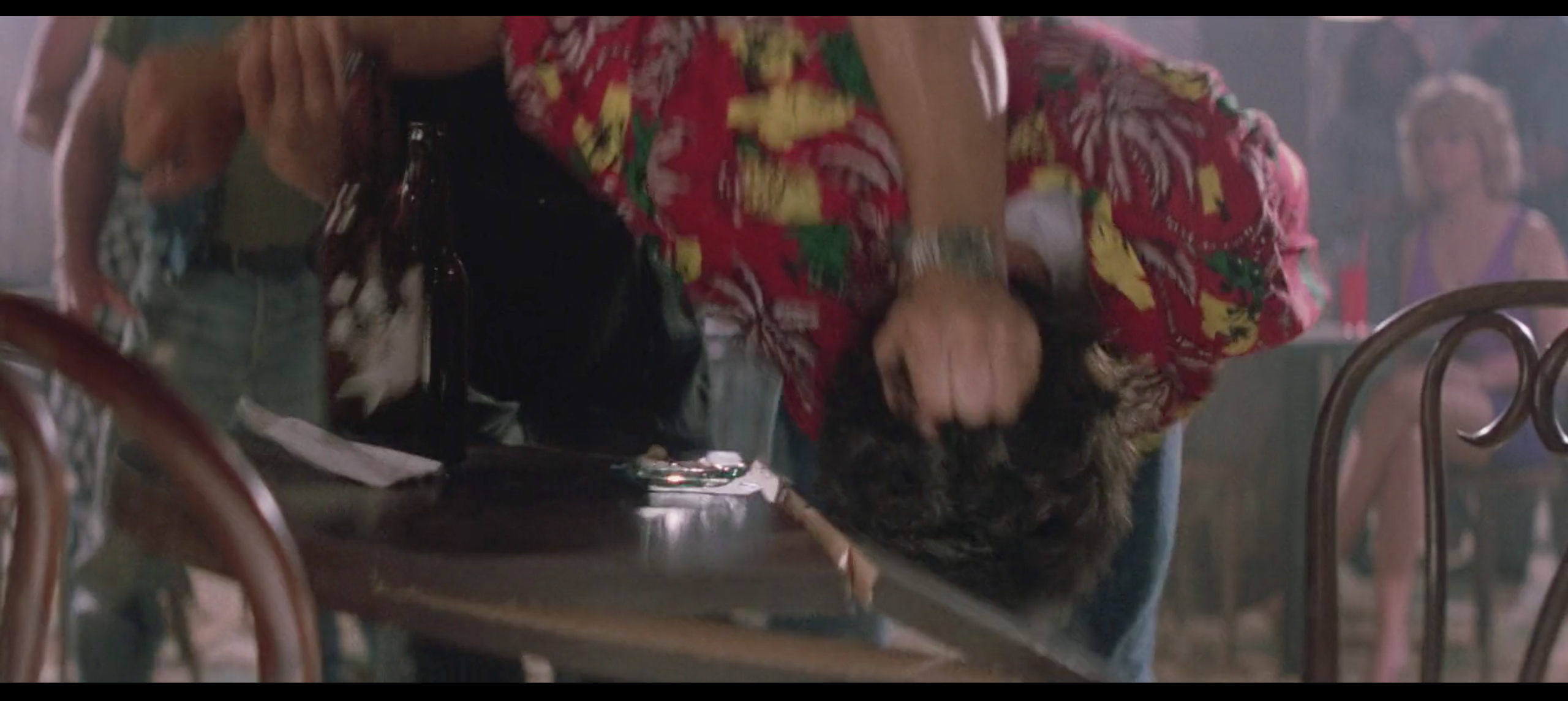
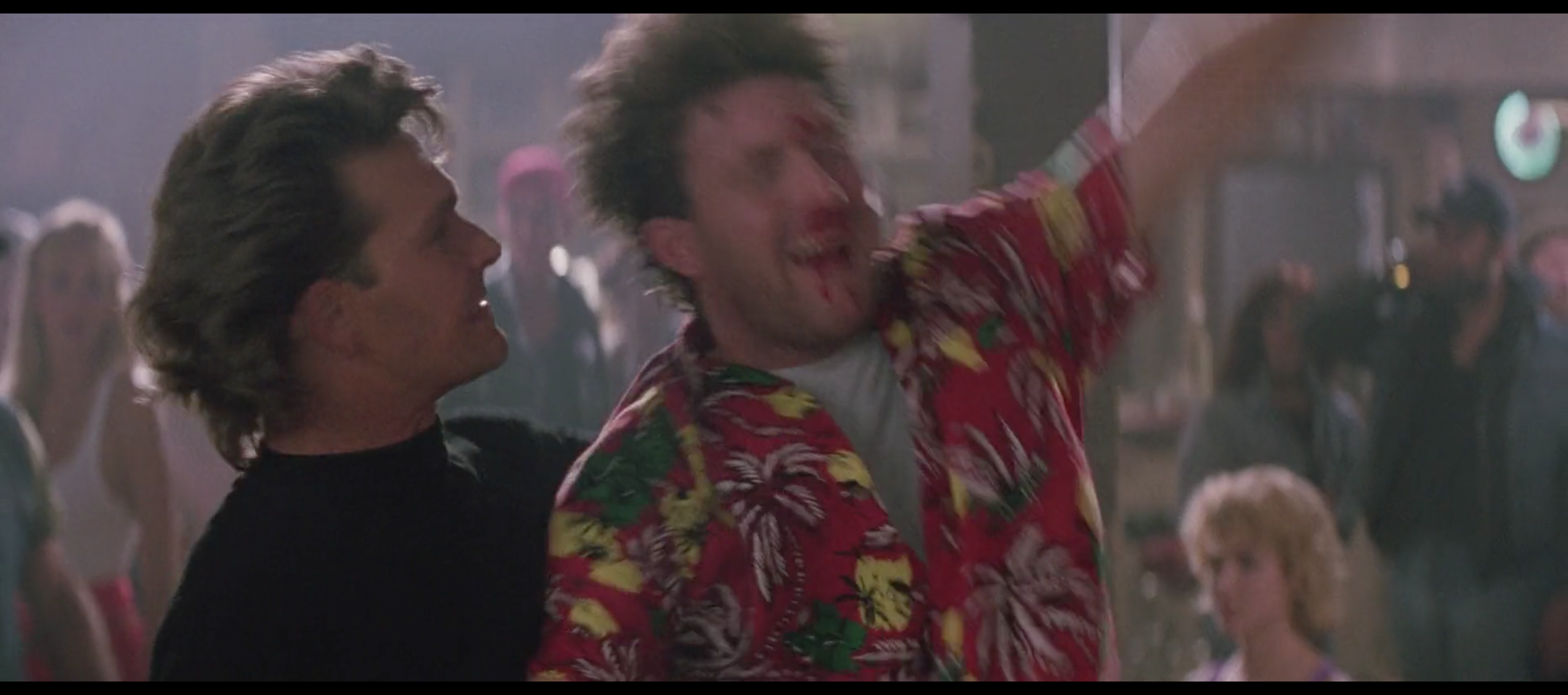
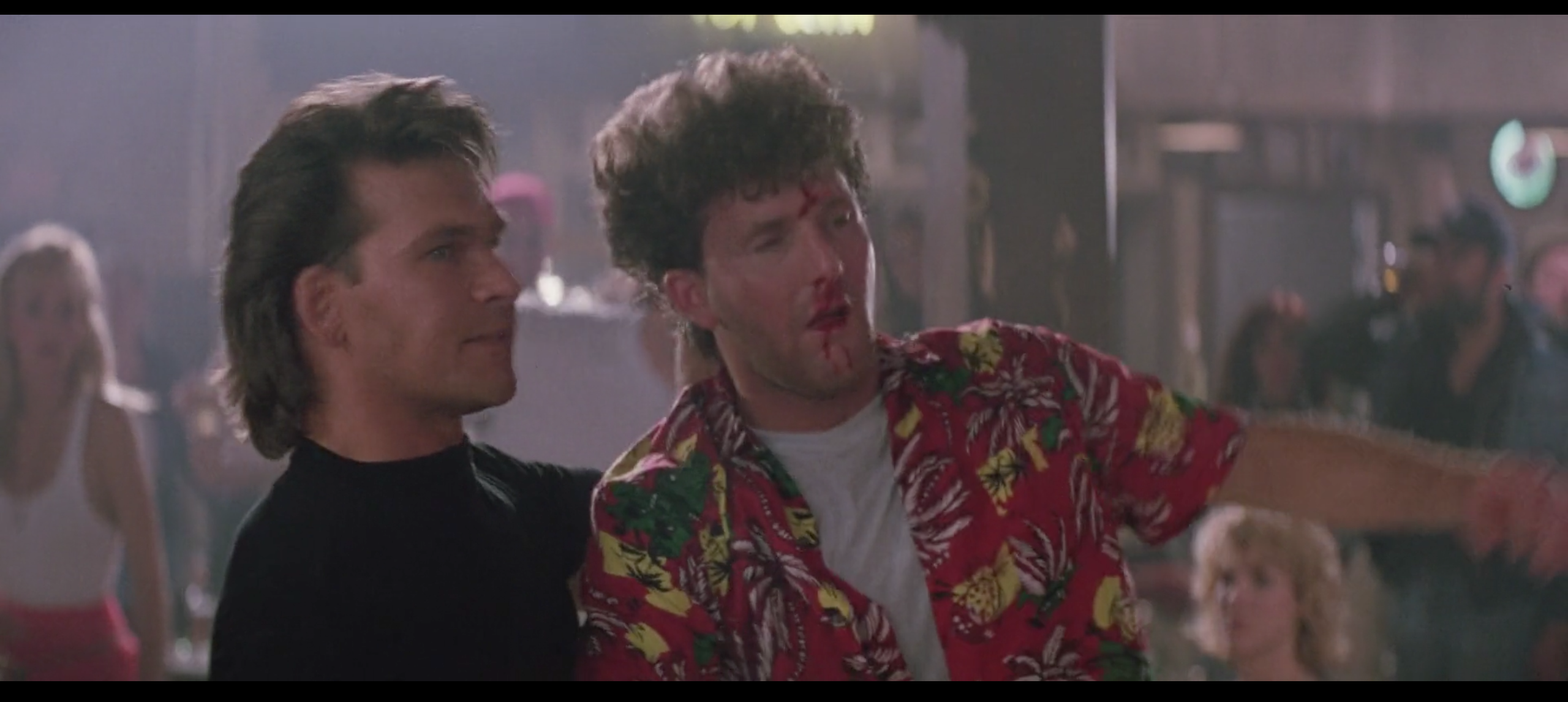
If you want a picture of the Double Deuce, imagine a table broken by a human face — for ever. I’ve been thinking about the way Dalton grabs the Hawaiian Shirt Knife Nerd who was willing to defend his girlfriend’s right to dance on a table literally to the death by the back of his head and smashes his face down into a second table so hard and so fast that the wood splinters cleanly in half a lot lately. It’s a terrifically intuitive and forceful bit of fight choreography, that certainly helps. It conveys Dalton’s efficiency of movement and his power at short range, key to making him seem like a physical threat when half the characters in the movie say “I thought you’d be bigger” to him at one point or another.
Crisp editing by Frank J. Urioste and John F. Link (Die Hard, RoboCop, Predator, Commando, Total Recall, Basic Instinct, Tombstone) sells the move, but not alone. As an actor, Patrick Swayze takes a heretofore unprecedented turn for the savage in this moment, scowling with fury we’d previously seen no trace of at all. As time passes we’ll see more and more of this look from him. (To the extent Dalton has a character arc it’s largely one long descent that begins at a moment we’ll discuss in detail later in this series and ends with five murders.) Dalton traffics primarily in a blend of the Western and Eastern forms of coolness; he’s gunslinger tough and martial-artsist enlightened. The audience needs to see what happens when he gets heated up, and how little normal men can do to stop him when it happens.
When does it happen? This is important as well. The scene that precedes the table incident is none other than the Giving of the Rules, in which Dalton lays out his credo for successful bouncing and cooling. “Never underestimate your opponent/expect the unexpected”? Check. Dalton chose to act in such a way that this guy was done before he even realized the fight had started. No surprises coming from that corner. “Take it outside/Never start anything inside the bar unless it’s absolutely necessary”? Okay, sure, we’ll allow it. This bizarre little man drew a knife and threatened to murder a bouncer simply because he’d been asked to ask his girlfriend to stop climbing on the furniture. Sounds absolutely necessary to me. (And the Third Rule? Perhaps you know it already, perhaps you don’t. We will not be discussing it just yet. We will not discuss it…until it’s time to not not discuss it. Let’s just say that grabbing a human being by his hair and forcing his skull through a table sturdy enough to dance on speaks volumes on the Third Rule’s contents.)
What happens immediately afterwards? Everyone in the bar gazes and gasps in awe. People nearly move in slow motion, they’re so stunned by his prowess. Even the woman whose boyfriend has just been given some kind of concussion gingerly takes Dalton’s hand to be led down off the dancing table, and looks back over her shoulder at him on her way out of the bar. This is a man worth turning into a pillar of salt for. “The name…is Dalton,” Cody announces from the stage (through the chickenwire), after being filled in by his sighted bassist as to the nature of the hubbub—like a talk-show host announcing a guest, or the lead singer introducing the band. People in the Road House Universe absolutely adore people who break tables with other people’s faces.
Finally, there’s the savagery of the act itself. Powerful agent to the uninitiated. WA-BAM! He broke a table with a guy’s face! Didn’t even give him a chance! If you’re a first-timer and you reach this moment, any fears you may have had as to whether the first big barfight was the last time you’d see anything that gratuitously, moronically violent, this lays your fears to rest. You ain’t seen nothing yet.
040. The Second Rule
“This is the new Double Deuce,” says Frank Tilghman. We are at the start of an all-hands staff meeting, and Tilghman is pointing to the concept art for the bar’s redesign. But standing nearby is his latest hire, Dalton. It is through Dalton, with Dalton, in Dalton that the new Double Deuce will be achieved. Dalton embodies the new Double Deuce. He is its future.
When Dalton takes over as cooler he becomes more than just the chief bouncer. His role is not to handle a series of discrete incidents, but to institute sweeping reforms that will eliminate such incidents forever. “It’s going to change,” he states—not a threat, not a promise, a fact. His bouncers, too, must change for this to take place. As below, so above.
Bouncing on the Dalton Path is a matter of following “three simple rules.”
This is the second.
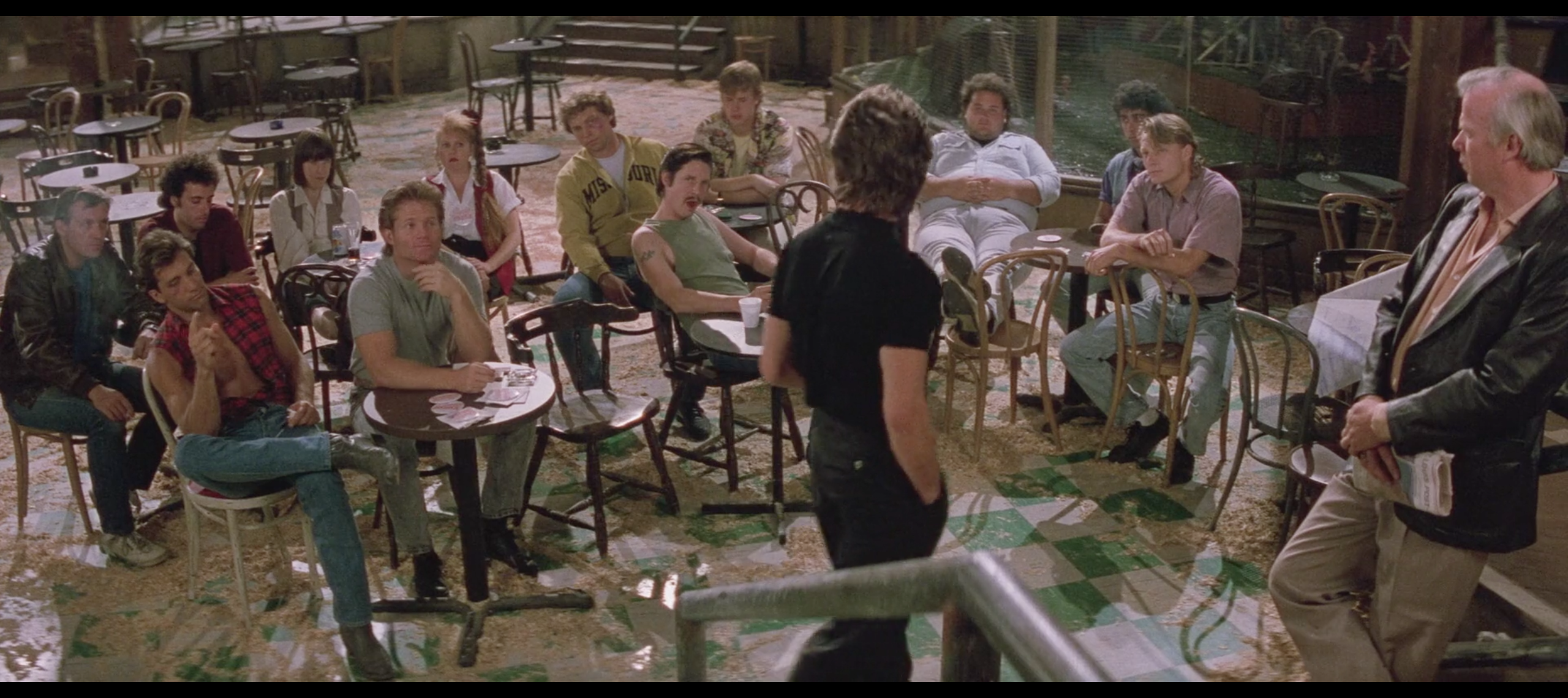
2. Take it outside. Never start anything inside the bar unless it’s absolutely necessary.
A bouncer less wise than Dalton would think Rule 2 begins and ends right here. How much more could there possibly be to this purely practical commandment? Your job is to maintain a convivial atmosphere for the patrons of your establishment by keeping the bad element at bay. You can’t do this if you’re beating the shit out of a guy on the dance floor. Ergo, you either force or lure your opponent out of the bar—your ultimate goal at any rate—before engaging in fisticuffs. What else is there?
What else indeed. As you can no doubt imagine, many, many violent incidents occur at the Double Deuce between this speech and the end of the movie. Dalton and his men take it outside a grand total of once during that time. Dalton in fact grabs a guy by the back of the head and smashes his face through a table this very night. What conclusion can we draw from this?
What we have here is another “If you think this sentence is confusing, then change one pig” situation.
Let’s start with the assumption that Dalton, as evidenced by his own actions, must intend this rule to have some larger meaning beyond its (eminently sensible) practical application regarding the bouncer’s ideal field of battle. I would suggest that we look to the Third Rule for the key to unlock this mystery. A thorough examination of that rule must wait for another day, but for now suffice it to say “It’s nothing personal” is a central component.
Could it be the case that in commanding the staff of the Double Deuce to “take it outside” when the moment of truth arrives, what Dalton really means is to step outside themselves? Those who follow the Dalton Path must see themselves as parts of a greater whole. They are but tools in the hands of the Cooler; does the hammer hate the nail? They are the immune system of the bar-organism; does the white blood cell hate the infection in the wound? The bouncer is the agent of Gemeinschaft. Proper function necessitates depersonalization so that the wider view may come into focus.
Now let us go further. What is it to “start something inside the bar”? We have already learned that many of the forces that threaten the Double Deuce are not conflicts that arise organically between patrons, but deliberate infiltration and provocation directed by an outside agent: Brad Wesley. Wesley himself is merely a symptom of larger societal crises: capitalism generally, the tyranny of the small business owner specifically, toxic masculinity, and even, as we will see when we enter his Trophy Room, ecological destruction.
Moreover, let us not allow “conflicts that arise organically between patrons” to pass by unremarked upon. Dalton identifies the Double Deuce’s problematic clientele as “Forty-year-old adolescents, felons, power drinkers, and trustees of modern chemistry.” Cultural neoteny, the carceral state, alcoholism and addiction, and the role of business and government in fomenting all of the above: One need not absolve the meathead or the Knife Nerd of personal responsibility to correctly argue that they themselves are often victims of forces far beyond their control.
Now let us return to the Second Rule. “Never start anything inside the bar unless it’s absolutely necessary,” says the man who will break a piece of the bar’s furniture in half with another human being’s face just a few short hours later. Who is he really addressing here, and what is he saying to them? Is he simply telling the bouncers (and waitstaff and bartenders and band members and the unknown entity in the brown jacket) to avoid throwing hands inside these four walls? Or is he employing paradox to demonstrate that nothing ever truly starts inside the bar—that while the Dalton Path offers a safe route through the bar for all who choose to walk it, it is a road without beginning or end?
For our struggle is not against flesh and blood, but against the rulers, against the authorities, against the powers of this dark world and against the spiritual forces of evil in the heavenly realms. (Ephesians 6:12)
039. Biker Gang
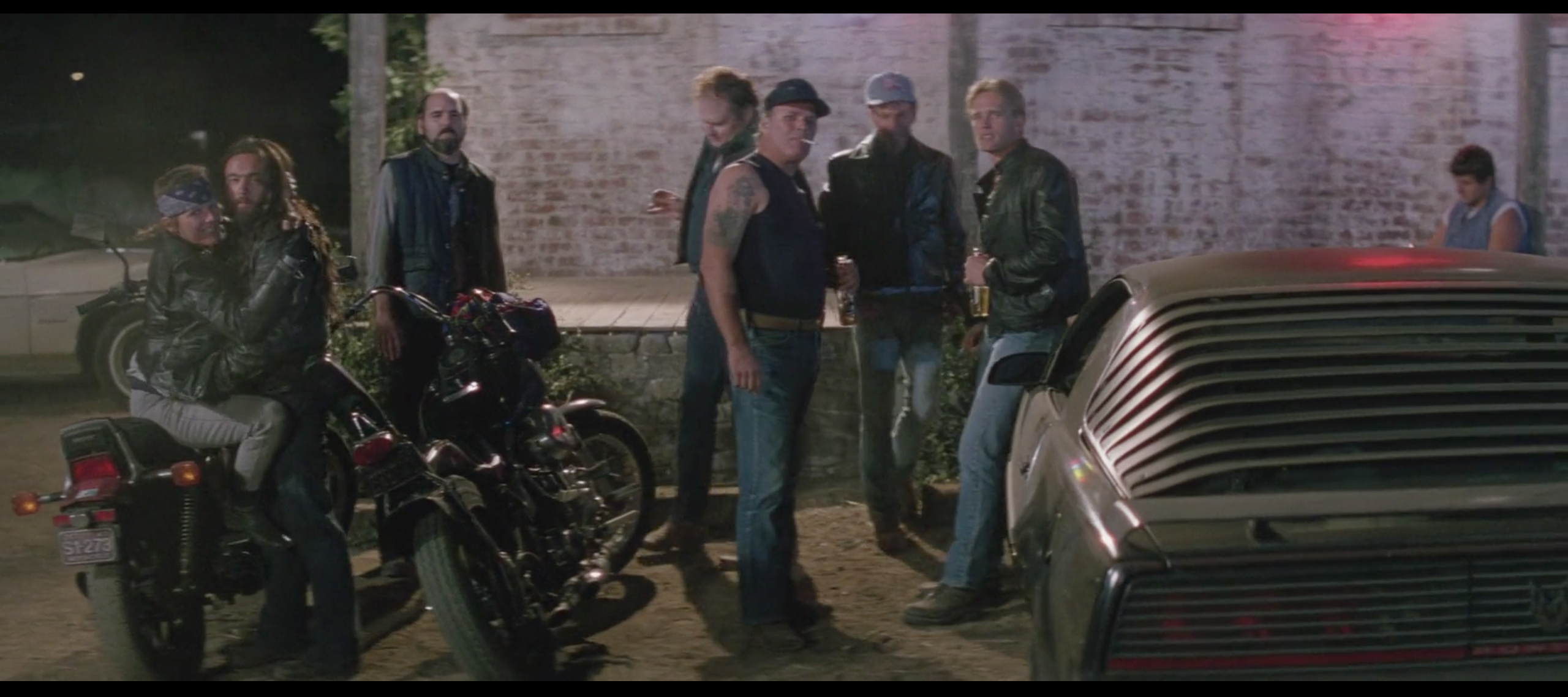
The very first people to give Dalton shit upon his arrival in Jasper aren’t Brad Wesley and his goons. They aren’t the corrupt members of the Double Deuce’s staff. They aren’t even Knife Nerds or other random ne’er-do-wells among the club’s clientele. They’re a biker gang, in the Double Deuce’s parking lot. “Mer-SAY-dees!” they whoop it up as Dalton parks his luxury work of German engineering in the unpaved unloading zone for the town’s worst element, glaring at him all the while. “Hey hotshot! What’s wrong with Dee-troit cars?” Dalton simply stares back at them and their bikes and their very cool ’80s bad-guy car, tosses away his cigarette, and goes about his business. You and I are left with more to ponder.
At first blush it’s just a bit of color, a way to convey that the Double Deuce is a rough and tumble environment before you so much as step through the doors, in the same way that watching Morgan the evil bouncer toss a guy through those doors a few seconds later (“Don’t come back, peckerhead!”) lets you know what you’re in for once you set foot inside. What makes it a uniquely Road House bit of color how none of it has the slightest relevance at any point in the future, and how no element of it is ever heard from again.
Are biker gangs a threat Dalton will face in his quest to clean up the Double Deuce, and eventually the entire town of Jasper? No. Not even a little bit, in fact. The problems all stem from Brad Wesley, the Fotomat King, and his merry band of assholes. This is Road House, not The Road Warrior. Though Dalton and Brad Wesley could well be the Mad Max and Lord Humungus of the post-guzzoline Missouri wastelands should it come to that, this is merely informed speculation.
Is there a slobs vs. snobs angle to the movie? Again, no. For one thing Dalton always stows away his fancy car and uses a ringer instead once he starts working, so he doesn’t even bring the Mercedes back to the Double Deuce, or anywhere else for that matter, until the end of the film. He doesn’t ostentatiously spend his money, or wow the local yokels with his citified ways, or even crow about his NYU philosophy degree to woo Dr. Elizabeth Clay. What’s wrong with Dee-troit cars? Nothing, as far as he’s concerned. (This is a question better directed at Brad Wesley.)
Maybe these guys play a role in the ensuing all-hands-on-deck barfight, the movie’s first? Once again, no. The instigators and all the primary combatants are just the usual drunken shitbirds and meatheads. While it is true that one of the bikers miraculously appears inside as the Shirtless Man about twenty seconds later, this is down to Road House‘s charmingly free-form approach to continuity, rather than the idea that this guy somehow raced around to a back entrance, bared his chest, and started boogying down in the time it took Dalton to cross the parking lot and enter from the front. The Shirtless Man, at any rate, is a dancer, not a fighter.
But in their own pointless way, the bikers illustrate the importance of Dalton’s First Rule: “Never underestimate your opponent. Expect the unexpected.” Your enemies could look like anyone, come from anywhere, and attack at any time, even if their offense consists solely of “Buy American” jingoism. A cooler of Dalton’s experience and skill would have devised a plan for combatting these creeps within seconds, and likely kept it filed away throughout the course of the film, in case Brad Wesley ever hired them to run his clunker off the road, or prevent him from accessing one of Jasper’s many auto and auto-parts dealerships—or, less facetiously, bring the fight to grizzled old road dog Wade Garrett before he so much as parks his motorcycle. Indeed, one could argue that Dalton’s purchase of a beat-up car to replace his Mercedes was his way of defeating these opponents by depriving them of their casus belli. Victory is his before battle is joined.
038. The Laughing Man
The men who look at Dalton are not the only Road House characters who model behavior for their audience. Nor are the women. To understand this movie, one must understand the Laughing Man.
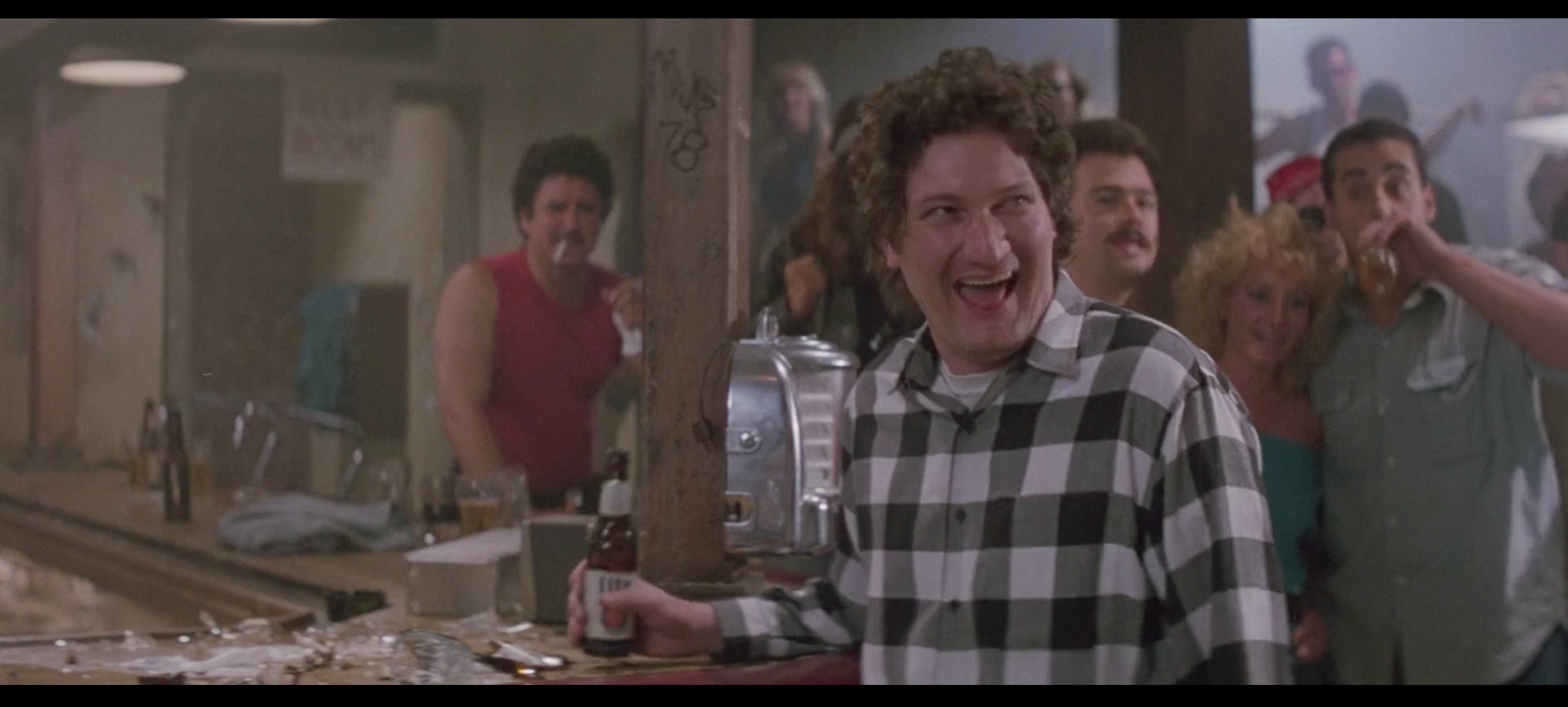
An anomalously odd, almost Lynchian presence in a film that’s otherwise much more straight-down-the-middle in its abject stupidity, the Laughing Man is an avatar for the audience in that the events of the film transmogrify him from observer to participant.
A member of the rogues gallery that greets Dalton upon his arrival at the Double Deuce, he is at first content to simply watch the opening barfight unfold, giggling and guffawing and going slightly crosseyed like a cartoon woodpecker all the while. As a matter of fact, he is at second content to do so, and at third, and presumably ad infinitum. In an another world, perhaps one in which Wes Bradley successfully wooed the first Dillard’s to Casper, Wyoming, this hyena-man is still standing by the bar, laughing like a Joker henchman at everything that has since unfolded. The fool on the hill sees the goons going down.
But that is not the world we inhabit.
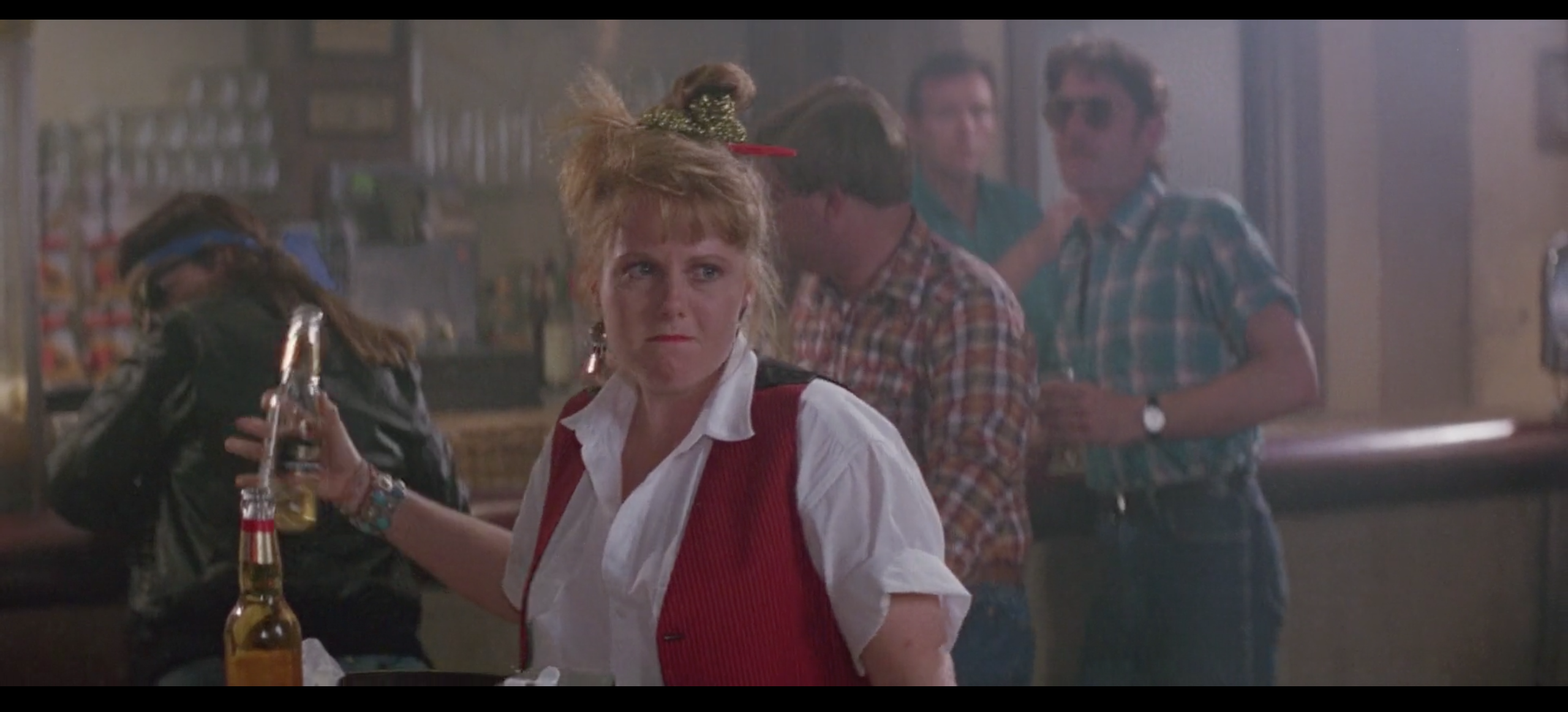
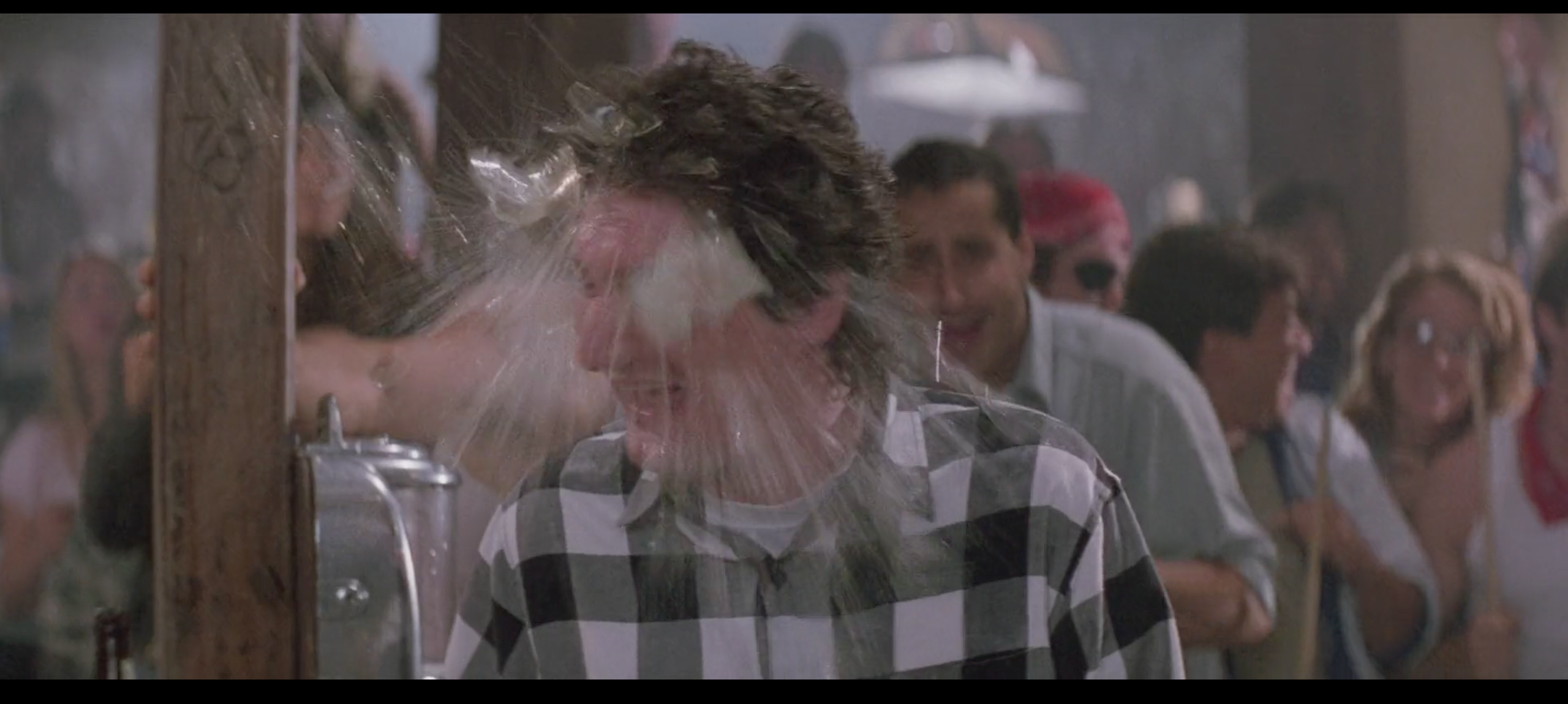
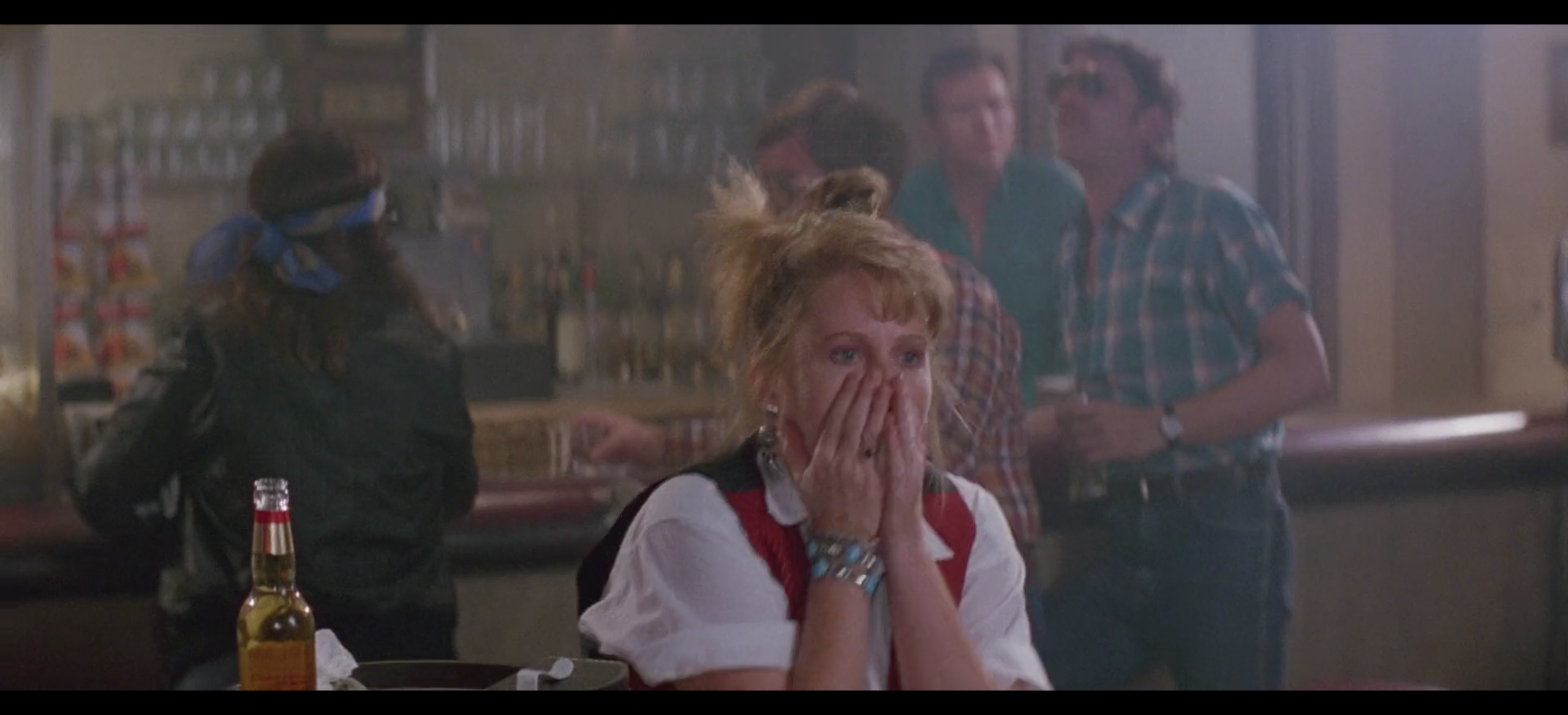
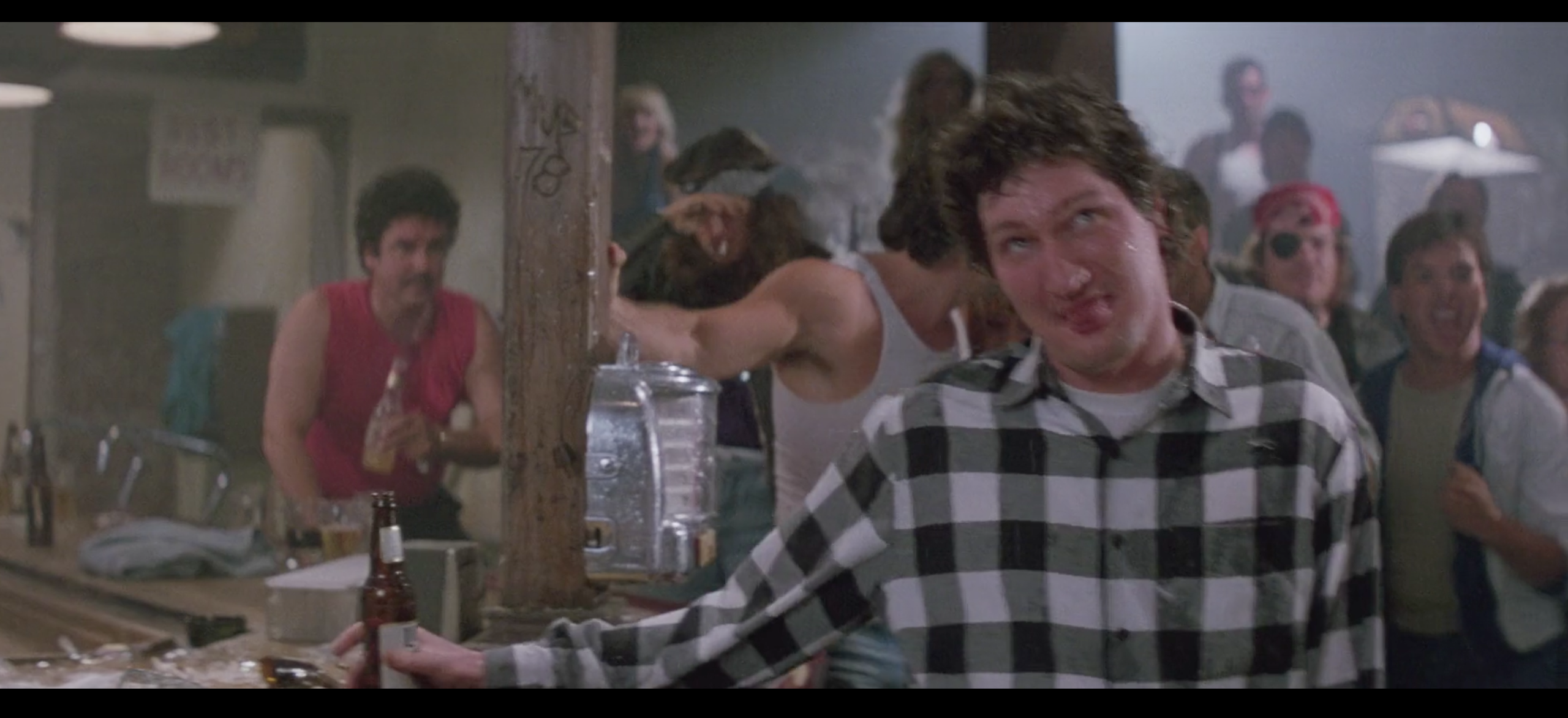
In this world, the ageless waitress who appears to have started working at the Double Deuce after quitting her job at Norma Jennings’s Double R lobs a bottle through the air, intending to hit some other asshole but clocking this harmless nimrod right between the eyes instead. He goes down with the kind of exaggerated overselling you see from pro-wrestling mid-carders, or from anthropomorphic animals around whose heads birds chirp in a saturnine orbit after someone hits them with a rolling pin.
The waitress looks upon her works and despairs. But should we? No! The Laughing Man is concussed so that we might continue. He shows us that no matter how much we might wish to laugh at this movie, it will draw us in until we have no choice but to laugh with it, or suffer for our refusal. You are in the Jasper of the mind now. Laugh and the world laughs with you!
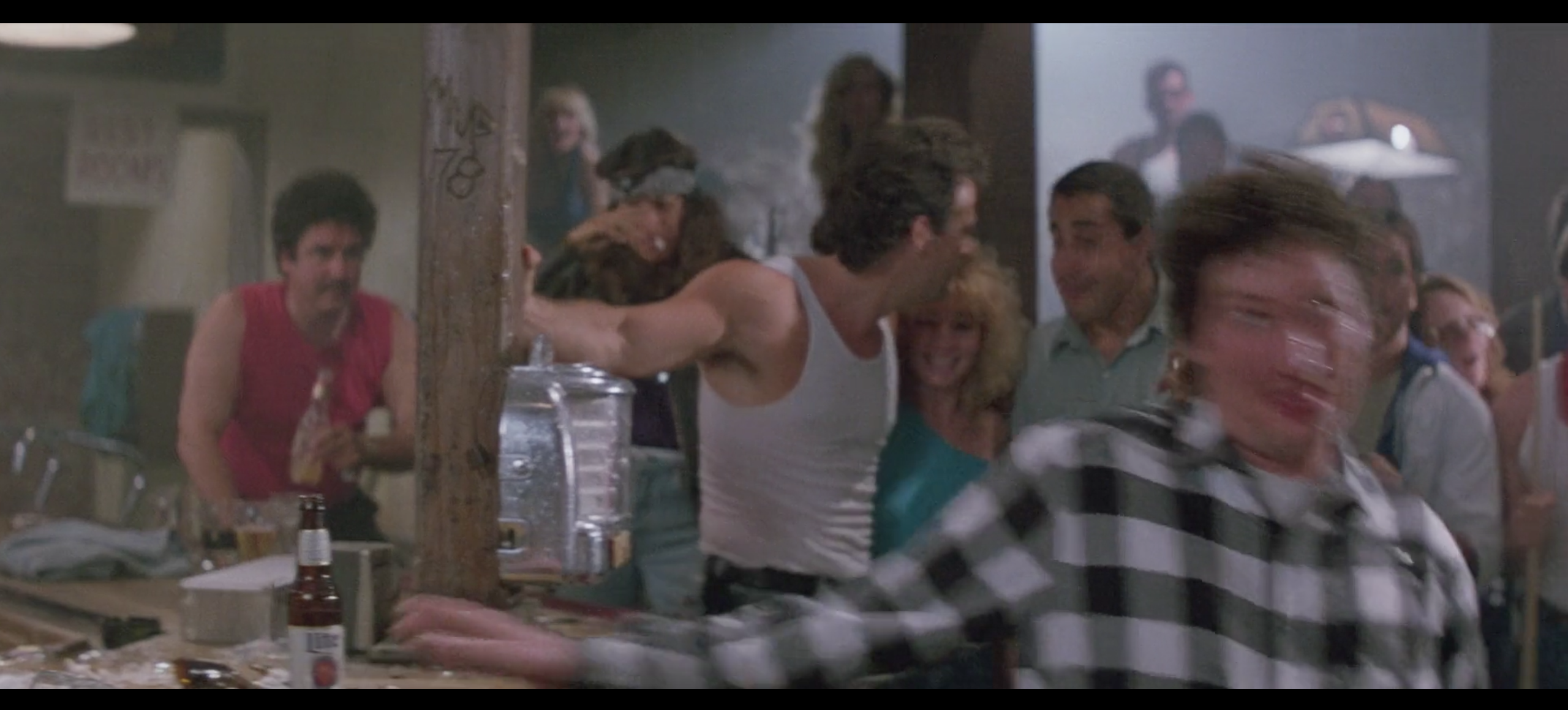
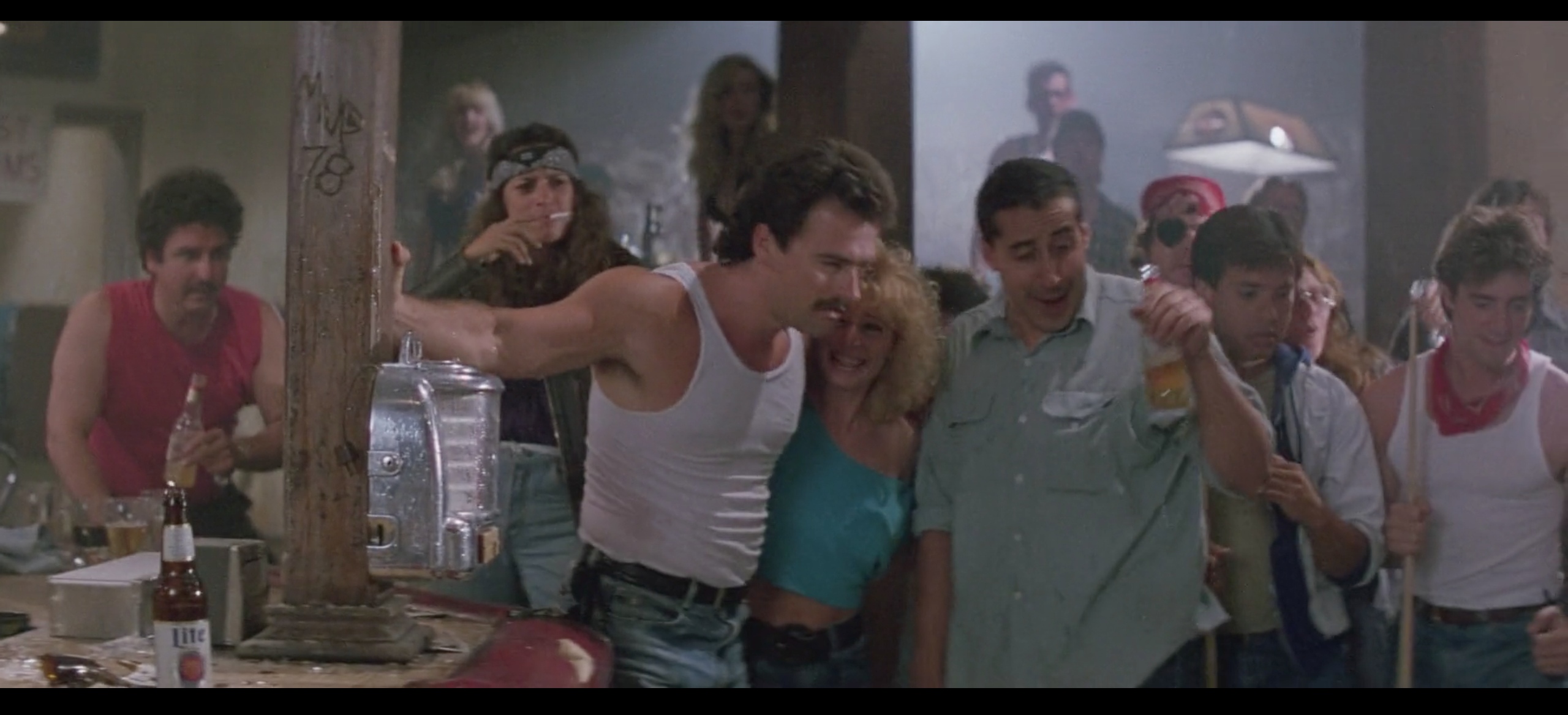
037. Denise & Carrie Ann
I was a theater kid in high school, and yes, I am glad you were sitting down. As the president of the Drama Club, the only coed activity my all-boys Catholic high school had to offer, I usually had better things to do than nitpick blocking, from learning my own steps to realizing how unforgiving for teenage boys pleated dress pants can be. But I did have one pet peeve I remember to this day.
Pretty much every musical in the high-school repertoire has around three or four major characters who—whether because they’re too old, too young, don’t sing, don’t dance, aren’t residents of the town/actors in the company/members of the Conrad Birdie fanclub, or any number of other factors—don’t take part in the big dance numbers, or aren’t active in the events of a particular show case scene. However, they are often at least present at those times, typically clustered in little groups around the perimeter. What would always bug me was when two characters who’d never spoken to each other before in the show, and for whom because of narrative economy it would be a big deal for them to speak to each other, like worthy of a song and dance of their own, wound up standing next to each other, stage-whispering about Professor Harold Hill’s latest chicanery or whatever.
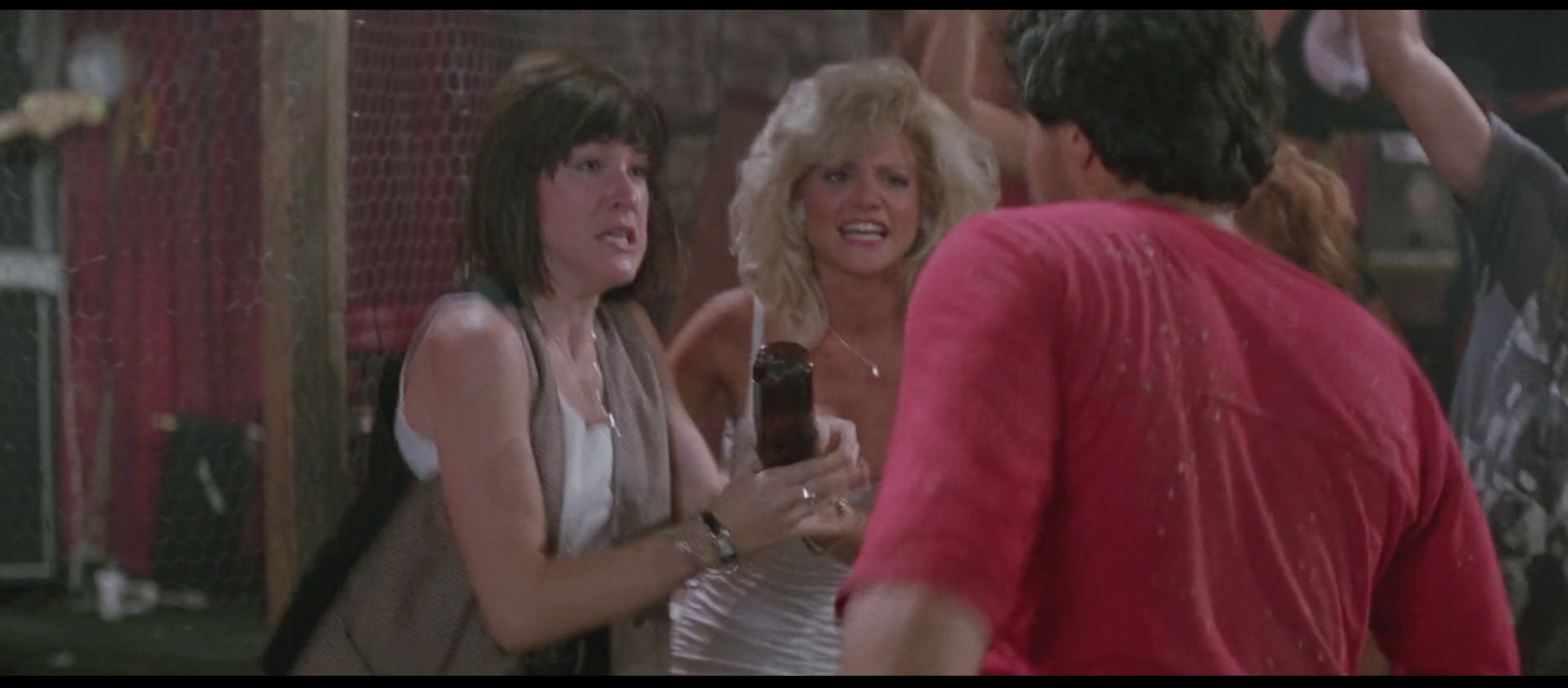
I think about that when I watch Denise, Brad Wesley’s kept woman, and Carrie Ann, the Double Deuce’s coolest employee, team up during the first big fight. They cower together to shelter from the action. They root and heckle and holler as a unit. They wrap protective arms around one another when the going gets tough. Denise cheers Carrie Ann on when she starts slugging one of the participants. She actually hands her a bottle to use as a weapon!
Do these characters have anything in common? Do they have any mutual friends? Do they ever speak to each other…I was gonna say again, but really the phrase I’m looking for is at all? Do they even come within five feet of one another? If you’ve read thirty-six essays about Road House and counting you’re no doubt familiar enough with the film’s approach to continuity to answer those questions. But there’s a gigantic fight scene going on, and they’ve gotta stand somewhere, and the director is probably too busy telling gigantic men which tables to fall through, so a few perfunctory “stand over there”s are all they got, and they improvised. If it helps, imagine they’re the juniors playing Mayor Shinn and Mrs. Paroo, silently emoting together while forgetting to cheat toward the audience during “Shipoopi.”
036. Bleeder
I want to tell you a story of a man and his bleeder.
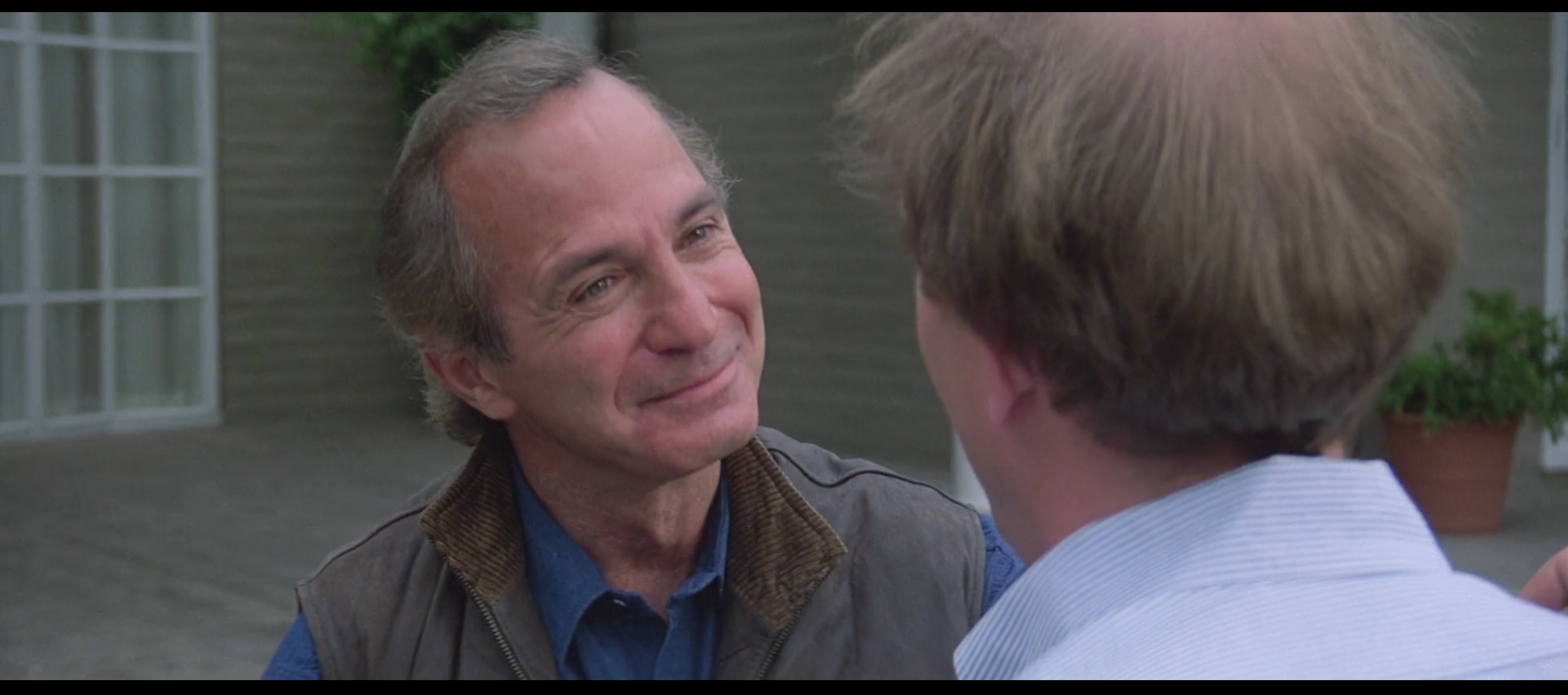
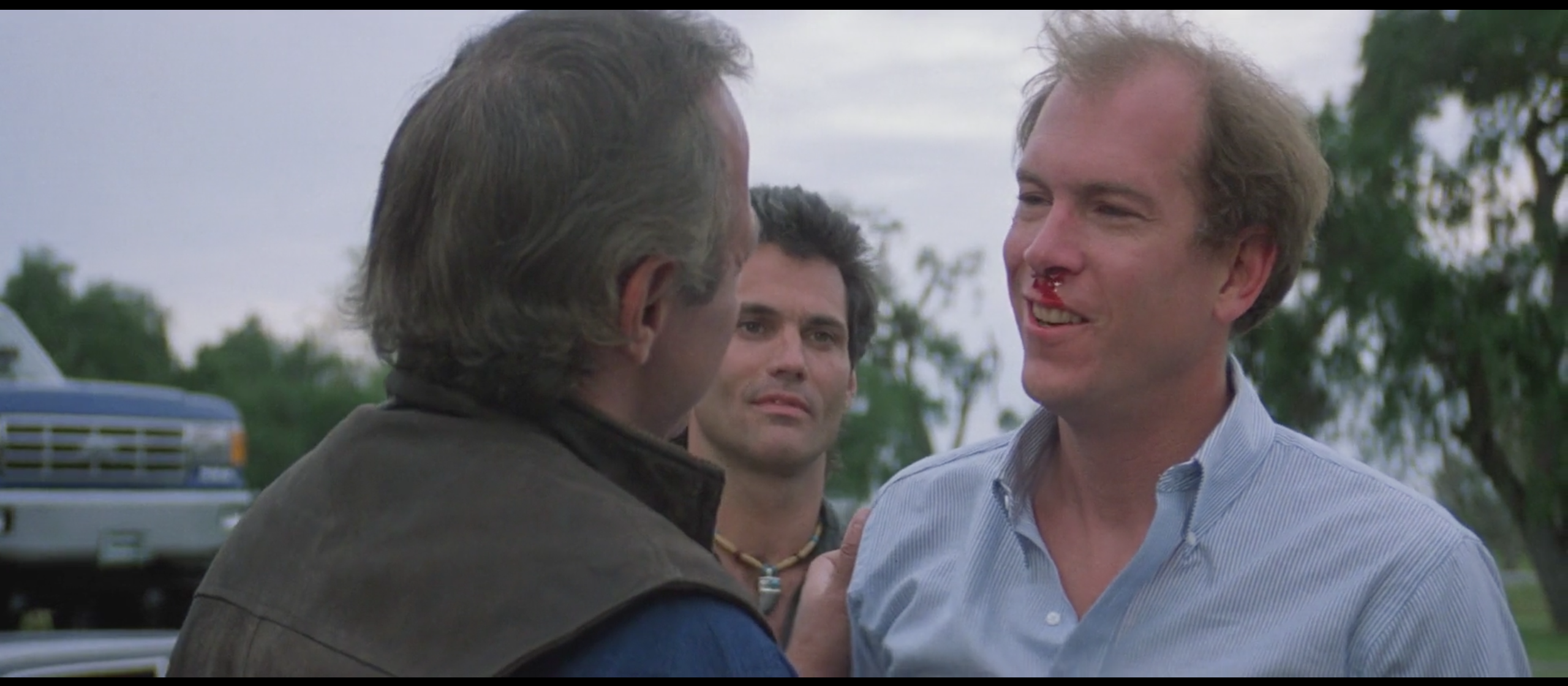
The man is Brad Wesley—sportsman, outdoorsman, liquor distributor, civic leader, JC Penney franchisee. The bleeder is O’Connor, the goon upon whom Brad Welsey’s disfavor falls, to his great misfortune.
The scene in which Wesley beats O’Connor, ostensibly for failing to defeat his newfound enemy Dalton and restore his nephew Pat McGurn to his position as bartender at the Double Deuce but for the stated reason that O’Connor bleeds too much (?????????), is a fanmaker. It’s up there with the first deck-clearing barfight, the realization that Dalton visits four separate salesmen of cars and/or car parts, the Giving of the Rules, Doc’s Dress from an Italian Restaurant, “pain don’t hurt,” you name it. It’s even more of a fanmaker if you are, as you should be when you watch Road House, fucked up. It whipsaws back and forth from one emotion to its diametric opposite so fast and so often that it makes you feel fucked up whether you are or not. Only the lag time in comprehension caused by chemical intoxication comes close to replicating the Bleeder Scene’s otherwise inimitable psychological Gravitron.
We’re going to take it frame by frame.
The goons roll up to Brad Wesley’s mansion. Among them are Pat McGurn, Tinker, and O’Connor, the three men defeated by Dalton and his bouncers at the Double Deuce the previous night. Ketchum and Karpis, who are never referred to by name in the film, arrive separately in the monster truck.
Wesley and his right-hand man Jimmy exit his mansion to greet their visitors. Wesley is holding a half-smoked cigar. Jimmy puts on his shades. Wesley sighs with exasperation. Wordlessly and shamefacedly, Pat skulks past them into the mansion himself.
Wesley smiles sardonically.
[Tone: disapproving irony]
WESLEY: Did I explain it wrong? Is that it?
O’CONNOR: No boss, you didn’t.
[Tone: pity for Pat, with a hint of condescension]
WESLEY: Pat’s got a weak constitution. You boys know that. That’s why he’s working as a bartender.
[Tone: righteous familial fealty]
He’s my only sister’s son. And if he doesn’t have me, who’s he got?
[Tone: just the facts about the job]
And If I’m not there, you’re there.
Wesley affectionately grabs Jimmy by the back of the neck.
[Tone: mixed admiration for his favorite son and regret for his own lack of perspicacity]
Shoulda let you go, Jimmy.
Wesley begins circling the assembled goons.
[Tone: Disappointed schoolmarm]
Well, one of you boys owes me an apology. Now I’ll leave it up to you to decide which one of you wants to say “I’m sorry.”
TINKER (contritely removing trucker hat): ’m sorry, boss.
O’CONNOR: I’m sorry, boss.
[Tone: forgiving father figure]
WESLEY: I believe you, Tinker.
[Tone: mounting suspicion]
But you, O’Connor, somehow I don’t believe you.
[Tone: assistant manager who really doesn’t want to have to report this to corporate]
Now you better try it again, because if there’s one thing I can’t stand, it’s a man who’s untruthful.
O’CONNOR: I’m sorry, boss.
[Tone: fast-burning anger]
WESLEY: And if there’s one thing that disgusts me, it’s a man who can’t admit when he’s wrong.
O’CONNOR: I swear to God, boss, I’m sorry.
[Tone: pure hate]
WESLEY: You disgust me, O’Connor. You wanna know why you disgust me?
O’CONNOR: No, why, boss?
Wesley punches O’Connor in the face, causing his nose to bleed. O’Connor feels the blood and looks at his boss, confused.
[Tone: cheerful scientific observation]
WESLEY: ’Cuz you’re a bleeder. You bleed too much.
[Tone: the kind of contempt that ends with kneeing someone in the balls]
You are a messy bleeder.
Wesley knees O’Connor in the balls. O’Connor doubles over.
[Tone: pure disappointment]
You’re weak.
[Tone: prepping for a Quod Erat Demonstrandum]
You got no endurance for pain.
On “pain,” Wesley slams his fist down onto the back of O’Connor’s head, knocking him to the ground.
Wesley looks at the other goons, who are all smiling happily at the unfolding events, with “what did I tell you” grin that rapidly fades. He pats the crumpled O’Connor on the back.
[Tone: stern but ultimately kind tough-love football coach]
Now come on. Get up.
[Tone: ER doctor on a double shift talking to a drunk patient who cut his forehead after walking into a lamppost]
Yeah you’ll be fine. Come on.
O’Connor tries to stand and falls even flatter. Wesley looks around at his goons.
[Tone: “Do I have to do everything around here?”–style fed-up fury]
Well help him up!
Ketchum and Jimmy lift the dazed O’Connor to his feet.
[Tone: enough with the pity party]
You’re gonna be fine.
Wesley smiles benevolently. He puts his hand on O’Connor’s shoulder.
[Tone: “I’m not just your boss. I consider us a family.”]
And you know why? Because I like you.
O’Connor smiles, glad to be forgiven. Wesley socks O’Connor right in the jaw, knocking him out cold. Wesley addresses his goons as he turns to go back inside.
[Tone: scraping cat turds off his shoe]
Get this piece of shit coward outta here.
The Bleeder Speech contains every feeling possible to express in its idiom. It is the White Album of ‘80s action-movie bad guy speeches. Brad Wesley is the Fab Four (and Eric Clapton on “While My Guitar Gently Weeps”), and the Bleeder is his muse—the Beach Boys, Bob Dylan, John Lennon’s mom, Paul McCartney’s dog, Yoko Ono, Karlheinz Stockhausen, Ringo Starr quitting and fleeing to a boat in Sardinia for a few weeks, and the Maharishi Mahesh Yogi all rolled into one, wrapped in a short-sleeved dress shirt, and beaten up in a driveway with a monster truck parked in it.
035. Shithead
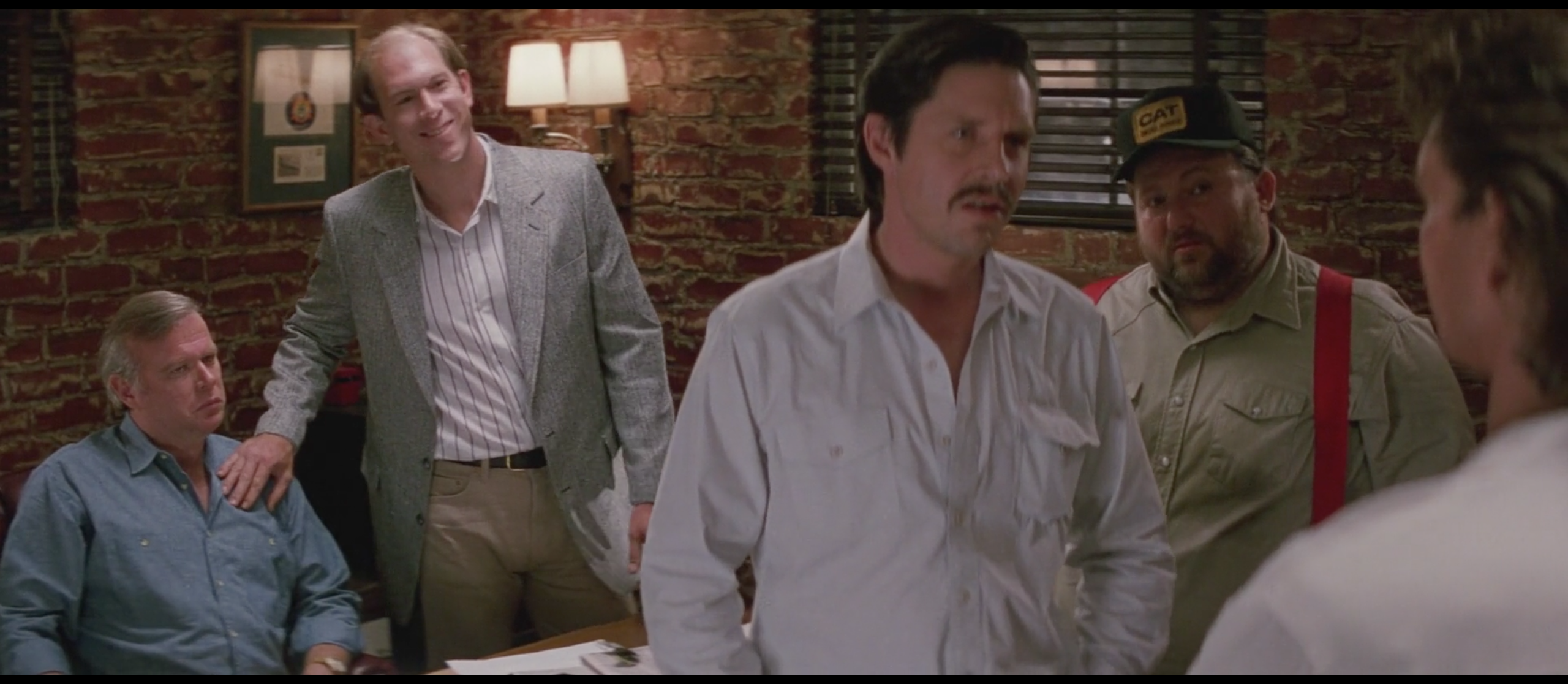
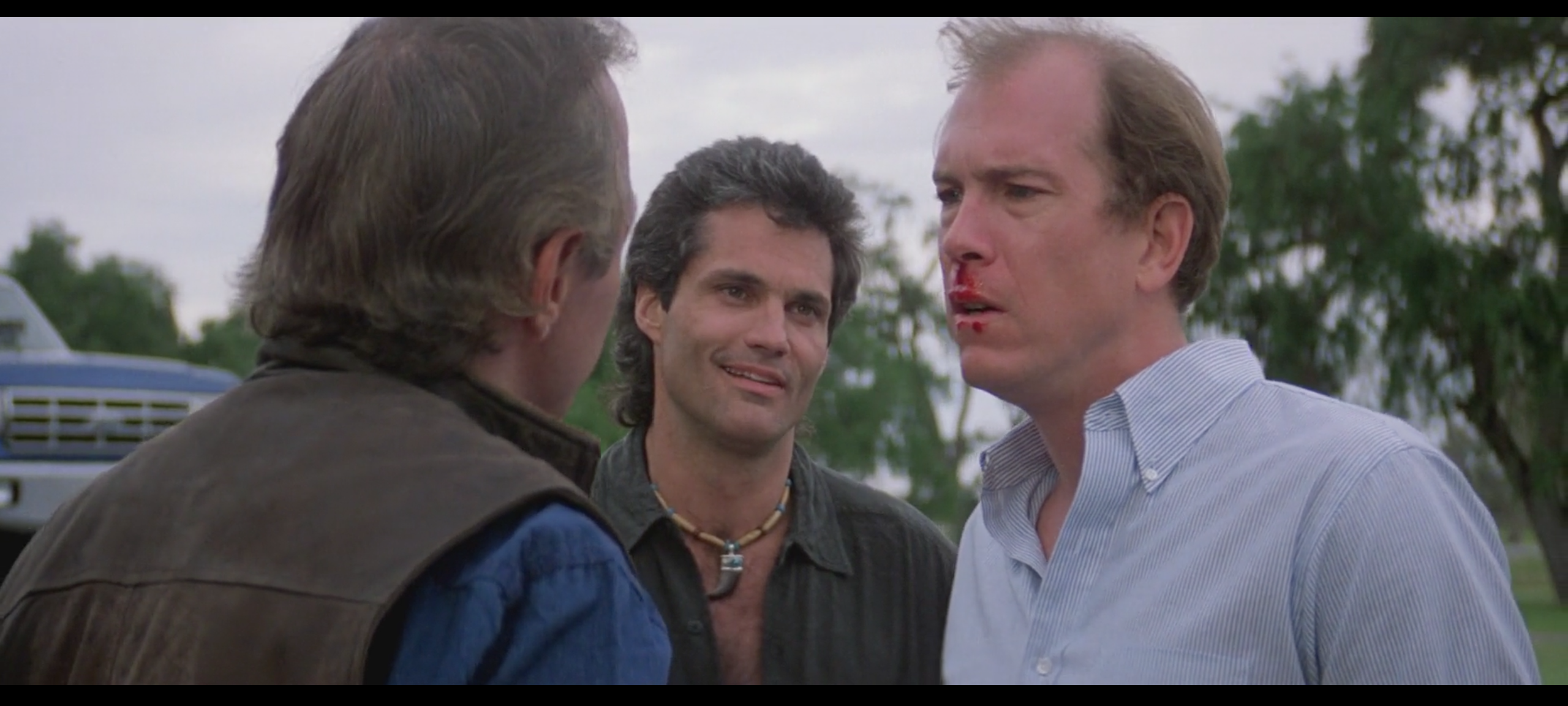
I don’t think I’m spoiling anything for you when I say things do not go well for O’Connor, as a rule. The Brad Wesley goon most likely to be mistaken for a once-promising Celtics prospect who suffered a career-ending injury and now owns a chain of Honda dealerships throughout the Greater Boston area, O’Connor gets his ass definitively kicked by Dalton and his fellow bouncers within minutes of our meeting him. He gets it kicked again by Brad Wesley, basically for the crime of getting it kicked in the first place, though the proximate cause is his pronounced tendency to bleed from ass-kickings, a condition Wesley is not helping. He gets it kicked again by Dalton and Wade Garrett later in the movie, gets it kicked right into the trash, I’m not even kidding, he ends up in a dumpster. And in the end Dalton murders him off-screen. Thus always to bleeders.
But this towering yahoo sure makes an impression when he first shows up on screen thanks to four simple words: “Hey, shut up, shithead.”
Does he say this to Frank Tilghman, who’s office he’s crashed in order to force him to re-hire Wesley’s sister-son Pat McGurn? Does he say it to Dalton, who shows up and tries to put a stop to it all? Does he even say it to Pat himself, a guy who needs his Rich Uncle Pennybags to make people be nice to him? No. He says it to Tinker, the sweatiest goon, cutting off Tinker’s attempt to engage in biting repartee with Dalton.
PAT: You don’t get it, do you?
DALTON: Why don’t you explain it to me.
TINKER: I’ll explain it to you—
O’CONNOR: Hey, shut up, shithead.
Mere transcription doesn’t do O’Connor’s delivery justice, though. For one thing, it necessitates the use of commas, which are not audible in actor Michael Rider’s Juilliard-educated bass voice at all. The whole thing comes out in a single exhalation, heyshutupshithead, like one self-contained sound of rebuke is all Tinker merits. O’Connor looks and sounds bored with even having to go through that much effort before he so much as finishes the sentence.
“Utter contempt” is too generous to describe what’s going on here. The fact that O’Connor sounds like White Barry White makes it all the more brutal, more hilariously unnecessarily mean. This is the verbal equivalent of missing the trash with the thrown remnants of a half-eaten egg salad sandwich and just leaving it there as you walk away. It’s the voice of God doing Pusha T’s “EEYUGGH” ad lib, at you. Never before or since have two nouns combined to elicit a prescribed response more effectively.