
Archive for the ‘Uncategorized’ Category
“Game of Thrones” Season Five: What Did We Learn
June 15, 2015Take a look at the political game that gives the show its title. Things may be bad now, but the season began with the possibility of setting up something better, as a quartet of newly minted leaders took charge and tried to shape the system to suit their vision. The Night’s Watch elected good-hearted Jon Snow as their 998th Lord Commander. Daenerys Targaryen settled in as the monarch of Meereen, attempting to rule through diplomacy rather than dragons. Stannis Baratheon became the new King in the North, following up his daring rescue of the Wall from a wildling invasion with a plan to defeat the even more dangerous forces of House Bolton. And after a lifetime of playing second fiddle to the men in her life — her husband, her father, her son Joffrey, and her brothers Jaime and Tyrion — Cersei Lannister found herself in almost complete control of King’s Landing, ready to rule more or less openly on her own.
But as Lady Sarah of House Palin once put it, “How’s that hopey-changey thing workin’ out for ya?” Jon governed nobly, Cersei ruthlessly; Stannis and Dany somewhere in between. Yet all four fledgling regimes ended in roughly the same place — with their leaders dead, deposed, defeated, or stuck between a Dothraki and a hard place. In fact, each was undone by events they themselves had set in motion. Jon fell to the men who’d elected him after ignoring their concerns about the Free Folk in their midst. (Et tu, Olly?) Dany’s attempts to moderate and mollify her divided city by reopening its fighting pits led to a massacre that required a last-minute dragon-assisted exit. Stannis executed his own daughter to preserve his messianic image; he then lost his dignity, his army, his wife, his war, and quite likely his life in return. And Cersei empowered religious fundamentalists to eliminate her rivals, only to become their biggest victim.
I took a big-picture, big-theme look at ‘Game of Thrones’ Season Five for Rolling Stone.
“Game of Thrones” thoughts, Season Five, Episode Ten: “Mother’s Mercy”
June 15, 2015…Each death was written and shot to feel unique, and uniquely awful.
Cersei Lannister’s walk of shame, however, felt even worse.
The Lannister lioness was shaven and shorn (much like another literary lion of note, Aslan from C.S. Lewis’ fantasy-classic Chronicles of Narnia), then forced to march naked through the streets of King’s Landing for a full five minutes of agonizing screen time. For critics of the series who believe that its repeated depiction of misogynistic sexual violence is, if not endorsement, then at least exploitation, Game of Thrones will have done itself no favors by preserving this punishment, drawn straight from Martin’s books. (Certainly, its track record with regards to female nudity is decidedly mixed.)
But too much art that purports to address uncomfortable topics does so by making them comfortable to encounter, leaving audiences feeling good about their own moral choices without ever asking them to confront anything deeper. This is not that kind of art. Terrible though her crimes might be, Cersei deserved this no more than Theon Greyjoy, murderer and traitor though he is, deserved to be tortured and mutilated. But as a male victim of sexualized violence, “Reek” is an exception; females, from the little girls purchased and abused by the late, unlamented Meryn Trant to the Queen Mother herself, are the rule. The gendered epithets hurled at her along rotten vegetables and buckets of shit demonstrate that as a woman, her fate was guaranteed to be worse than if she were a man. You certainly didn’t see her cousin Lancel, with whom she committed the crime, subjected to the same fate. Game showed us the screeching, leering face of patriarchy in all its ugliness and wouldn’t let us look away.
In doing so, it took one of its most unsympathetic characters and, in the space of five minutes, made her a person most of us would have bodily thrown ourselves in front of to protect. By the time the Queen started crying for her loss of basic human dignity, it’s likely viewers were crying too. Great art will do that to you. Maybe it must do that to you.
I reviewed the Game of Thrones season finale for Rolling Stone.
“Halt and Catch Fire” thoughts, Season Two, Episode Three: “The Way In”
June 14, 2015You know that old saying about how you can’t judge a book by its cover? Halt and Catch Fire seems hellbent on puncturing the proverb; it’s a show that’s always taken pride in how it communicates about its characters through their appearances. Tonight’s episode — “The Way In” — is a case in point: Success story Gordon Clark suits up and shaves to show he’s enjoying his current victory-lap life. Former silicon-prairie gunslinger Joe MacMillan dresses casual in a plain white tee to signify his simple new outlook. And, more subtly and perhaps most importantly, punk coder extraordinaire Cameron Howe is letting her chopped-off, bleached-blonde hair grow long and dark. The founder of Mutiny is, literally and figuratively, putting down roots.
This latest rock-solid installment is striking for doubling down on the stability of its leading ladies. That may be an odd thing to say when Cameron threatens to fire her partner/resident voice of reason Donna after a company-wide meltdown — and then has a panic attack that only the abrasive Tom Rendon can rescue her from. But think about it: The dynamic duo of Clark and Howe are building an pre-Internet powerhouse from the ground up, and all their arguments stem from how seriously they’re taking it. It’s the men who find themselves locked out of where they want to go, forced to devise workarounds to get back in.
Halt and Catch Fire was terrific tonight, you guys! I reviewed it for Rolling Stone.
‘Game of Thrones’: Why Knowing Nothing (About the Show) Is Great for Book-Readers
June 14, 2015Now I get to feel all the nervous anticipation, stomach-churning dread, and jaw-on-the-floor shock everyone else does each Sunday at nine—or that I did, for that matter, every time I sat down to watch new episodes of Breaking Bad or Mad Men or The Sopranos or any other seminal New Golden Age drama you’d care to name. Much has been made of the excesses of spoiler culture, and complaints about the constant demand that not so much as a peep about the plot be uttered in advance of a viewer’s initial encounter with it are thick on the critical ground. But deciding what to reveal and when to reveal it is a core component of narrative fiction, every bit as deliberate and valid an aesthetic choice as the casting or cinematography or score — doubly so for a show that derives as much of its artistic heat from spectacle and shock as Game of Thrones does. Only now that the TV version has jettisoned its rocket-booster books and truly taken off, in other words, are book readers like myself genuinely seeing the show the way it was meant to be seen.
In practical terms, this is nerve-wracking as all hell. I greeted the ominous avalanche that signaled the arrival of the army of the dead with the same what-fresh-hell-is-this bewilderment as Lord Snow. I watched the White Wedding of Sansa and Ramsay with a mounting mix of queasy repulsion and vain hope that the coming catastrophe could be avoided. And by the time poor Princess Shireen took her long walk to a tall stake in the snow after an episode full of foreshadowing and fakeouts, I felt like I was being marched to the flames along with her. On the flipside, I got to witness the big When-Dany-Met-Tyrion moment with its full holy-shit power preserved. This is a show that’s all bass and treble — as Cersei put it, “you win or you die; there is no middle ground” — and I feel like I’m hearing it for the first time.
“Hannibal” thoughts, Season Three, Episode Two: “Primavera”
June 13, 2015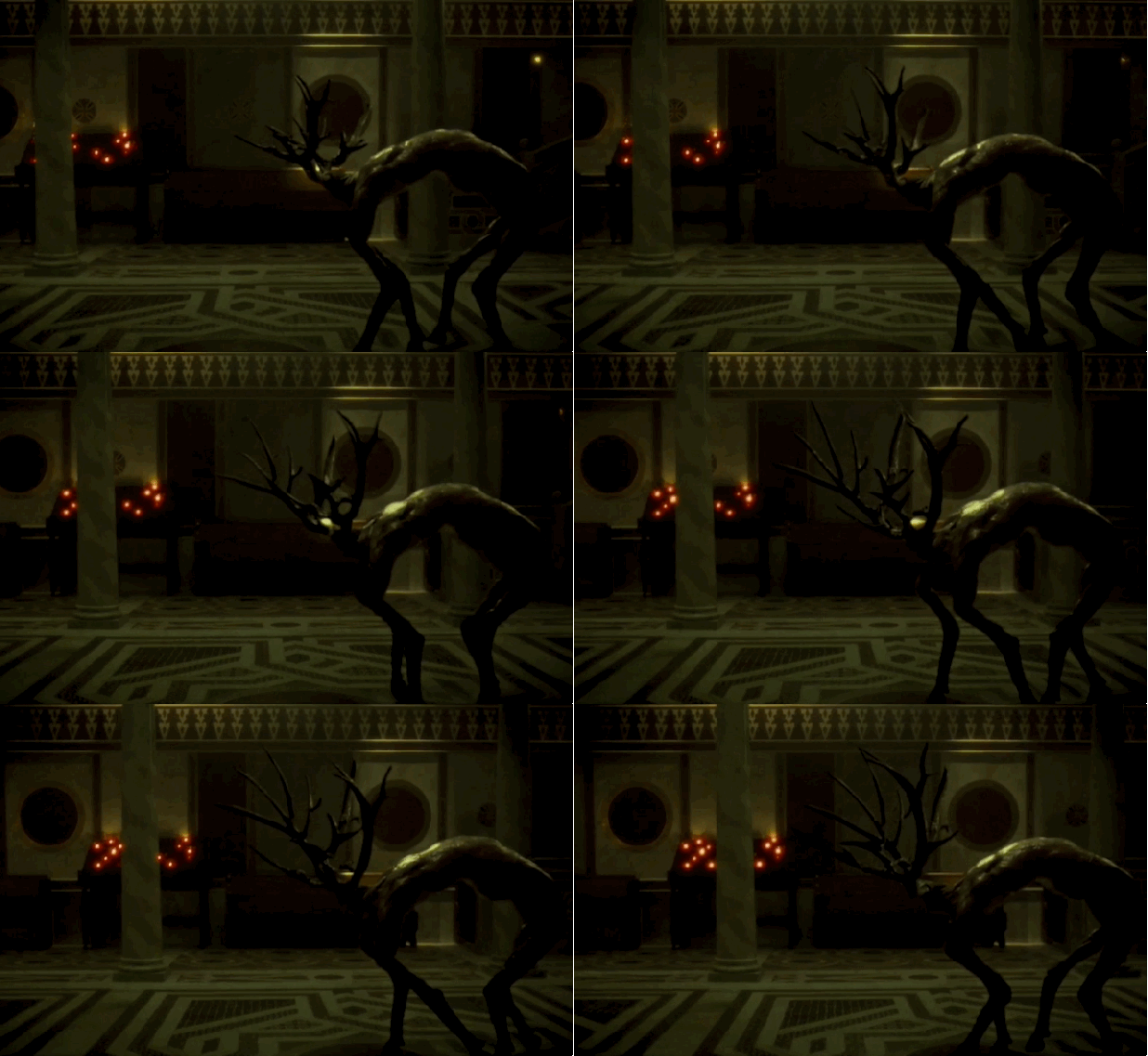
Il Mostro’s crimes were crazy, albeit not quite as crazy as NBC censors blurring out nudity in Botticelli’s paintings while letting people be graphically mutilated onscreen. But they also show that even this criminal supergenius had a period where, like any artist, he learned by copying from the best before moving on to make his own masterpieces. Case in point: the gigantic heart Hannibal fashioned out of the twisted limbless corpse of stupid sexy Antony Dimmond, the smarmy scholar who saw through Lecter’s false identity last week. Though impressive enough on its own, like all great art its full potential is only unlocked when it’s put in front of its intended audience, Will Graham. He envisions its transformation into a repulsive antlered avatar of Hannibal, in a sequence that’s part Hellraiser’s rebirth scene, part Beetlejuice’s sculpture garden, and part Salvador Dalí’s Soft Construction with Boiled Beans.
I reviewed this week’s typically marvelous episode of Hannibal for Decider.
Art, empathy, and Hal’s Emerald Attack Team
June 11, 2015mramgine asks: Are you familiar with the controversy surrounding what happened with Green Lantern back in the 90s, where Hal Jordan was turned into a supervillain and fans got so pissed that some sent death threats to DC? Why do you think certain creative decisions in media cause such reactions? Are some of these people mentally disturbed or is there some other reason for such behavior?
Welp, George R.R. Martin knows who I am.
June 11, 2015“Meanwhile, other wars are breaking out on other fronts, centered around the last few episodes of GAME OF THRONES. It is not my intention to get involved in those, nor to allow them to take over my blog and website, so please stop emailing me about them, or posting off-topic comments here on my Not A Blog. Wage those battles on Westeros, or Tower of the Hand, or Boiled Leather, or Winter Is Coming, or Watchers on the Walls. Anyplace that isn’t here, actually.”
The Boiled Leather Audio Hour Episode 39!
June 11, 2015BLAH 39 | (What’s So Funny ‘Bout) Peace Love and Bummer Stannis: Discussing “The Dance of Dragons” and Other Elements of Late Season Five “Game of Thrones”
We’re back, and we’ve got a burning desire to discuss Stannis, Shireen, and the controversial scene that dominated the conversation around “The Dance of Dragons,” Game of Thrones Season Five’s penultimate episode! This time out, Stefan and I tackle what the Mannis’s heel turn really means for the character, the adaptation, the fandom and more. We also take a quick tour of the disappointments of Dorne, gaze into the fires and give you our predictions for the season finale (including a theory from Sean that’s either bold or batshit), and address the very nature of criticism itself. All in a tight 32 minutes and 32 seconds!
Additional links:
Stefan’s review of the episode.
George R.R. Martin recommends Boiled Leather for your fighting about GoT needs.
Sean’s piece on the four worst types of TV critics.
You Are a Bad Person!
June 10, 2015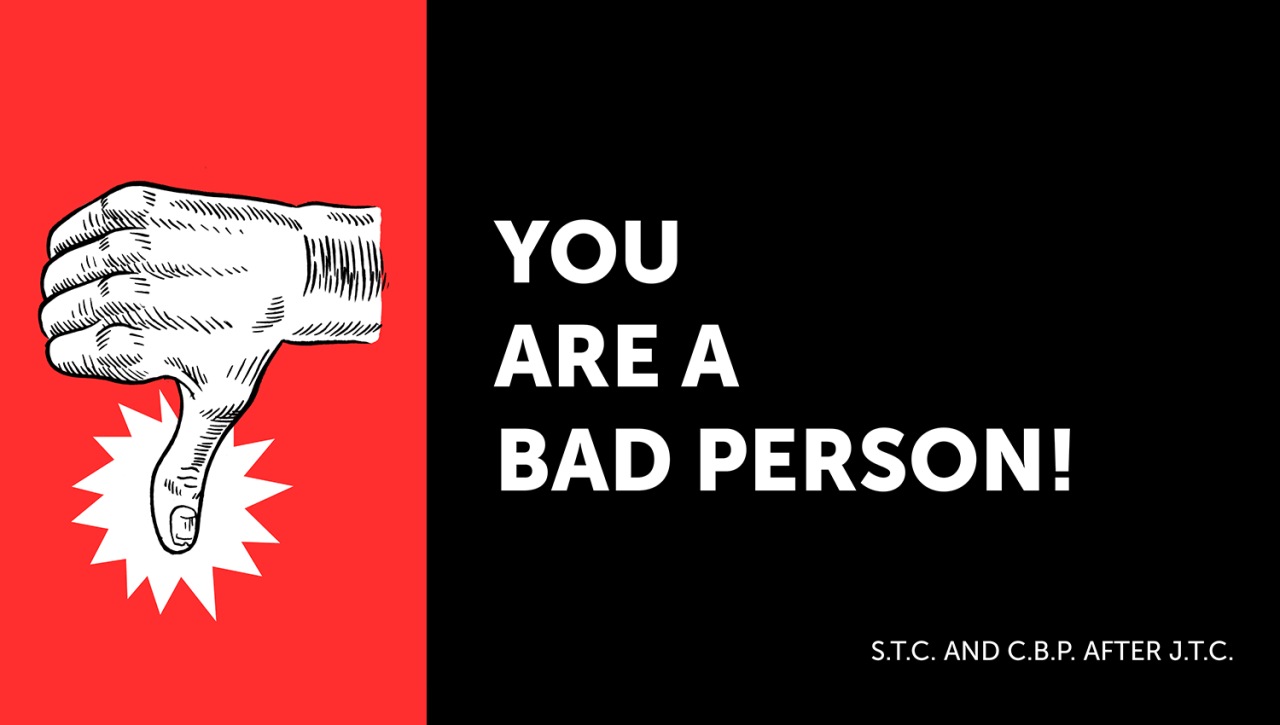
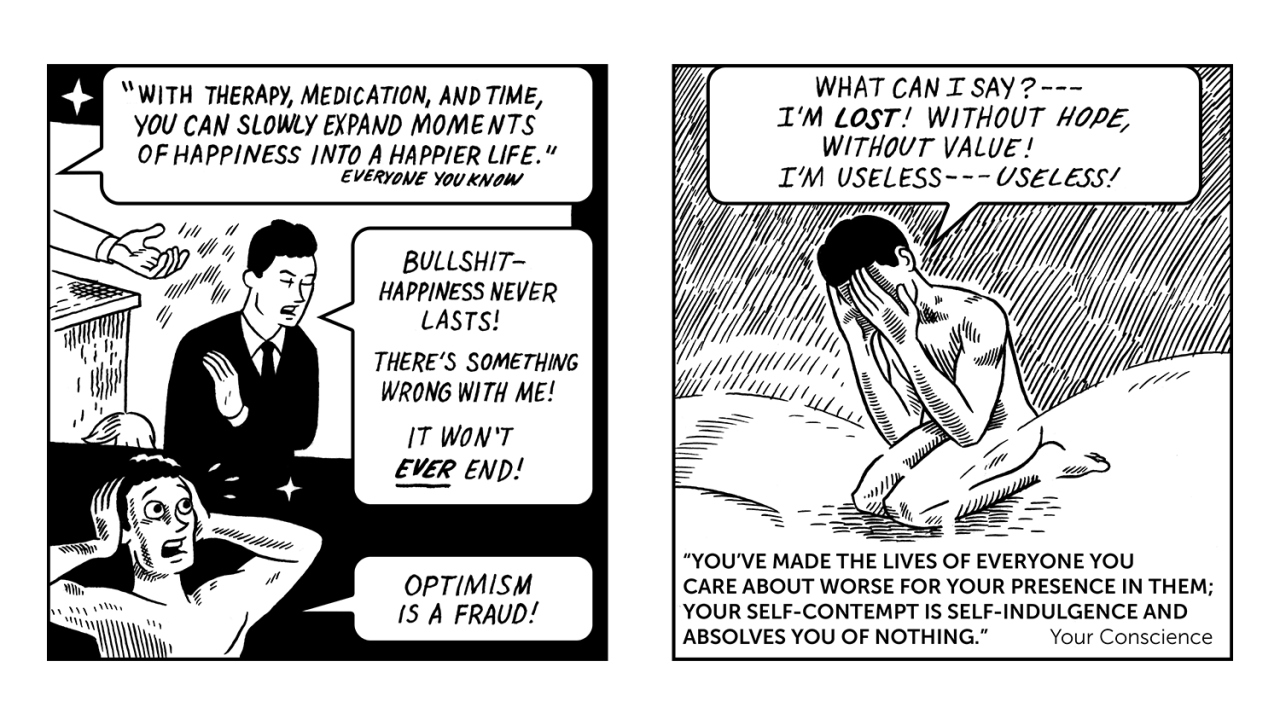
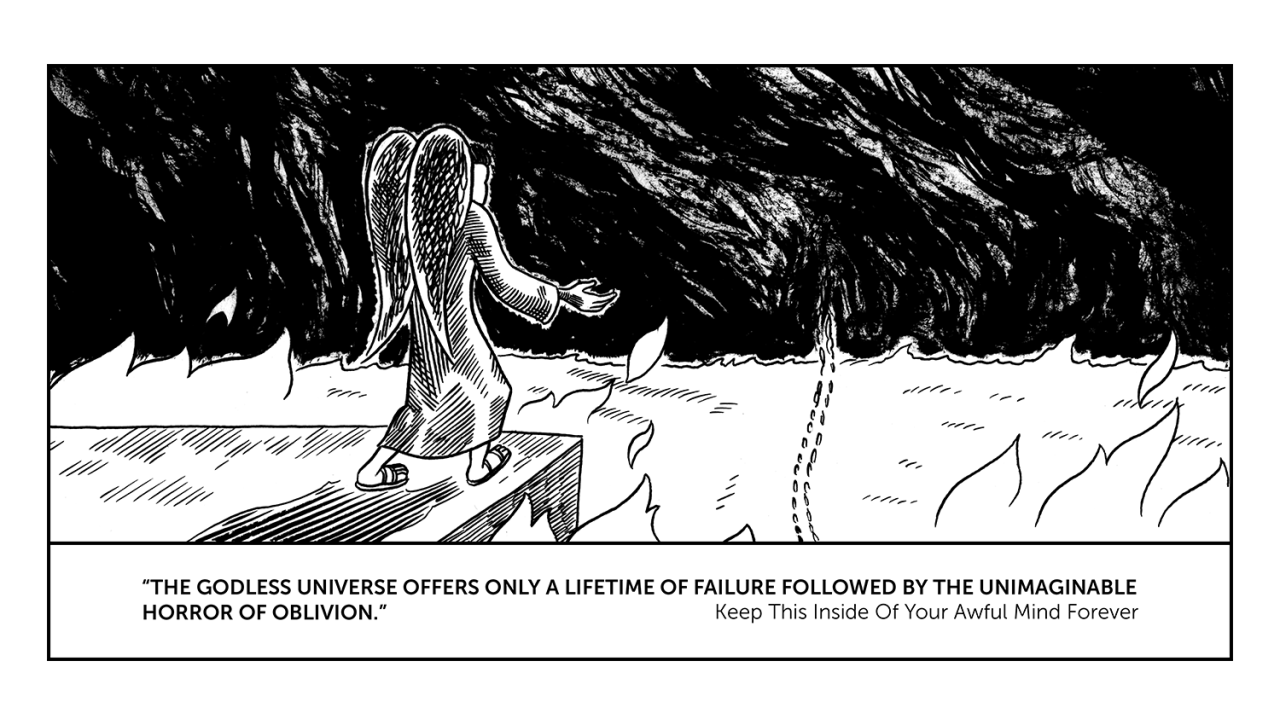 “You Are A Bad Person!”
by Sean T. Collins & Colin Panetta (after Jack T. Chick)
originally published in Mutant #6 by Atomic Books
“Halt and Catch Fire” Thoughts, Season Two, Episode Two: “New Coke”
June 8, 2015But the funniest thing about this episode: It was genuinely funny. Halt 2.0 appears to have included a serious humor upgrade, a welcome development given the clenched-jaw tension of Season One. There are great little visual gags, like Gordon using SEXYBEARD as his Mutiny username. There are lol-worthy throwaway one-liners, as when a Mutiny’s code monkey crams all the free pizza he can eat into his face while saying “I don’t even want this anymore!” Even the music gets in on the act: When Joe shows up for his first day at work, the one-time wunderkind’s stylish synthpop soundtrack cuts out the second he sets foot in his dingy new digs. It’s a perfect sonic spit-take, and a sign that the show’s sophomore evolution away from self-seriousness may be the best way to get people to take it seriously.
I reviewed tonight’s Halt and Catch Fire, which has become a fun show, for Rolling Stone.
“Game of Thrones” thoughts, Season Five, Episode Nine: “The Dance of Dragons”
June 8, 2015The difficulty of telling true from false, of choosing sides, is precisely why the show burned Shireen. Why risk kneecapping Daenerys’ triumphant reunion with her dragon and the primal thrill of her first ride with this horror? The answer lies in the look in Tyrion’s eyes as he watches Drogon torch insurgents and bystanders left and right. The Imp, it turns out, is a true idealist (the biggest cynics often are; constantly being let down will do that to you). He had high hopes that the Khaleesi truly would “break the wheel” on which humanity has suffered for so long. Now, faced with the wrath of a literal monster, he sees what that the flames of war consume ally, enemy, and innocent alike. “You can stop this,” he told her minutes earlier when Ser Jorah Mormont fought for her favor in the arena. “She can’t,” Hizdahr said. Indeed she couldn’t.
This is the antiwar point the show is making even amid the wonder of Dany’s wild ride, just as surely as it did during the horror of Hardhome last week, when a literal avalanche of corpses rained down upon the living. This is the point it makes every time it shows us some all but unwatchable atrocity, no matter how hard we wish they didn’t. The elemental force that is war has one purpose and serves one god: death. Ice freezes. Fire burns. And as a wise woman once said, “When this kind of fire starts, it is very hard to put out. The tender boughs of innocence burn first, and the wind rises, and then all goodness is in jeopardy.”
“Hannibal” thoughts, Season Three, Episode One: “Antipasto”
June 5, 2015Hannibal captures the strange, very adult phenomenon inherent in relationships between you and your coworkers or you and your therapist: Within these fixed confines you become truly important to one another, yet you only ever see each other’s forward-facing parts. Hannibal’s psychosis, Will’s unclassifiable disorder, Dr. DuMaurier’s years-long manipulation by Dr. Lecter — these factors make them unknowable, but stand in for the mysteries we all choose to leave unexplored in the people we work with, because separation is safer than immersion.
This is the one-two punch that makes Hannibal haunting. At the same time its story pokes and prods at our most intimate and complex connections with one another — often through the work of its protagonists, profilers and psychiatrists for whom this is literally their vocation — its grand guignol imagery loosens your moorings and sets you adrift in the realm of pure nightmare. The human element forces you to lower your guard; when the wall is down, the horror is poured into your brain like a black liquid, pooling in the creases of your cerebellum till it’s impossible to get clean again. Once you let this devil in, he’s there to stay.
I’m covering Hannibal for Decider this season! Here’s my review of the season premiere.
“Hannibal”: The Sick Genius of TV’s Darkest Show
June 4, 2015This is a show that leaves you thinking that maybe the world is a little bit worse for its presence — a mark of all great horror. And whether you’re a fan of the genre or a practitioner, you’ve got to be like Will Graham voluntarily connecting with the worst humanity has to offer. You must be willing to turn to the work and say “just fuck me up.” In this series, that thrillingly self-destructive impulse is invited — and then rewarded a hundredfold with some of the most gorgeous visuals of murder and cooking you’ve ever seen. When you binge on Hannibal, Hannibal binges back. Bon appétit.
DQ25
June 2, 2015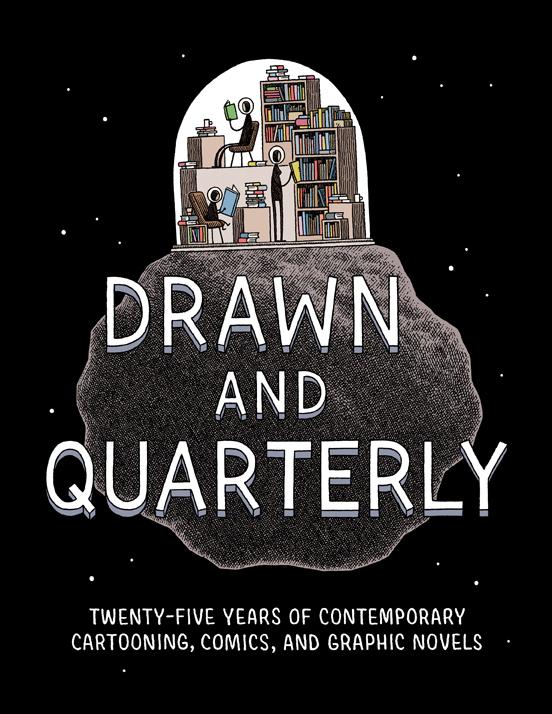
I interviewed the great editor and publisher Tom Devlin in this beautiful book about Drawn and Quarterly, one of the best and most important comics publishers of all time. It’s out today, and it’s filled with comics by wonderful cartoonists. Check it out!
“Game of Thrones” thoughts, Season Five, Episode Eight: “Hardhome”
June 1, 2015At its best, fantasy — like horror, science fiction, and the whole spectrum of genre storytelling — uses unreality as a key to unlock aspects of reality that the reason and logic of the workaday world keep hidden. Simply put, the White Walkers are the series’ vision of war itself: death breeding death breeding death until nothing living is left. Sansa and Theon, Daenerys and Tyrion, newly minted pit-fighter Jorah Mormont and fledgling hitwoman Arya Stark have each caught their own glimpses of this truth. Tonight we saw that vision with crystal blue clarity, in the metaphorical form of a literal avalanche of bodies, and the creature responsible. Jon Snow saw it too. Now he carries its message, and the game — the real game — begins.
I reviewed tonight’s fucking magnificent Game of Thrones for Rolling Stone. The ending gave me the chills and made me cry.
“Halt and Catch Fire” thoughts, Season Two, Episode One: “SETI”
June 1, 2015Across the board, Halt’s great leap forward makes for a breezier, better show. Though the painstaking process of chronicling the group’s personal-computer empire-building last season gave the show a sturdy core, it was also exhausting for the audience as well as the characters. Jumping ahead means skipping past the back-and-forths that bogged the series down just as surely as calling a ceasefire on the constant hostility does.
And it clears some space in the hard drive for much cooler stuff. There’s some just-this-side-of-showy stylistics, like the opening sequence in which a hand-held camera follows Donna around the chaotic Mutiny office for minutes on end. There’s a nifty metaphor for Cameron’s “where you see a wall, I see a door” thinking in her customer-service call, where she coaches a gamer trapped in a room full of holograms to escape by simply walking right through them. There’s a more playful sense of humor, from the goofy mid-Eighties commercial for the “Giant” to the sight of a coked-up Gordon reading William Gibson’s cyberpunk classic Neuromancer and muttering “What the hell??” with a bloody tissue up his nose. There may even be a new structure, since for all we know each season will focus on a brand-new aspect of the tech biz — like how The Wire handled Baltimore, but with joysticks.
“Outlander” thoughts, Season One, Episode 16: “To Ransom a Man’s Soul”
June 1, 2015This is the problem with Outlander, really: It always feels like just a TV show. Rooting Randall’s torture of Jamie in the undeniable facts of physical — their nude bodies streaked with blood and spit and tears and sweat and lube — may have alleviated this fact, or obscured it if you want to be less charitable about it, by creating a sense of terrible intimacy. But who are they, really? Randall’s a one-dimensional sadist and Jamie’s a heroic hunk with more scars than facial expressions. The take-no-prisoners treatment of rape in all its horror, the sociopolitical ramifications of its emphasis on masculinity or recovery — neither factor matters all that much if the characters are ciphers, their story stays so predictably linear, and music and voiceovers tell you exactly how to feel about all of it at all times. Grading it all on a curve because the sex scenes are strong, or this sexual assault sequence was strong in an entirely different way, does no one any favors.
I reviewed last night’s Outlander finale, an ambitious failure, for the New York Observer.
“Under the Skin” Is the Best Horror Movie You’ve Never Seen
May 27, 2015
Like comedy and pornography, horror is a practical art with a concrete aim; it exists to frighten. This utilitarian aspect makes horror a genre that constantly interrogates its own past, examining how other scary movies scared people in order to refine and surpass them. So like almost all of the great horror films,Under the Skin exists in conversation with its forerunners. The main character’s pattern of luring lonely, horny, pasty men to a decrepit house to be consumed by some nightmare secreted from the floor evokes the plot of Clive Barker’s similar meditation on agony in the UK, Hellraiser; a late-game makeup effect recalls its even more uncompromisingly brutal sequel, Hellbound: Hellraiser II. The circular, ocular forms that dominate the movie’s abstract opening sequence recall not only the baleful gaze of the killer computer HAL 9000 in Stanley Kubrick’s 2001 (a frequent point of comparison in reviews) but also the similar combination of curvilinear shapes and unnerving musical dissonance that kicks off Tobe Hooper’s The Texas Chain Saw Massacre (a film with which UtS shares an unarticulated but brutal meat-is-murder subtext, one that’s a lot clearer in the source novel).
Another Kubrick masterpiece, The Shining, earns a visual echo in the bird’s-eye-view shots of the characters driving the curvy roads carved through the rugged region. Its long silent passages, in which our sole window into the world of the film is the monster at its center, force us into her skin in a fashion reminiscent of Norman Bates’s clean-up and disposal in Psycho. Indeed, the ominous hums and screeching strings of Mica Levi’s score place it with Bernard Herrmann’s Psycho, John Williams’s Jaws, and the Ligeti/Penderecki/Wendy Carlos/Rachel Elkind–dominated soundtrack of The Shining at the top of the horror movie music pantheon.
The list could go on—seriously, I cut several entries for space—but it’s important to note this: None of these elements exist to be spotted, per se. They’re not overt references or homages, but rather a bedrock on which the film can be built into something new and unique. Under the Skin uses our shared vocabulary of horror tropes and techniques to create a new language, just like the disembodied syllables we hear the main character murmur over the stunning, dissociative opening sequence evolve into the words she uses to seduce and destroy.


Under the Skin is one of the best horror movies ever made, and one of the best movies I’ve ever seen, period. I make the case for it over at Decider.
May 26, 2015
I was sexually abused when I was three or four years old. The exact date, like some of the specifics, is lost to my memory. As far as memories go I suppose this is one of my earliest, actually. My brain gives me gifts unasked for, sometimes.
I came under the care of two teenagers my family trusted. The elder of the two spent a week humiliating and abusing me. (The younger of the two saw everything and did nothing.)
She locked me alone in a room for hours, and forced me to work around the house, whatever that could have looked like for a three year old, when I was released. She fed me food she had rendered inedible through means I’m glad remain a mystery to me, and when I inevitably could not bring myself to eat it I went hungry. (At the time the only available category for bad food my brain had access to was “stale,” so that’s the description of the peanut butter and jelly sandwich she made me that I remember formulating. Whatever was wrong with that sandwich, which I can still taste in my mouth over 30 years later, it wasn’t stale bread.) She made fun of me constantly, exclusively. She made me wear diapers, which like all children I’d stopped using with pride, and when the time came to relinquish me back to my parents’ care she threatened that they would put me in diapers and keep me in them if I told.
On the day she gave me a bath, she made me stand naked while she examined and ridiculed me. I can’t remember if she touched my penis, honestly I can’t, but she must have: I had a birthmark or freckle on it at the time, which she mocked. I was a freckly kid, and my mother had told me freckles were where the angels kissed me before I was born. “Did the angels kiss you there?” my abuser asked, laughing. I didn’t recognize what was being suggested, obviously, fortunately, though I sensed it was bad. I looked down and saw something that, while neither repulsive nor ridiculous, was now alien to me. What I understood most clearly was that my private parts were no longer private. They could be seen and touched and kissed and made fun of and laughed at. I had no more power to stop it than I could force my mouth to chew and swallow the tainted food my abuser served me. Here was another plate.
I knew what had been done to me was mean, which is a child’s word for wrong. I knew I’d done nothing to deserve it, so I had nothing to fear if I divulged it. When this time period drew to a close I told my parents what I could immediately, without hesitation. That put an end to it.
Until recently I hadn’t thought much about this incident, or its impact on my life. I didn’t think there’d been one. After all, I was lucky in many respects. The abuse occurred over a discreet time period, rather than an ongoing one. The physical component could have been much worse. I was so young that I didn’t understand the sexual component to be sexual; certainly no one presented it to me as such after the fact. I didn’t yet feel shame, thank christ. Authority figures believed me and not my abuser. I know so many people who went through so much more. I am not the kind of person to cut himself slack for suffering.
Fifteen, sixteen years ago I rifled through my dad’s files and found a gifted-children evaluation that had been done on me prior to kindergarten. The evaluator noted that when given animal toys to play with, I had the predators menace the smaller animals until other, bigger animals came to fight the predators and rescue the prey. The evaluator ascribed this to the incident, but I’d always thought it was just how kids play. Isn’t all narrative conflict-driven? I put the report aside. I put the abuse aside.
I am currently at what I hope to be the tail end of a years-long bout of depression, and my life now is very different than my life before it began. My depression’s worst depths roughly coincided with the start of a period of intense sexuality. Given my interests as a critic and artist, this combination has been pretty fucking good for me, professionally. I write to figure things out; I figure things out when I write; this is true even when figuring things out is not the goal. I can’t help it. I am also fortunate enough to be in both a romantic relationship and a therapeutic one in which figuring things out is the goal. And so, inevitably, I’ve wormed my way back into this soil.
I’ve known for many years, because it’s been screechingly obvious to me even at my most oblivious, that sex is part of a cycle of humiliation and redemption for me. I was bullied badly in elementary school, and by middle school the teasing and mockery had hardened me into a fist of resentment against my social betters. By my sophomore year in high school it became apparent to me that I was now attractive to girls. This was great fun for all the usual healthy reasons, but I also saw it as slam-dunk evidence that I wasn’t the faggot and loser and geek and baby the male jocks said I was. Indeed, another human being need not be present for this catharsis to take effect: I felt a thrilling flash of “that’ll show them!” the first time I masturbated, because my body worked the way a man’s body should. Sex as a proving ground.
I identified this feeling early, but it never occurred to me to ask why I felt it. Why does the successful exercise of sexuality validate me as a person? Why does the mere fact of my sexual autonomy mean anything? Why does the concept of the body as a machine the operation of which exists outside normal social strictures of shame and propriety turn me on and get me off, ever since the very first time? If sex has taken on such importance in calibrating my personality, and if that calibrator was damaged by my abuse, were the parts of my personality that aren’t directly sex-adjacent able to be damaged as well? I don’t know.
I suspect, though. I suspect now. I suspect that at an age when I couldn’t imagine anything worse than being made to be a baby again, powerless and devoid of self-control, my abuser rooted my private experience of my body in a diaper. I suspect that at an age when every word from my mother’s mouth was love, my abuser used a story she’d told me to make me feel good about my body and hurt me with it, turned me against myself. I suspect that my baseline self-evaluation was reset at “not okay,” and that I grab what I can from outside and stand on it as long as I can to stay above it, which is never long enough. I suspect that anything that demonstrates that my body is my own and that my body is good is a balm to my soul but that its palliative effects only last so long. I suspect that I was conditioned to believe myself a shameful excess, a burden to everybody, and that my personal life has been an endless, futile scramble to make myself as unobtrusive and inoffensive as possible, to find solace only in hiding my own need.
I’ll never know, though. That’s the thing that bothers me the most: I’ll never know. This thing that happened to me, that was done to me, is dark matter. I know it’s there, but that’s all I know. Even if it were to have shaped me the way I suspect it might have, it’s convinced me I have no right to claim it as such — that the story’s not worth telling even if it’s mine to tell, since everyone has a story, don’t they, and if I went for all these years not thinking about it, not noticing it, even now I should just shut the fuck up about it, it’s vanity to pretend I have any reason to complain, you will be laughed at again, you are laughable again, how bad could it be? How bad could it be? I don’t know. I don’t know. I don’t know.