
Author Archive
Quote of the day
October 10, 2007Mrs. Voorhees is the perfect mother: Not only will she kill for her son, she’ll die for him.
–Betsy Palmer, aka Friday the 13th‘s Mrs. Pamela Voorhees, Going to Pieces: The Rise and Fall of the Slasher Film
The Blogslinger: Blogging The Dark Tower, October 2007–Day Nine
October 9, 2007Read: The Waste Lands–the rest of “Key and Rose”
I don’t know if it’s my buddy Bill’s encouraging words or what, but to paraphrase Gibby Haynes and Ministry, all of a sudden I find myself in love with this book–something about this section really ding a ding danged my dang a long ling long. I liked Jake’s moment of clarity in the vacant lot as the true workings of the world were revealed to him. I like that someone or something knocked his ass out with a brick (surely given Jack Mort’s number on Odetta back in the day, that’s no coincidence), and that the action picks back up with this mystery unsolved. I like the fragment of the poem about the Turtle. I like Jake going home and pwning his dad with his eyes apparently literally on fire. I like that the French teacher was nice to him. I LOVE that he got an A+ on his crazy English essay. I like that he kind of made up with his mom and dad and it wasn’t that kind of irrevocable years-in-the-making blow-out that you see with some frequency in King’s work (cf. Frannie and her dad vs. her mom in The Stand, Eddie vs. his wife and Eddie vs. his mom in It, etc.). I really REALLY loved the Charlie the Choo-Choo story and the frightening suddenness with which you realize “whoa, this has gotten weird, hasn’t it?” (cf. Beverly Marsh’s coffee date with Mrs. Kersh in It). I like that that section meshed so well with the haunting, driving song “Moss” from Gus Gus’ latest album Forever which I’ve been listening to all day. I like that the voices of Jake’s bifurcated memory (with which I had so much trouble) are now bickering like annoying monsters in a children’s story:
Quit! he screamed at them. Just quit! You were gone all day, be gone again!
I would if he’d just admit I’m dead, one of the voices said.
I would if he’d just take a for God’s sake look around and admit I’m clearly alive, the other snapped back.
And I fucking ADORED this:
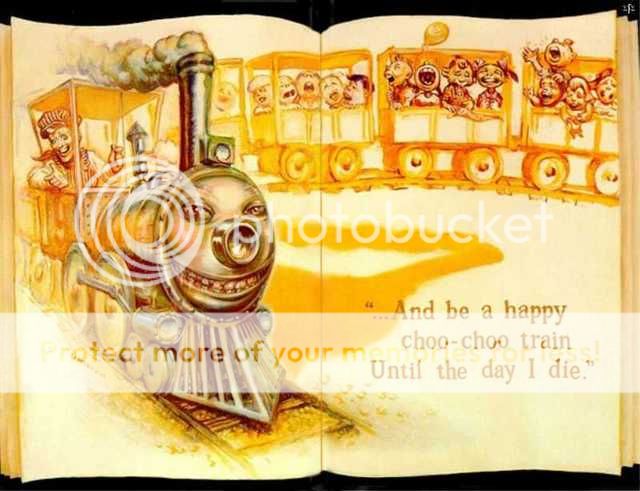
Ned Dameron FTW!
I’m back, back in the Dark Tower groove. (For now. No promises!)
Metacomics: product
October 9, 2007…I think it’s not only excellent that DC is publishing a line for teen female readers, it’s doubly excellent that there’s a teen female writer involved in the line as well. So my instinct is to write something that would, in effect, praise all involved–in essence, give them a tickertape parade and the key to the city.
—Jeff Lester, on DC’s Minx line in general and Mike Carey, Louise Carey, and Aaron Alexavitch’s Confessions of a Blabbermouth in particular.
I think this is an instinct worth fighting against. I’m saying this without having read any Minx books, so that’s not a dig against them or the line at all. What I mean is twofold:
First, consciously gearing your entertainment product toward a particular demographic is a value-neutral act. This may be less apparent in comics because the art form in North America has been so completely dominated for so long by products geared toward men in their teens, 20s, and 30s, with that age bracket edging upward year in and year out, which makes it look like a comic geared toward any other group is half-act of charity, half-revolutionary declaration. But it is in fact still the case. It’s not remarkable that there are books and movies and TV shows geared toward women and men and teens and tweens and gay people and black people and whatever else, and it really shouldn’t be that remarkable that the same is true in comics. What would be remarkable is if they were good comics, regardless of the target demographic.
Second, involving a member of the target demographic in the creation of entertainment product for that demographic is also value-neutral. It can be good, it can lend authenticity to the work, it can lead to writing with an ear for the attitudes and dialogue inherent to that demographic, but it could just as easily do none of those things. John Kerry and John McCain are Vietnam veterans and by most accounts behaved admirably during that war, but I doubt either of them would make better Vietnam movies than Francis Ford Coppola or Stanley Kubrick. So having a teenage girl co-write a comic about teenage girls for teenage girls is unremarkable. What would be remarkable is if it were a good comic, regardless of who wrote it.
You’ll notice that I’m using the word “product” here. I use it to refer to art that is intended to serve a demographic first and foremost, before any other concerns, possibly even before any other ideas about the work form in the heads of the creators at all. Again, I’m not doing this to slag on the Minx line, with which I’m not terribly familiar other than to say that Jim Rugg drew one and I love Jim Rugg and that book looked really lovely when I flipped through it. In that same piece, Jeff puts it thusly:
DC’s Minx line openly promotes itself as being for female teen readers and I think that’s good: OGNs aimed at teen females is a market that’s worth tapping into; the more teens, females, and female teens we get reading comics the better; and if a teen who wanders into a shop looking for the next Minx book ends up picking up, say, Jaime Hernandez’s Locas, then, really, the whole thing is worth it. But by creating a book line with such a clearly defined target audience and a clearly defined goal, you’re one step closer to creating books that are more product than art. And while I don’t have a particular problem with that–I don’t mind picking up a Minx book knowing it’s unlikely I’m going to read some intense work of raw personal vision, the next Diary of a Teenage Girl by Phoebe Gloeckner–I do think the closer a work comes to being product, the higher the expectation becomes that the product be of professional standards.
What’s interesting and maybe troubling about this formulation is that making great comics is an ancillary concern at best. These comics are supposed to be worthwhile 1) because teen females are an underserved market; 2) because introducing women and teenagers to the industry is good for the bottom line; 3) because maybe they’ll eventually lead those women and teenagers to pick up comics that are great. But the possibility of being a work of Diary of a Teenage Girl-level passion and genius isn’t even entertained.
Mind you, the only reason I’m focusing on this particular demographic is because I noticed Jeff’s post; the same things can be said for any number of “new mainstream” efforts to provide competent genre-based entertainment for the non-superhero, non-art comics, non-manga comics readers out there, or the theoretical ones that might manifest were such comics made available. I don’t doubt for a second that there are tons of great romance comics and young-adult comics and action comics and detective comics (as opposed to Action Comics and Detective Comics, which happen to be pretty good themselves these days) floating around in some cartoonists’ heads out there quite independent of whether a targeted line or a company that specializes in getting its books optioned by Hollywood exists to publish them, or that some of those comics do indeed end up at some of those outlets. I just want to see things proceed in that order. Anything else strikes me as a desire to create the comics equivalent of a sitcom that NBC aired after Friends or an action movie you might half-watch on a cross country flight. What’s really strange about it is that in some quarters this is seen as some sort of triumph for comics. It’s like, I can see where Kim Thompson was coming from when he perjoratively said “more crap is what we need,” but it’s weird to me that people are excited to create it, or to champion its creation.
Blogslinging: Reload
October 9, 2007I was just about ready to abandon the Blogslinger project today, because I just haven’t been enjoying the books (aside from The Gunslinger), and there are plenty of other books in the sea. So kudos to my old pal Bill DeFranza for unwittingly writing in at just the right moment and saying enough intriguing and encouraging things about the rest of the series to keep me going. Perhaps not at the same clip–I might as well get over the idea that I’ll finish all seven books by October 31st–but at least for the moment, I’m gonna keep on trucking.
Carnival of souls: special “October is the cruelest month” edition
October 9, 2007As part of its 31 Days of Horror October blogathon, Not Coming to a Theater Near You’s Adam Balz reviews Who Can Kill a Child?, a Eurohorror children-run-amok flick cited by Eli Roth in his defense of a scene that deigned to answer that question in Hostel Part II.
As part of his 31 Days of Zombie! October blogathon, Rob Humanick gives 28 Weeks Later the “one of horror’s recent best” props it richly deserves.
Shoot the Projectionist invites you to submit your nominees for 31 Flicks That Give You the Willies.
Snarkerati presents its list of the Top 50 Dystopian Movies of All Time.
Moviefone counts down its list of the 31 Best Horror Movies of All Time.
Facets Features is rolling out 31 Days of Horror Clips.
Links via The Horror Blog, My New Plaid Pants, Infocult, GreenCine Daily, and my own bad self.
Metacomics: fans vs. readers
October 8, 2007The term “comics fans” gets a lot of static because of how it frames the comics audience’s relationship with the medium, or more specifically the superhero segment of it, in uncritical, boosterish terms. It’s a descriptor that, when deployed a certain way, is seen to cut off critical thinking in favor of the “what’s the shocking secret behind Supergirl’s origin?” level of engagement with the work. To the extent that criticism is present it tends to be of the “Wolverine would never say that” variety–in other words, it’s surface-level, concerned with plot and dialogue and whether characters look a certain accepted way rather than the formal aspects of the comic–and it tends to be offered as pressure to get things back on the right track, at which point the fandom can continue unabated. Plus, it’s a little strange linguistically: No one ever says “I’m a prose fan,” that sort of thing. For these reason I try to avoid calling the audience for comic books “comics fans” unless I’m deliberately referring to the segment of that audience that does look at comics in that way. I use “reader” rather than “fan” in other cases.
On the other hand, calling myself a “comics reader” is a woefully inadequate way to describe my relationship with the medium, which has a passion and a depth (whether or not that’s a good or bad thing) that a neutral word like “reader” doesn’t even come close to conveying. I’d no more think of myself as simply a “comics reader” than I would a “music listener” or “film viewer,” and I doubt many people who engage with any of those art forms would either. It would be disingenuous to suggest that I’m not a comics fan (or a rock nerd or a movie buff or a horror fanatic, for that matter). It’s probably a safe bet that anyone who’s felt moved to write about their opinions on comics (in particular or in general) is in fact a comics fan too.
The Blogslinger: Blogging The Dark Tower, October 2007–Day Eight
October 8, 2007Read: The Waste Lands–“Key and Rose,” parts 1-16
I realize it’s a mug’s game to criticize a depiction of time-travel paradoxes by saying “hey, that’s not how that would work!”, but, well, hey, that’s not how that would work!
Roland’s bifurcating memories make sense. He was doing his quest thing and came across Jake, who’d been killed in our world and then brought over into Roland’s world. Various things that Roland and Jake did together, including Roland allowing Jake to fall into that pit in the mountains and die, enabled Roland to catch the man in black. This in turn enabled Roland to enter our world. While he was there he prevented Jake from being killed.
Boom! Paradox. The only way Roland even got to the point where he could prevent Jake from being killed is for Jake to have been killed. He’s running around as an impossible man, continuing a timeline that he himself has just prevented from starting. As the storyteller you’ve got a couple of options at this point: You can have Roland’s entire post-meeting-Jake timeline fade or blink from existence and start over at the point of origin, thereby retconning all that stuff, OR you can say “Okay, the post-meeting-Jake timeline still exists for Roland, so that he COULD stop Jake from being killed, but now that’s ruptured his brain and he’s got two sets of memories.” That’s what King did.
BUT, then there’s Jake’s situation. In the original timeline, he got killed in our world and brought over to Roland’s world. He and Roland had some adventures, and then Roland let him die. Because of all that, Roland had the chance to enter our world, and why he was there he stopped Jake from being killed. So Jake continues living in our world.
Where’s the paradox there? In the original timeline, he died and got brought over to Roland-land, and in the new one he didn’t because Roland hijacked the body of the guy who pushed him. It’s the equivalent of Roland going back in time to tell HIMSELF not to do something. THAT Roland wouldn’t have two sets of memories; neither should this Jake. It would be one thing if the Jake that had gone into Roland-world was still around–HE’D have the two sets of memories. But this one never went there, never did any of that stuff. Why does HE have bifurcated memories?
And this is without any of the business about our-world-Jake “remembering” the circumstances of his own death even before they WOULD have happened in the original timeline. That’s not a time-travel issue, that’s a magic issue, pertaining (I guess) to King’s collective-destiny concept ka-tet. Now that I think of it, that shows up in a lot of his books, that feeling that you’re with the people you’re supposed to be with and doing the things you’re supposed to be doing–it certainly happened with the kids in It and with Nick & Tom and Stu & Glen in The Stand. So in all likelihood that’s the explanation for the time-travel wonkiness too: Jake “remembers” what happened to him even though he never was never advanced far enough along this timeline to really-remember it at all because it was his ka and the continuing of his life along a never-got-killed, never-went-into-another-world timeline wasn’t. But if you’re used to thinking about these things along the lines of how they worked in Terminator or Back to the Future or whatever, man, does it knock you out of the action.
Trick or treat, smell my feet, give me something good to eat
October 7, 2007This week’s Horror Roundtable presents Halloween tips from its esteemed panel. Mine might put you in mind of a certain Smiths album title.
The Blogslinger: Blogging The Dark Tower, October 2007–Day Seven
October 7, 2007Read: The Waste Lands–the rest of “Bear and Bone”
Looks like King finally figured out what his series was about, as this section of Book Three concludes with a wholly unabashed infodump about the decaying nature of space-time in Roland’s world. Not to put too fine a point on it, but just like telling us Roland’s going crazy in the introduction and then having Roland himself spell out “I’m going crazy” rather than showing us, this is some weak storytelling. I guess it’s supposed to have a “Council of Elrond” feel, but instead it feels like what it probably was–King suddenly realizing why Roland needed to get to the Dark Tower after years of writing about the journey. Here we see the big problem with the “make it up as you go along” school of epic fantasy writing.
I did like the robots, though, and the abandoned machinery. It kind of reminded me of how creepy the air raid siren was in the old Rod Taylor The Time Machine–a machine that has outlived its purpose (and its makers) by so long that it loses, for lack of a better word, context can be very disconcerting, sad, frightening. Even this section, though, seemed overwritten, intent on telegraphing just how disconcerted and saddened and frightened the characters were rather than allowing these emotions to unfold before us.
Sea Monsters in 3-D
October 6, 2007I saw this on a movie marquee as I was driving today and nearly crashed the car. Sea Monsters 3-D? What the hell is THAT?”
Apparently, it’s this.

Holy crap.
I know that, as Matt Zoller Seitz says in his review, 50% of the movie probably is kind of boring, stagey examinations of paleontology a la the IMAX movie at the Museum of Natural History, but if the other 50% is GIANT PREHISTORIC SEA CREATURES IN 3-D?
Holy crap.
The Blogslinger: Blogging The Dark Tower, October 2007–Day Six
October 6, 2007Read: The Waste Lands, “Bear and Bone” parts 1-21
Well, the show goes on, at least for now.
I find that I really don’t give a shit about Eddie and Susannah at all, which is probably a pretty big problem given that they show no signs of going away. Indeed, one of the future installments of the series is called Song of Susannah, so unless that’s intended in the same way that, like, “American Pie” is the Song of the Big Bopper, she at least is sticking around and staying in the foreground. They’re just so much less interesting than Roland, so of a piece with every other screwed-up just-folks King everyman and everywoman. Give me the granite-faced cowboy-cum-knight-errant over a pair of Mary Sues for King’s attitudes toward substance abuse, sibling rivalry, racial relations and mental illness anyday.
I don’t know, maybe that’s unfair. Maybe I just fell in love with an idea of what this series was going to be–no-frills post-apocalyptic dark fantasy starring Clint Eastwood, Stephen King’s answer to The Road Warrior–and am bummed that I can’t write Books Two-onward as an armchair author. But I feel pretty secure in saying that the material with Eddie and Odetta/Detta/Susannah, and the material involving Roland set in our world, is less successful even on its own terms than the original all-Roland all-Mid-World* material was on its terms.
But I’ll tell you one thing: Of all the possible plot twists I expected, a giant 70-foot cyborg bear built along with eleven other giant animal cyborgs to protect an interdimensional portal by some futuristic-by-today’s-standards military-tech company that in fact predates the current action by some two millennia was not one of them! I sort of wish this discovery hadn’t been spoiled by an illustration that showed up before the revelation did in the text itself, but oh well. This is the kind of batshit crazy stuff the previous volume could have stood to have a lot more of. A 2,000-year-old half-animal, half-machine bear the size of King Kong! That’s GREAT.
The other thing that got me pretty excited is what I believe to be the first sign that these books tie into King works other than the ones involving Flagg: the Turtle, one of the Twelve Guardians who, like the giant bear, protect the dimensional portals. Roland says he’s a really important guardian and (quoting a bit of doggerel) that “he holds us all within his mind.” That sure as shooting sounds like the Turtle from It, the giant extra-dimensional being that supposedly vomited up the universe and served as the benevolent opposition to It Itself.
It was at this point that I realized I’m not reading these books like regular books, where I derive enjoyment primarily from the plot and the prose and the characters. I’m reading them like a game or a puzzle, impatiently plowing through accounts of how Eddie was better at basketball than his brother and anxiously awaiting the parts where another pair of pieces come together or another major clue is revealed. I’m reading them so that I can read Wikipedia entries on King characters like Flagg without worrying about having something that happens to them in a whole ‘nother book spoiled.
* PS: A whole lot of basic information about these books, like the name of the world Roland inhabits, show up in the Arguments or Afterwords or jacket copy before they show up in the text itself. Besides the name “Mid-World,” I’m pretty sure I learned about the nature of Roland’s quest (something’s broken with reality and he wants to go to the Dark Tower to try and fix it), his last name (Deschain), and the fact that he’s going insane from these extra-diegetic sources rather than the story itself.
Blogslinging clarification
October 6, 2007The reason I got so upset when I found out there’s a revised version of The Gunslinger isn’t some sort of principled opposition to authors or filmmakers or whoever altering their work after the fact. For every Jabba the Hutt in Star Wars Episode IV there’s a French interlude in Apocalypse Now Redux or a Bilbo stealing the Ring rather than winning it in The Hobbit. From what I can gather–via an email from Tom the Dog and this post by Bruce Baugh, the near-simultaneous reading of which is what alerted me to the existence of the revised Gunslinger–this happens to fall a bit closer to the former category than the latter, at least in my view, because it involves going back and planting clues that weren’t there after the resolution to the mystery had been thought up and judged insufficiently supported by what had already been written. It’s tough to think of that as anything but cheating, but hey, I’m willing to extend the benefit of the doubt until I read it.
What really ticked me off is simply that this is a time-consuming project as it is, involving some fairly intense concentrated reading of a long series of long books I find I’m not super-enjoying, without having to go back and re-read an entire book. Which is clearly (clearly to me at least) what I’d have to do to glean everything that King intended to be gleaned.
Feh.
Can someone at least tell me WHEN he made these revisions? Like after which book in the series did he go back and revise the first one? I’m assuming he did this between books Four and Five, because the unrevised Gunslinger that I read bears the same trade dress as my copy of Book Four, Wizard and Glass. But I’m not gonna assume anymore. Point being that maybe after I read the last book written prior to the revisions, then I’ll stop and read the revised version of The Gunslinger before reading the remaining books. This would probably mean that I have my reading schedule set through December, which is frustrating, which is why I’m not 100% sure I’ll do it at all, but we’ll see.
I wish the comments worked just as much as you do, but alas, so please hit the email link in the left-hand sidebar and clue me in. Do try to avoid spoilers, please.
Argh.
Outraged blogslinging
October 6, 2007There’s a REVISED version of The Gunslinger?????
This pretty much makes me want to stop reading these books.
Quote of the day
October 5, 2007While the “infected with rage” angle is fresh, the plot of 28 Days Later essentially apes (or is it pays homage to?) the story arc of Romero’s Dead trilogy (Night, Dawn, and Day) in 100 minutes.
The Blogslinger: Blogging The Dark Tower, October 2007–Day Five
October 5, 2007Read: The Drawing of the Three–“The Pusher”; “Final Shuffle”
Now that I’ve finished it I can safely say that I liked The Drawing of the Three less than The Gunslinger, maybe a lot less depending on how I feel at the moment you ask me. It’s not that it’s a bad book, although the flaws stand out clearer here than in most of the King I’ve read, the main one being the ostentatious overwriting of the main action sequences. During Eddie and the gunslinger’s confrontation with Balazar and his underlings, and during the gunslinger/Jack Mort’s rampage through the gun shop and the drug store, practically every sentence uttered and every movement made is surrounded by three or four paragraphs detailing what the gunslinger’s thinking, what his our-world counterpart is thinking, what each of their antagonists are thinking, and on and on and on. I’ve seen King employ this technique of superdecompressing an action sequence before during the shootout with the “zookeepers” in The Stand–and to much greater effect, since its use was basically limited to that one sequence, where it was meant to convey how a lifetime of terror and violence was packed into a minute-long confrontation. Here it’s the default mode, and it eats up page after page for no reason.
But the main reason I prefer The Gunslinger is that The Gunslinger is just different. Different setting, different style, different tone, different structure than most any King novel I’d read, and this is all to its benefit. With The Drawing of the Three you can do an apples to apples comparison with pretty much any King book. It doesn’t feel special, which is how an epic fantasy life’s-work type thing should feel.
But I don’t want to be churlish. I liked the “lobstrosities,” the monotony of the characters’ journey on the beach, and (in this most recent section) the fun of watching the gunslinger use the body of the serial killer he finds himself inhabiting as the equivalent of a kamikaze airplane. Of course the guy deserved it, but seeing the glee with which Roland inflicts pain upon this body he’s hijacked brings back the grim gunslinger of the first book, the one who’d let a kid die rather than risk his quest. This goes double with the two cops he dupes and then assaults–as we learn, his actions that day all but ruin their lives and careers, not to mention necessitate major surgery on at least one, and their only crime was being kind of lame. After all those tender times with Eddie and Odetta, it’s nice to see the gunslinger being scary again.
And oh yeah–Flagg shows up in this section! Well, kind of. He’s mentioned, in passing, as someone (or something–Roland’s onto him) the gunslinger encountered once long ago, a powerful magician who turned someone into a dog and was being chased by two guys named Dennis and Thomas. These of course are the characters from The Eyes of the Dragon who vowed to chase Flagg, the villain of that book, through whatever other dimensions he traversed until they caught him and put a stop to his evil. What really surprised me about this passage is how minor it made Flagg seem–it’s a throwaway mention of the character, who apparently kind of briefly brushed up against Roland during a confusing time in the gunslinger’s life, and who most importantly has nothing to do with Marten or Walter or any of the other big bads in Roland’s quest. Consider me flummoxed.
PS: This book offered a curious amount of interior monologue for ancillary characters: Jane the flight attendant, that mafia goon who worships Balazar, Odetta’s limo driver, the cops, Katz the pharmacist, etc. At any moment you’d think that one of them is about to become an important character in the book, but you’d be wrong.
PPS: Here’s a custom-made Roland action figure by Joe Acevedo. (Hat tip: Justin Aclin.) He looks a lot younger than I see him, insofar as he doesn’t look exactly like Clint Eastwood, but hey.

Bilbo’s back, alright?
October 5, 2007Entertainment Weekly presents a history lesson on the dispute between New Line and Peter Jackson that’s keeping The Hobbit from being made–and, to put it in the terms important to the studio, preventing another couple billion dollars from being grossed. The piece largely confirms the impression that while Jackson (and the other LOTR talent who’ve taken issue with New Line’s accounting practices) are justified in their demands, the studio seems to have gone nuclear in response more out of pique than out of any kind of legal precedent. It goes on to report that a thaw is at hand and a deal may soon follow for Jackson to at least produce the Hobbit movie(s), if not direct them (something his current slate of projects may prevent), but without any specific sources or evidence cited to support this, who knows. (Via AICN.)
Mome‘s the word
October 4, 2007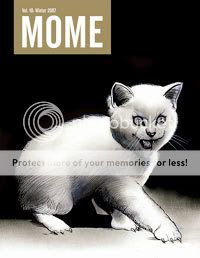
Over at Comic Book Resources I have a lengthy interview with Eric Reynolds, co-editor of Fantagraphics’ engrossing quarterly anthology series Mome. Check it out!
Hey
October 4, 2007Remember when Shakespeare in Love beat Saving Private Ryan for Best Picture at the Oscars? That was pretty fucking crazy, wasn’t it?
I bring this up because, inspired by the completion of Ken Burns’ The War, I just watched the Omaha Beach sequence of Saving Private Ryan and marveled once again at how frightening it is.
What other movies have intensely scary openings? The two that jump to mind are the Dawn of the Dead remake and 28 Weeks Later, but obviously there are others that I’m missing.
The Blogslinger: Blogging The Dark Tower, October 2007–Day Four
October 4, 2007Read: The Drawing of the Three–“Shuffle”; “The Lady of the Shadows”; “Re-Shuffle”
At this point what strikes me the most about Book Two in this series is how different it is and how different it feels from Book One. The Gunslinger was really no-frills, a collection of very austere short stories lashed together between two covers. Even if King’s comparative inexperience as a writer led him to the occasional, perhaps unintentional storytelling complexity–like the extended flashback within an extend flashback in the opening chapter–the book was a journey every bit as straightforward and austere as the gunslinger’s.
In The Drawing of the Three, however, you’ve got this comparatively elaborate structure involving a prologue, a section introducing a new main character, a sort of intermezzo section paced to mimic fading in and out of consciousness, a nother section introducing another new main character, another intermezzo, and so on. Meanwhile you’re dipped back into King’s reference-heavy idiom-heavy modern-day mode of storytelling after spending all of Book One in tersely worded depictions of a barren fantasy world. What’s more, the gunslinger is now sharing top billing with (so far) two characters who almost never shut up, and whose psychological conditions make them prone to sounding antsy at best and psychotic at worst. It’s all but cacophonous compared to the first installment.
But I’m impressed by the way the characters’ long, tedious journey up the unchanging beach maintained the feeling of austerity that I found so appealing in Book One. It really just goes on and on and on. Even the presence of the lobstrosities becomes more of a chore than a thrill due to the constancy of the threat they present, and their monotonous querulous yammering. Ditto Detta Walker, the nymphomaniacal kleptomanaiacl sociopathic stereotype split personality of Odetta Holmes, the rich, beautiful and intelligent civil rights activist whose “drawing” is the main event of this book’s second major section. King makes her taunting, shrieking banter with Roland and Eddie menacing to them through its annoyingness as much as through the knowledge that she’ll make good on her threats if she gets the chance.
As for Odetta/Detta herself, I’m a little bit unwilling to let myself invest in her as a character, because I was so thrown by King’s hamfisted mafia characters that I’ve now got my convinced he’s just as bad at capturing any other subculture. At least with Detta he’s given himself the out that this alternate personality (and by the way, schizophrenia isn’t the right word for this condition at all, though I dunno, I guess that’s what they called it back then or else Ian Hunter wouldn’t have named his solo album You’re Never Alone with a Schizophrenic) is deliberately a racist, misogynist cliché.
As a side note, I have a very clear picture of each of these characters in my head. Roland is Clint Eastwood, Eddie is the Larry Underwood from the TV version of The Stand, and Detta and Odetta are, interestingly enough to me, two different contestants from this season of America’s Next Top Model, the latest episode of which I watched just prior to reading this section. (FYI: Detta, Odetta.) I have no idea what that means.
PS: I forgot to say this yesterday, but if Roland is so amazed at the abundance of things like paper and sugar in our world, shouldn’t he be even more amazed at the presence of so many guns in the hands of so many losers? Isn’t that kind of the whole core of his upbringing?
PPS: It might be fun if Book Three is as structurally different from Book Two as Book Two is from Book One, and so on throughout the series. Like, maybe one of them is an epic poem in free verse, and one of them is a Finnegan’s Wake stream of consciousness.
You heard it here second
October 3, 2007According to Bloody Disgusting, the directing team of Alexandre Bustillo and Julien Maury are in negotiations to helm the Hellraiser remake. BD regards this as good news based on the duo’s film À L’Intérieur, which was recently acquired by the Weinstein Co. (Sorry, Jason.) We shall see.