
Author Archive
The Blogslinger: Blogging The Dark Tower, October 2007–Day 23
October 23, 2007Read: Wizard and Glass–the rest of “Come, Reap”; “All God’s Chillun Got Shoes”; Afterword
Raced through the rest of the book yesterday and already the details are fading into the recesses of memory. I sure did enjoy it, though. When it finally came, the gunslingers’ massacre of Jonas, Latigo, their men and the traitorous townies was every bit as bloody, relentless, shrewd, and cathartic as I’d hoped. The fun thing about Roland and his pals–and to his credit King only hits this on the nose very rarely, preferring to leave it to the reader to realize–is that they’re pretty fucking horrifying. Between the three of them they killed upwards of 200 people, right? And none of them are older than high-school sophomores, if that. In another world they could be Eric Harris and Dylan Klebold.
Well, that’s probably an exaggeration. With the exception of Roland, who’s repeatedly characterized as tinged with madness, there’s no evidence that these kids would have ever gone bad, or at least “gone bad on their own” if you’re not feeling charitable toward their gunslinger training. It was that training and the accumulated weight of “a hundred generations of gunslinger blood” that brought out the killers in them. It occurs to me that one of the under-reported themes in King’s work is the mettle of children–their ability to be pretty hardcore if called upon. In the Dark Tower alone you’ve seen this so far in Roland, Alain, Cuthbert, Susan, Sheemie, and Jake. Hand in hand with this is his belief that children can be cruel, a theme that echoes everywhere from the group of Little Coffin Hunters who kill and mutilate the stray dogs of Hambry to “The Children of the Corn” (a story referenced in Wizard and Glass–thematically in the blood-madness of the townsfolk on Reaping Day and explicitly in the afterword). I guess if you acknowledge the latter trait, which anyone who’s been a kid probably would, you have to give some credit to the former.
Post-flashback the book took some wild twists and turns. I’m surprised at how little I was jarred by the sudden reliance on The Wizard of Oz–it’s such a random direction to go in after hundreds of pages of a junior-varsity Fistful of Dollars on supernatural steroids, and yet it worked. Perhaps because it centered on Flagg, whose demented, pop-culture-riffing sense of humor would lend itself quite naturally to trying to scare his enemies with the Wicked Witch and the flying monkeys and the twister and the Great and Terrible Oz and all that. Or maybe it’s just that the series itself lurches so dramatically from one style to another between books, and sometimes within books, that one more crazy jump is barely noticeable. Start on an evil supercomputer monorail, wander through The Stand in an alternate universe, flash back to the Wild Wild West for three quarters of the book, return to the present in the Emerald City, then have one last flashback-slash-Hamlet-riff before calling it a day? Sure, why not?
The Flagg situation, of course, is now more confusing than ever. So he’s not just Walter–he’s also Marten? I guess he’s also a balls-out fantastic shapeshifter or master of disguise, because Roland had contact with all three incarnations of this character and never made the connection. Still hasn’t, in fact, at least as far as King lets us know–he never says “Flagg, Marten, Walter–they’re all one and the same” or anything like that. (I wouldn’t be surprised to be informed of this in the Argument for the next book, though.) All my questions about yesterday’s “Flagg = Walter” revelation go double for “Flagg = Marten.”
Finally, we’ve got another Afterword, and with it we get another batch of information yet to be revealed by the story itself. Father Callahan from ‘Salem’s Lot is apparently going to show up? Or did he already show up and I just didn’t recognize him? And the main character from Insomnia, which I haven’t read, is also going to put in an appearance? Or was King saying that Dark Tower elements showed up in Insomnia rather than the other way around?
Maybe I’ll get some answers to these meta-questions in the revised edition of The Gunslinger, which I’ll be tackling next. As best I can tell–and I’ve gotten conflicting information from literally everyone who’s coached me on this–Book One received its revisions (the only book of the series to get anything other than a new introduction) between the releases of Book Four and Book Five, in preparation for that final stretch. My guess is that it’ll be a lot more Flaggish, and have some more of the now-familiar details about the political situation in In-World and Mid-World thrown in. And there will probably be a bunch of groundwork laid for the final three novels in ways I won’t pick up on yet, other than by noticing that they’re different from the original version. At any rate I’m looking forward to returning to the purest articulation of the Gunslinger and his world and seeing if it feels any different knowing what I now know.
Quote of the day
October 22, 2007A final statement? It sounds grim. I donate my final statement to all the deaf and mute.
–Alexander Pichushkin on the end of his trial, as quoted in “Trial wraps up for chessboard serial killings; Russian confessed to murdering 63; said his goal was to mark all 64 squares,” AP, MSNBC.com
Since self-aggrandizement and casual disregard for the truth are characteristics boasted both by the killer and the Russian government and law enforcement agencies who captured him, there’s undoubtedly a tall-tale element to this case. But the macabre particulars of Pichushkin’s story–he lived with his mother; he kept track of his victims by numbering the squares on a chessboard; he may have been trying to out-kill Andrei Chikatilo; he used Russia’s national vice, vodka, as both bait and weapon–make it too good to fact-check.
The Blogslinger: Blogging The Dark Tower, October 2007–Day 22
October 22, 2007Read: Wizard and Glass–“Come, Reap” chapters 1-5
Jeez, this is one long-ass flashback, isn’t it? I dared a peak at the back-cover blurb (something I basically never do with a book I already know I want to read until after I finish it–who needs informed expectations?) and discovered that the book is essentially touted as being one giant “remember when” story. So again we have a pretty radical break with the format of the preceding volumes.
I’m still enthralled by this story, incidentally. It’s not just King’s “period” work in the series is superior to his standard modern-day mode, though it is. And it’s not just the mounting suspense leading toward the final confrontation, though that’s a hoot. It’s little details that don’t appear to have much payoff, thrown in there just because it makes things a bit richer–Eldred Jonas and Coral Thorin’s mutually fulfilling sex life, for example. I’m not sure why that’s in there, except to make the book’s heavy and one of its supporting characters more fun to read about.
But there were several momentous revelations in this section that probably trump all the fun little touches:
1) Roland, Cuthbert, and Alain all survive whatever battle is to come. We find this out in one of those throwaway glimpses at the future of which King (and Tolkien) is evidently fond:
By the time the following year’s Huntress [Moon] came around, all three of them would be confirmed smokers, tanned young men with most of the boyhood slapped out of their eyes.
So unless they spend another year in Hambry–which, judging by how many pages remain in this flashback section according to the table of contents, is a non-trivial possibility now that I think of it–they live to fight another day. I was actually pretty happy to read this because I enjoy knowing the good guys will win, though a similar throwaway bit about how the young gunslingers would rue Roland’s decision not to kill Rhea the witch and have done with it indicates that there’s some bad stuff heading their way even though they survive. There’s no guarantee Susan will, that’s for sure, and I’m guessing she doesn’t.
2) The Wizard’s Glass is an object of Ring of Power/Palantír-level magic and addictiveness. I enjoyed how this sort of slowly worked its way into the story–brief unexplained joking references made to the Wizard’s Rainbow by the boys–before we get the flashback-within-a-flashback where Roland’s dad explains to them what these 13 magic crystal balls are and advises them to be on the lookout for the pink-colored one because it’s believed John Farson has ahold of it. It’s a hell of a coincidence that they happen to stumble across this very object in their backwater hideaway, but I guess that’s ka. Ka, destiny, fate, and magic are wonderful cheats for writers, you know.
3) Um, Walter is Flagg? Walter is Flagg! Admission: I had this revelation, which would have had me totally flipping my shit and probably actually waking my sleeping wife up this time around, spoiled for me by the dopey Wikipedia entry for Eyes of the Dragon, goddammit. I tried to convince myself it was a mistake, but I wasn’t good enough at that to un-spoil myself. Oh well, it’s still pretty fucking rad. But it begs quite a few questions: Walter/Flagg gives everyone who meets him, including cold-blooded killers, a serious case of the heebie-jeebies–so how come he fit right in as a “loyal” member of Roland’s dad’s retinue? Why pick a name that doesn’t have the traditional “R.F.” initials–is it just because King thought of Walter before Flagg and was stuck with the moniker? Did Flagg also have a non-R.F. name at some point during his career in the world of The Eyes of the Dragon or am I misremembering? Why does Walter speak in modern-day Flaggisms to Jonas (and presumably everyone else he deals with on Farson’s behalf) yet in the more archaic mode of Mid-World and In-World when he and Roland meet in The Gunslinger? Is that the part of The Gunslinger that gets the most heavily revised, in order to make Walter mesh with Flagg as we know him? Earlier “Argument” sections have called Walter a servant to the “even more powerful sorcerer” Marten–is he really Marten’s servant, and is Marten really more powerful, or is that deliberate misinformation, or did King just not know where he was going with all this yet, or what? Roland once recalled seeing Flagg–as Flagg, not as Walter, presumably–turn some dude into a dog while being chased through Mid-World by Dennis and Thomas from The Eyes of the Dragon–how did he not put two and two together? Does this, and Flagg’s ability to dupe Roland and his dad, have to do with his previously undisclosed power to appear as completely different people depending on who’s looking at him? When Walter warned Roland about the Ageless Stranger, he was really warning Roland about himself? Whose bones were those on the ground after Roland woke up from his long vision if not Walter/Flagg’s? Yes, questions, questions, questions, flooding into the mind of the concerned young person today.
Anyways, it’s a crackling good yarn. One final observation: I’m keeping my eye on Olive Thorin.
The Blogslinger: Blogging The Dark Tower, October 2007–Day 21
October 21, 2007Read: Wizard and Glass–the rest of “Susan”
We’ve got ourselves quite the little page-turner here. The return to the fantasy language of Book One has made for the most assured and consistent section of the series since Roland’s journey through the desert and mountains. All the major beats seem to work here.
Roland and company’s three-on-three showdown with the Big Coffin Hunters unfolds at a tense yet almost leisurely pace, just the way you’d imagine these cowboy hardcases would start shit with each other. The time we spend alone with the BCH boys is time well spent, since like Gasher in Book Three they come across less like one-dimensional bad guys and more like people who’ve arrived at their current situation through a lifetime of conscious choices and reactions to circumstance. They’re bad guys you can understand.
Similarly, the mystery of what the heck’s going on in this backwater town–why they’re stockpiling horses and oxen, what they’re doing out at the oil patch, why all the town worthies are behaving so solicitously toward the Affiliation’s representatives–keeps you moving through the pages at a clip. Even when the mystery is “solved,” the secret presence of that magical glass ball at Rhea’s place indicates there’s still more to it.
I was sort of dreading the resolution of Susan’s post-deflowering bewitchment, since I find nothing pleasurable about the inevitable in fiction when that inevitable thing is the result of a ruse, but it wasn’t so bad. I’m sure her hypnotized hair-cutting will come back to haunt her in some terrible way–I’m sure things end badly for everyone involved in this tale but Roland, in fact–but at least she didn’t mutilate her face or genitals or something nasty like that. I’m glad it’s out of the way, too; I figured we’d be waiting to find out what was gonna happen until the end of this flashback.
Then again, I also figured the flashback would end with this section of the book, and now I see that it doesn’t. It looks like there’s significantly more flashback than present-day in this volume. I can live with that.
Oh God! Oh Jesus Christ!
October 21, 2007Megan Weireter’s review of The Wicker Man at Not Coming to a Theater Near You is easily the best piece of writing on this film that I’ve ever read. The way she elucidates how our sympathies for the two dueling religions slowly reverse, how both are portrayed sympathetically even as their adherents behave abominably, how fair a film it is–simply masterful. Please read it if you care about the movie at all.
The Blogslinger: Blogging The Dark Tower, October 2007–Day 20
October 20, 2007Read: Wizard and Glass–“Susan” chapters 4 & 5
I’m impressed with how well King’s handling the sudden mushrooming of his cast from a core of four people who are nothing alike, their pet, and the occasional sociopath they have to kill to an entire village-worth of Deadwood refugees speaking in faux-archaic patois. I kept a pretty good handle on who each person was, what they looked like, and what their motivation was in relation to the other characters. And any time it seemed this drama of Mid-World manners might get tedious, King throws in some world-building details about Farson’s forces or the gunslingers’ Arthurian roots, and bam, interesting again.
Still, it feels like we’re killing time before the obviously inevitable bloody showdown between Roland and his buddies and the Big Coffin Hunters, and before whatever nasty post-coital hypnotic suggestion planted in Susan’s head kicks in after she loses her virginity to Roland instead of Mayor Thorin. I mean, these things are clearly going to happen, right? Why dilly-dally?
Finally, King sure is flattering Roland by asserting that when he and the hotsy-totsy Susan meet, it’s she who feels compelled to rub one out while reminiscing about the meeting.
Worst Halloween Ever
October 20, 2007That’s the subject of this week’s Horror Roundtable. Mine will take you back to those heady mid-’90s.
Get the led out
October 19, 2007Short of Alyssa Milano’s Teen Steam, this may be the greatest videocassette of all time.
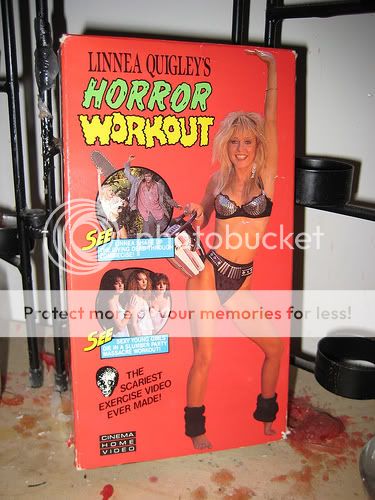
Eat your heart out, Fonda. Linnea Quigley will END you.
(Photo by Theremina. Hat tip: The Missus.)
This just occurred to me
October 19, 2007It’s well within Gary Groth’s power to solve his own problems with online critical discourse–that good criticism is hard and time-consuming to find, that it’s decentralized into different individual blogs, that it’s drowned out by millions of idiots, etc.–by rejiggering The Comics Journal‘s website into the kind of centralized, “destination” critical entity that would serve as the new-media analog to the print publications of yore that he lionizes. Or to The Comics Journal itself, for that matter. He’s certainly in a unique position to capitalize on TCJ’s brand recognition–as a name, if not always as an actual magazine, it remains revered among the kind of people who’d want to read the kind of criticism Gary supports, and hated among the kind of people Gary would want to be hated by. It’d certainly make it easier for him to find good criticism online if he published a lot of it on his own website. It doesn’t solve his problem with the Internet’s supposed inferiority to print generally, but there isn’t a print publication in the world that’s been able to thread that needle.
The Blogslinger: Blogging The Dark Tower, October 2007–Day 19
October 19, 2007Read: Wizard and Glass–“Susan” chapters 1-3
In which during an extended flashback, Roland’s first love Susan visits a witch…with sexy results! Yep, the second you saw your first reference to “a familiar heat in her belly” you knew you were in for some of King’s idiosyncratic, yet no less steamy for that, take on sex. That’s really the whole point of this section: how Susan ends up promised as some sort of sexual chattel/surrogate mother to the horndog mayor of her town, how Rhea the witch gets turned on by a magical glass (title character!) she’s been given as payment by the mayor’s goons and subsequently diddles poor Susan’s skittle during the course of examining her to ensure her virginity, how Susan and Mr. Underhill “Will Dearborn” meet and feel instant heat, mentally and physically. I found this last bit particularly convincing in its depiction of young love/lust, reminiscent of how I met my wife in fact, albeit with more horses.
In terms of the larger story, we discover that revolutionary warlord the Good Man, John Farson, is conducting his assault on the land of the gunslingers in the name of democracy and equality. Susan and “Will” treat this like lip service, and perhaps it is, but we’ve seen how deeply ingrained the aristocratic ways of this world are in its inhabitants. Maybe there’s more to the Good Man than his seeming status as another flunkie of the Beast that supposedly commands Marten, Walter, and Flagg. Or maybe democracy and equality as values have as little to do with The Dark Tower‘s conception of goodness as they do with The Lord of the Rings‘.
Quote of the day
October 19, 2007But here’s my argument: Jeremy Tinder should feel bad because he made a bad comic book.
He should feel good if he made a good comic, and bad if he made a bad one.
By this logic, should Abhay Khosla should feel bad because he wrote a bad review? Not “bad review” in the sense that it’s a review of a book he thinks is bad, but “bad review” in the sense that it starts with six paragraphs of self-congratulation for writing a bad review in that sense, then hides about two grafs’ worth of actual critique among hyperbolic invective, gibberish, more self-congratulation about daring to buck the critical consensus, and swipes at other critics?
Not for me to say. Just like Abhay, I don’t wanna be the bad guy here. And hey, those two grafs were pretty cogent…but what else was it that Abhay said?
If you have a pet dog, and the dog shits on your carpet, you don’t give it steak sandwich. Why? Because you don’t want dogshit all over your carpets. Ipso facto. Quo vadis.
Oh, right.
Echoes
October 18, 2007And as far as the comics themselves- one thing I really noticed this year was that most of the “new” comics were long on craft and short on narrative.
—Heidi MacDonald Frank “Cold Heat” Santoro
Click the link for Frank’s measured assessment of the pros and cons to this approach and its future prospects.
The Blogslinger: Blogging The Dark Tower, October 2007–Day 18
October 18, 2007Read: Wizard and Glass–the rest of “Riddles”
Time for another touchdown dance: We’re in Stand-world! Or at least I thought we were until the newspaper they found referred to President Reagan and Vice-President Bush. Weird, I thought. They crossed over into the world of the un-revised Stand? But I guess it’s not that either, not really–that version took place in 1980 and the revised one was 1990, but this is 1986. And we eventually discover slight but strange differences from the world we know: unknown fast food chains, car manufacturers, baseball teams and so on. The idea is that there are any number of different “levels” of reality, different worlds, all connected by the Dark Tower, and all breaking down. Things like The Stand‘s superflu can leak from one level to the next. It’s an amusingly diegetic way to explain the differences between the ultimate version, the original version, this version, and even “Night Surf,” the short story that contained the root of The Stand years ago.
It also strikes me as how King will justify the eventual revisions to The Gunslinger. Roland:
…in my world even the past is in motion, rearranging itself in many vital ways…
Okay. We’ll see.
Finally, it’s pretty rad that they’re (apparently) calling Flagg the Crimson King in this world.

The Blogslinger: Blogging The Dark Tower, October-November 2007–Index
October 17, 2007Here you shall find links to all of the posts in my blogathon reading of Stephen King’s Dark Tower series. This post will be updated with each new entry.
Day 3: The Drawing of the Three–Argument; “Prologue: The Sailor”; “The Prisoner”
Day 4: The Drawing of the Three–“Shuffle”; “The Lady of the Shadows”; “Re-Shuffle”
Day 5: The Drawing of the Three–“The Pusher”; “Final Shuffle”; Afterword
Day 6: Blogslinging clarification
Day 6: The Waste Lands–Argument; “Bear and Bone” parts 1-21
Day 7: The Waste Lands–the rest of “Bear and Bone”
Day 8: The Waste Lands–“Key and Rose” parts 1-16
Day 9: The Waste Lands–the rest of “Key and Rose”
Day 10: The Waste Lands–“Door and Demon”
Day 11: The Waste Lands–“Town and Ka-tet” parts 1-15
Day 12: The Waste Lands–the rest of “Town and Ka-tet“
Day 14: The Waste Lands–“Bridge and City” parts 1-15
Day 15: The Waste Lands–“Bridge and City” parts 16-22
Day 16: The Waste Lands–the rest of “Bridge and City”; “Riddle and Waste Lands”; Author’s Note
Day 17: Wizard and Glass–Arguement; “Prologue: Blaine”; “Riddles” chapters 1-3
Day 18: Wizard and Glass–the rest of “Riddles”
Day 19: Wizard and Glass–“Susan” chapters 1-3
Day 20: Wizard and Glass–“Susan” chapters 4 & 5
Day 21: Wizard and Glass–the rest of “Susan”
Day 22: Wizard and Glass–“Come, Reap” chapters 1-5
Day 23: Wizard and Glass–the rest of “Come, Reap”; “All God’s Chillun Got Shoes”; Afterword
Day 24: The Gunslinger (revised)–Introduction; Foreword
Day 25: The Gunslinger (revised)–“The Gunslinger”
Day 26: The Gunslinger (revised)–“The Way Station”
Day 27: Blogslinging bump in the road
Day 28: The Gunslinger (revised)–“The Oracle and the Mountains”
Day 29: The Gunslinger (revised)–“The Slow Mutants”; “The Gunslinger and the Man in Black”
Day 30: Wolves of the Calla–The Final Argument
Day 31: Wolves of the Calla–“Prologue: Roont”; “The Face on the Water”; “New York Groove”
Day 32: Wolves of the Calla–“Mia”; “Palaver”
Day 33: Wolves of the Calla–“Overholser”
Day 34: Wolves of the Calla–“The Way of the Eld”; “Todash”
Day 36: Wolves of the Calla–“Gran-Pere’s Tale”; “Nocturne, Hunger”
Day 38: Wolves of the Calla–“Secrets”; “The Dogan, Part 1”; “The Dogan, Part 2”; “The Pied Piper”
Day 40: Song of Susannah–“1st Stanza: Beamquake”
Day 42: Song of Susannah–“6th Stanza: The Castle Allure”; “7th Stanza: The Ambush”
Day 43: Song of Susannah–“8th Stanza: A Game of Toss”
Day 44: Song of Susannah–“9th Stanza: Eddie Bites His Tongue”
Day 47: The Dark Tower–“Callahan and the Vampires”; “Lifted on the Wave”; “Eddie Makes a Call”
Day 48: The Dark Tower–“Dan Tete”
Day 49: The Dark Tower–“In the Jungle, the Mighty Jungle”
Day 50: The Dark Tower–“On Turtleback Lane”; “Reunion”; “The Devar-Tete”; “The Watcher”
Day 52: The Dark Tower–“Tracks on the Path”
Thought of the day
October 17, 2007People, including world class cartoonists, waste hours and hours fretting over the “novel” half of the term “graphic novel” because what about non-fiction or short story collections or non-narrative work or autobio or whatever, but no one cares how big your “mini-comic” is.
18 Thoughts on the Small Press Expo 2007
October 17, 2007(This post originally appeared at The Comics Reporter. Thanks again, Tom.)
1. I’d been to SPX only once before, in 2003, back when it was at its old “indie comics sleepaway camp” location in the Holiday Inn in Bethesda proper. At the time I was not super-crazy about the experience. This, on the other hand, was one of the best cons I’ve ever been to.
There are many reasons for that (you may have already seen one of them) but I have to think that the venue change played a big part. Now every single table and booth is all in one giant high-ceilinged room, which makes the convention floor feel more like an energetic marketplace of art and ideas and less like an estate sale, as one SPX staffer described the vibe at the old venue. There was also convenient access to a patio on which to sit and chill and smoke and talk on your cell and read, and a pretty terrific bar/restaurant. And to the extent that anything is convenient via the Metro, with its insanely vertiginous escalators and absurdly arcane payment system that I’m pretty sure involves the use of an abacus, the old downtown Bethesda restaurant area is still within easy reach.
2. I see that one of my complaints about SPX 2003 was a lack of compelling debuts. Boy, was that ever not the case here. I feel that there have been years within even my comparatively brief comics-reading memory where we’d have been lucky to see as many world-class comics appear within 12 months as went on sale for the first time at this one show, even with The full list (scroll down to the nominees for Outstanding Debut) isn’t even a full list when you factor in mini-comics and the like.
3. And holy moley, the mini-comics! In terms of their craft as objects, Jeffrey Brown observed that the number of minis with color, silk-screened, die-cut, or hand-sewn covers actually appeared to be greater than the black-and-white jobs. There certainly were some gorgeous and compelling comics available; it would have been quite easy to wipe out your spending budget at Shawn Cheng, Sara Edward-Corbett and Matt Wiegle‘s Partyka and Eleanor Davis and Drew Weing’s Little House tables alone. Trust me on that one.
4. Related: Most times I’ve been to a small-press convention, I’ve been excited to pick up new work from familiar artists but wary of diving into uncharted waters, and rarely have I seen previously unknown work capable of beguiling me into doing so. But there was an embarrassment of riches at SPX from artists I’d never heard of–and I like to think I’m a pretty savvy guy when it comes to these things. My poison included Matt Furie’s hilarious Boy’s Club from Buenaventura Press; Andres Vera Martinez’s Tejano Ghost Stories, drawn and designed in beautiful black and white; and the minicomics anthologies of the Closed Caption Comics collective, a group clearly influenced by that notorious cultural dead end Fort Thunder that had nearly everyone I talked to saying “Whoa, did you see those kids next to the Bodega table?” There were at least that many over again on which I could gladly have splurged.
5. Speaking of Bodega and Buenaventura, along with PictureBox Inc. they formed a new trifecta of alternative comics publishing to sit alongside Fantagraphics, Drawn & Quarterly, and Top Shelf. Watching not one, not two, but three companies produce and sell high-quality avant garde work centered on alumni of the Fort Thunder, Paper Rodeo, and Highwater scenes is astonishing and invigorating.
6. Top Shelf has an exceptionally solid crop of new-ish releases and creators right now, with strong and interesting titles from Matt Kindt, Jeff Lemire, and Andy Hartzell, all of whom were on hand.
7. Oni was a visible and ebullient presence at the show as well, the most notable comparatively mainstream outlet there. They seem to have really internalized what made Scott Pilgrim connect and are continuing to deliver what may be the first organic wave of manga-influenced but not manga-derivative work we’ve seen, from their comfy digest formats on down: Wet Moon, Last Call, Black Metal and so on.
8. Where were NBM and SLG? I didn’t just miss them, did I?
9. AdHouse could have gotten away with charging $50 for their latest James Jean Process Recess art collection at this show, which you could also have said for PulpHope at MoCCA. They’re mightily impressive books. And if they subsidize Skyscrapers of the Midwest, even better.
10. Fantagraphics sold out of Paul Karasik’s I Shall Destroy All the Civilized Planets Fletcher Hanks book again. Everyone loves this thing, from Comics Comics editor Dan Nadel to former Wizard Editor in Chief Pat McCallum. (You see what I mean? Everyone!)
11. The roster of creators on hand was extremely impressive, even just within the official guests of honor and panelist slots. As Heidi MacDonald pointed out to me, the line-up ran the gamut from Jeff Smith and Matt Wagner to Kim Dietch and Bill Griffith to Gilbert Hernandez to Nicholas Gurewitch to C.F., an accomplishment in itself. Moreover, the people responsible for fully six of my top 10 releases of the year — Anders Nilsen, Kevin Huizenga, John Hankiewicz, Josh Cotter, Tom Neely, Gilbert Hernandez — were all present at the show. Had Nick Bertozzi made it (did he?), it would have been seven. Brian Ralph, Paul Karasik, Jeffrey Brown, and Nick Gurewitch would probably be in the top 15, too.
12. Speaking of Gurewitch, his tiny table could easily have been replaced by a giant throne made of candy and gold, such is his draw. I expect that whole webcomics corner of the floor to metastasize into a presence to rival any of the big altcomix publishers, and I’m a little surprised that hadn’t happened already.
13. In terms of the lines for their signings, Bone‘s Jeff Smith and Exit Wounds‘ Rutu Modan were the belles of the ball. This would seem to give lie to Heidi’s notion that storytelling isn’t valued by the snobs anymore.
14. The lines appeared to be shorter for the veterans like Beto and Deitch, but I’d guess that’s because they each signed for herculean stretches of time between the two days of the show. Please think about how awesome it is that you enjoy an art form where that happens. You can’t exactly count on having four hours to walk up and chat with, say, Bernard Sumner and Grace Slick at the same table in this world.
15. Speaking of the two days of the show, why are they Friday and Saturday? I asked around and found out that Sunday used to be a big hang-out day for the whole indie comics community (somewhere Gary Groth just spit on the floor and made the sign of the evil eye) involving a pig roast and a softball game against Diamond or something, but neither of these things happens anymore. Having 50% of your two-day show on a workday prevents people who would come from coming, period. This happened to my wife, and it cost all my former co-workers a day of show-going. I also heard complaints from creators that Friday’s late hours really screwed them up in terms of meals and sleep. Do a proper Saturday/Sunday show, for pete’s sake.
16. There was a panel on the State of Comics Criticism and I wrote about it here.
17. Much of crowd at this show was very attractive, a point that should be made often and loudly. This extends to many of the creators as well, both male and female, and not just in comparison to what most people in comics look like either. I don’t know how else to put this — whatever your preference, there was some grade-A tail on display, in extremely close proximity to social lubricants and hotel rooms, and you crazy kids should be out there ticklin’ and slappin’ and makin’ it happen.
18. I even enjoyed the five or so hours it took me to drive down from Long Island and back, despite the lack of vegetarian meal options at rest stops. I timed my departure and arrival to avoid the New York and Beltway rush hours and listened to a half dozen albums I haven’t had a chance to really dig into since I stopped commuting and lost my dedicated music-listening time. The new Radiohead‘s pretty good, huh? Best since Kid A. “All I Need” — holy moses.
The Blogslinger: Blogging The Dark Tower, October 2007–Day 17
October 17, 2007Read: Wizard and Glass–Arguement, “Prologue: Blaine,” “Riddles” chapters 1-3
Once again, a boatload of valuable information makes its debut not in the story, but in the “Arguement” (or “fancy-pants word for Introduction”) that precedes it. For example:
* The third person referred to by “the Drawing of the Three” is not one of Odetta’s alternate personalities, Susannah or Detta, as previously suggested, but Jake, who is only the third because Roland refused to draw Jack Mort.
* Walter, the man in black, possessed Jack Mort to make him kill Jake.
* Walter is only “half-human.”
That’s an awful lot of fudging of previously established facts for an intro. The fudging continues in the Prologue, “Blaine,” which is actually just the final chapter of The Waste Lands reprinted with slightly tweaked dialogue. I must admit I find this tendency to retcon previous books in the series on the fly worrying. Perhaps it’s meant to evoke the way reality itself is breaking down within Roland’s world, or maybe it’s just cheating.
Anyway, I enjoyed the resolution of Blaine’s riddle game. How could I not when riddles from The Hobbit actually showed up in a scene this heavily indebted to that one? Additional Tokienisms were invoked by the Falls of the Hounds, which read like a cross between the Argonath with a canine makeover and those sphinxes who guard the Southern Oracle in The Neverending Story.

One more thing: At least I don’t have to worry about the illustrations spoiling the book anymore, since it’s impossible to figure out what Dave McKean’s illos are supposed to represent anyway.
Quote of the day
October 17, 2007Jame Gumb is a mysogynist serial killer, fostering a brutal hatred of women. The character mocks both women and homosexuals, with his mockery of his captive Catherine (Brooke Smith) and his lisping whispers to his dog Precious; a film about homophobia doesn’t a homophobic film make.
—Stacie Ponder on The Silence of the Lambs
I agree completely.
Rimshot of the day
October 16, 2007It’s funny to have a movie “aimed squarely at [Americans] and our violence-saturated culture” by a German.
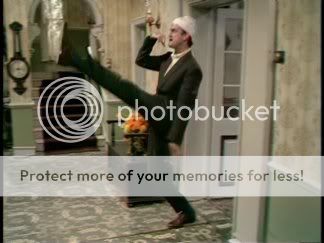
(Great movie, though! Question: Will the Funny Games remake get tagged as torture porn, or will it be okay because it was made by a European and can easily be read as an indictment of the kinds of things critics enjoy viewing indictments of?)
The Blogslinger: Blogging The Dark Tower, October 2007–Day 16
October 16, 2007Read: The Waste Lands–the rest of the book
Any reading experience that involves pumping your fists in the air and silently cheering (so as not to wake your wife, who went to sleep two hours ago) is probably a pretty good one. Such was my reaction to the return of your friend and his, Randall Flagg Richard Fannin, the highlight among highlights of the strongest section of this series yet.
You’ll recall that the whole reason I decided to read the Dark Tower series was for more Flagg, who I’d heard was the big bad. Obviously I was going to be pretty delighted by his big comeback no matter what. Plus, years of reading comics and consuming genre entertainment have me geared toward appreciating the frisson of continuity. (I think my favorite example of how much enjoyment you can get out of just a little reference to past adventures is from Indiana Jones and the Last Crusade: “What’s that?” “The Ark of the Covenant.” “Are you sure?” “Pretty sure.”)
But it wasn’t just the button-pushing that had me that excited, it was how that button was pushed. First, after a couple hundred pages of deft back-and-forth between the equally compelling perspectives of the four main characters, King suddenly cuts away from the climax itself for a chapter starring a character named Andrew. Huh? Oh, okay, that’s the real name of the Tick-Tock Man, the Thor-like warlord who ran the Grays. (Funny that his opposite number on Pubes was a dwarf; funny also that his flashback to better times in his city involved the presence of a guy whose job was to beat another guy into doing his jobs. Things have been pretty profoundly wrong around here for a while.) And then, just as out of the blue, Flagg himself arrives, sounding and even dressing much like he did back in post-plague Las Vegas. The thing that really thunderstruck me is that after all this build-up of the Tick-Tock Man–the way that his minion Gasher is made to seem horrible in such a way as to make Tick-Tock seem all the more horrible as Gasher’s boss, his Conan/Lord Humungous-like bearing (complete with a leg thrown over the side of his thrown), his ability to out-kill even Roland–he’s just the Dark Tower’s answer to Lloyd Henreid or even the Trashcan Man. (I might have known from that moniker!) It’s a startlingly effective bit of writing.
So what else happens? Blaine isn’t a demon after all, not really. He’s HAL, a computer gone bad, only instead of operating a spaceship he operates the entire city, though he appears to be most deeply personified in the pink monorail (paging Dr. Freud!). In a way his set-up is similar to that of It‘s titular entity: A central consciousness located elsewhere with a sort of pseudopod/embodiment sent out to do dirty work, but if you kill the latter you kill the former too.
The waste lands themselves feel familiar too. And not just in terms of Mordor, to which in true King fashion Susannah directly compares it. If a character or circumstance in a King novel is reminiscent of something else from pop culture or literature, you can bet a character will say or think so; in fact, during this very book, both halves of my high concept description of Roland as “Conan starring Clint Eastwood’s Man with No Name” are explicitly referenced as Eddie and Jake think about the gunslinger. But no, what the waste lands really reminded me of, with their misshapen bug- and bird-like beasts, is “The Mist.” I wonder if Project Arrowhead had anything to do with the technology that powers the Beam?
I can see why King’s fans wanted to pull a Misery on him upon reaching the end of this book, which doesn’t even bother pretending to offer a conclusion, even a “to be continued” conclusion like the previous two books. It basically just stops in the middle of a scene, like an even more cliffhangery Two Towers. I’m glad I don’t have to wait for Book 4, which I hope follows more in the mode of the second half of Book 3, “Lud,” than in that of the first half, “Jake.”
Mostly I wanna see the two hardcases throw down.